






First, marketing work is unusually language heavy. Virtually everything marketers produce—strategies, briefs, reports, recommendations, presentations—is text. LLMs eat text.
Second, marketing sits at a curious intersection of creativity and process. It has enough structure to be codifiable and enough ambiguity to reward the kind of probabilistic pattern-matching that AI does well.
Third, marketing functions have been chronically under-resourced for years, creating constant pressure to do more with fewer people. AI doesn’t just threaten marketing jobs, it offers a solution to a problem that CFOs have been circling for a decade: a legitimate way to phase out the marketing “cost” from their organizations.
And fourth, one can find oneself in the marketing profession with no formal training in it. These people produce sub-optimal outcomes and are easily superseded by newly minted, all knowing algorithms.
Indeed, the transition has already begun in a slow, structural constriction of marketing that will take a decade before its full revolution has been revealed. The story of AI adoption will play out in four sequential chapters within our industry.
It begins with hiring
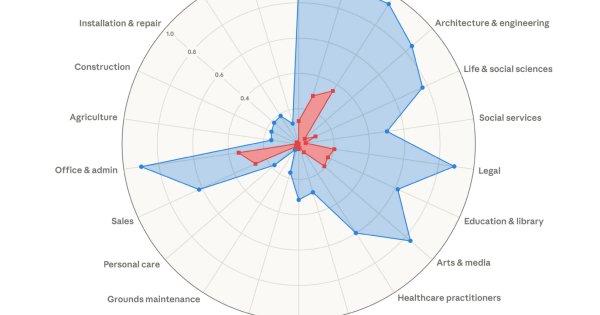
The Bureau of Labor Statistics projects that occupations with higher AI exposure will grow more slowly over the next decade. Marketing is near the top of that exposure ranking. According to Taligence’s analysis of active marketing job postings marketing jobs in the US fell by 7% year-on-year and 15% quarter-on-quarter in Q2 2025.
When the number of available roles drops, those currently employed stay put. Sure enough, the U.S. voluntary quit rate has fallen to 2%, the lowest in a decade, according to the BLS JOLTS data.

Less movement means the job market stagnates. When people stop leaving roles, roles stop being backfilled. And when roles aren’t backfilled, something insidious happens: the organization discovers it didn’t need those roles anyway.
Marketing Week found that almost a quarter of marketing businesses cut senior leaders last year and would not replace them.
With fewer marketing jobs existing and fewer people leaving the ones that do, salaries do not keep pace.
They don’t have to. It’s a buyer’s market. The 2025 CMO Survey—an independent U.S. study tracking 281 marketing leaders—found median marketing salaries stayed flat last year: a decline in real terms against inflation.
The distribution of this decay is not uniform, and that is perhaps the most disturbing detail in the Anthropic report.
Workers in the most AI-exposed occupations are disproportionately younger, more educated, and earlier in their careers. The data found hiring younger workers has specifically slowed in exposed occupations, roughly 14% less versus 2022.

