





Bad Bunny helped bring good ratings.
Despite a relatively uneventful game, where the Seattle Seahawks defeated the New England Patriots by a score of 29-13 at Levi’s Stadium in Santa Clara, California, Super Bowl 60 scored huge ratings for NBCUniversal.
According to broadcaster NBCU, the game averaged 124.9 million viewers on NBC, Peacock, Telemundo, NBC Sports Digital, and NFL+, based on official live + same-day Nielsen big data + panel. It was down around 2.8 million viewers from Super Bowl 59 on Fox, which drew 127.7 million viewers to become the most-watched Super Bowl.
Regardless, NBC’s game was the second-most-watched Super Bowl ever. It’s also the most-watched show in the history of NBCU, setting an all-time media record by peaking at 137.8 million viewers in the second quarter.
Telemundo averaged 3.3 million viewers, with the game becoming the most-watched Super Bowl in U.S. Spanish-language history, according to NBCU. Peacock also had its “best day ever” for reach and hours streamed, with the post-Super Bowl debut of The Burbs becoming the highest Day 1 Peacock original debut ever.
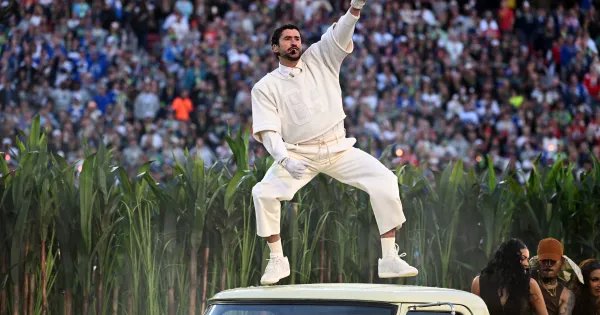
Meanwhile, the Apple Music Super Bowl LX Halftime Show featuring Bad Bunny averaged 128.2 million viewers from 8:15 p.m. to 8:30 p.m. ET. Though that’s down from Kendrick Lamar, who drew an average of 133.5 million viewers across television and digital platforms for Super Bowl 59, NBCU noted that total social consumption (inclusive of fans, owned platforms, broadcast partners, influencers, etc.) of the halftime show set a record of four billion views after the first 24 hours, up 137% year over year, according to Ripple Analytics.
Data and measurement company EDO recently told ADWEEK that Bad Bunny was “right up there” with the incremental engagement levels of performers from the past five Super Bowls, and it “wasn’t even close” when compared to TPUSA’s counterprogramming with Kid Rock, who had “a fraction of the incremental engagement that Bad Bunny generated.”
Additionally, Sunday’s Primetime in Milan and Milan Prime presentation averaged 42 million viewers, marking NBCUniversal’s largest Winter Games audience since Day 2 of the 2014 Sochi Olympics. This is an increase of 73% over the corresponding 2022 Beijing Olympics show (24.3 million), which followed NBC’s presentation of Super Bowl LVI.


