





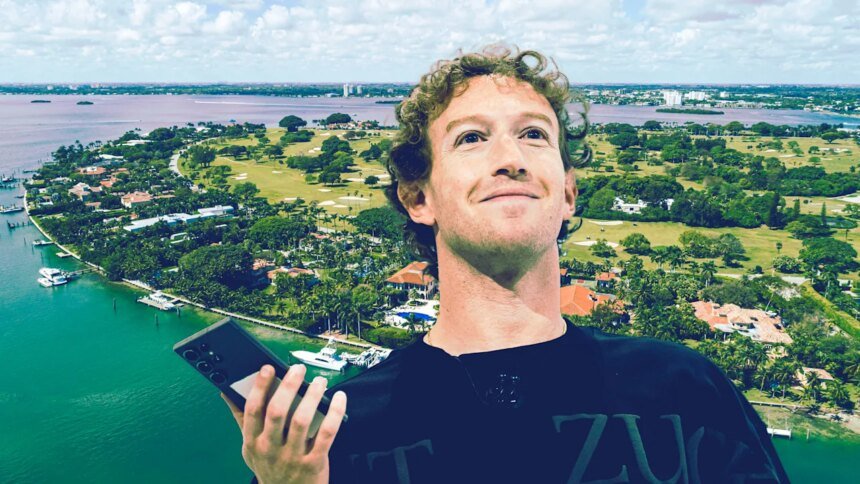


Mark Zuckerberg’s new house in Miami Beach has sweeping waterfront views. It also sits at ground zero for climate change.
Zuckerberg and his wife, Priscilla Chan, are the latest in a string of billionaires and celebrities to move to Indian Creek, a private island in Miami’s Biscayne Bay. Neighbors include Jeff Bezos, who owns three homes on the island, as well as investor Carl Icahn, Ivanka Trump, and Jared Kushner.
Like much of Miami, the area faces mounting climate risks. “It’s very subject to flooding and rising seas,” says Stephen Leatherman, an environmental professor at Florida International University who studies the state’s islands.
Miami’s sea levels have risen eight inches since 1950. By 2040, the water is projected to be 10 to 17 inches higher than it was in 2000. As the water rises, that’s making “sunny day” flooding from high tides more common—up 400% over the last 20 years in Miami Beach—and storm surges are increasingly dangerous.
First Street, an organization that analyzes climate risk for specific properties, doesn’t yet have data for Zuckerberg’s house, which was newly built. But it estimates that a home down the street faces “severe” flood risk, with the potential for 5.9 feet of flooding in an extreme event. That property also faces possible 184-mile-per-hour hurricane winds and more than three weeks per year of extreme heat.
Indian Creek is an artificial island, created in the early 1900s by dredging sediment from the bay. It was once a mangrove forest, dense with trees and shrubs that helped shield Miami from storms. Today, only about 2% of mangroves remain in the area. Ironically, wealthy homeowners have often cut down mangroves in front of their own homes to have better views, increasing their flood risk.
The island sits around seven feet above sea level, slightly higher than some other parts of Miami. But other parts of Miami are sinking, and it’s not clear if the island, built on soft sediment, may also be subsiding. And “if a hurricane comes, they’re going to get a big storm surge in there,” says Leatherman. In theory, the water could surge as high as 15 feet to 20 feet in parts of Miami in a worst-case hurricane.
Of course, Zuckerberg and his neighbors have money to throw at the problem. “If you’re willing to build to a higher standard to mitigate against wind by putting concrete gables on your house, and you basically build a bunker, you can do that,” says Ed Kearns, chief science officer at First Street. “And if you raise that bunker up 10 feet, then you’re above the storm surge.” He points to a house that survived Hurricane Michael when every nearby house was destroyed. (Zuckerberg and Chan did not immediately respond to Fast Company‘s request for comment.)
Climate change also poses other threats to infrastructure in the area—for example, saltwater is beginning to contaminate drinking water, and critical power stations are more exposed to flooding. Still, a billionaire has the option to easily leave in a disaster: Zuckerberg, for example, also owns other houses in California and Hawaii. The new house, worth perhaps $150 to $200 million, is only 0.087% of his net worth; if it was destroyed in a hurricane, he could handle the loss. (It’s worth noting that Zuckerberg may be changing his primary residence to avoid the possibility of a 5% wealth tax in California, which could put him on the hook for an $11 billion tax bill; so far, the proposed tax hasn’t yet been approved as a ballot measure for this fall’s election, but some wealthy residents are already moving.)
The same isn’t true for non-billionaires in the area. Floridians are already grappling with rising insurance premiums—or the challenge of getting insurance at all—as extreme storms keep hitting the state. As Miami’s population grows, housing costs are climbing, potentially pushing lower-income residents into more flood-prone neighborhoods. The city as a whole has far fewer resources to invest in resilience than the small, heavily fortified “Billionaire Bunker” island of Indian Creek.
The contrast is stark. Most Miami residents face increasing vulnerability to climate change. Billionaires like Zuckerberg can mitigate many of the risks, but doing so comes at a price and raises broader questions about whether $200 million might be better spent strengthening public resilience rather than building private fortifications.

