





Everyone who has tried to code with Anthropic’s Claude Code AI agents runs into the same usability problem: If you run two or three concurrent artificial intelligence sessions—say, one rewriting your server code, another generating tests, a third doing background research—you are forced to manually hunt through separate terminal tabs, each one generating a relentless stream of machine-readable log entries, just to figure out what each program is actually doing at any given moment.
Not only is it hard to follow what’s really going on, but not checking constantly can also lead to problems, as agents might stop to ask you something and you won’t notice it for minutes or hours. Developer Pablo De Lucca thought there had to be another way: What if you could create a control panel and alert system that bridges the AI coding agents with your brain in an intuitive way, allowing you to control at a glance what’s going on? That’s how Pixel Agents was born.
Pixel Agents is an extension that runs inside Visual Studio Code, the most popular code editor on the planet. If you have no idea what I’m talking about, that’s okay. The important thing to know here is that the UX of agentic coding could someday soon look a lot different.
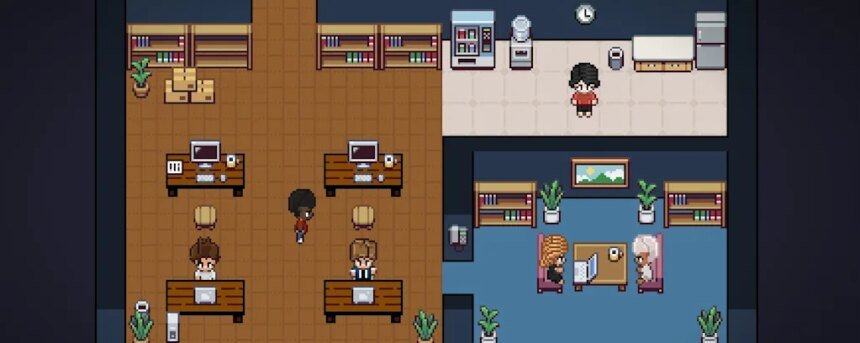
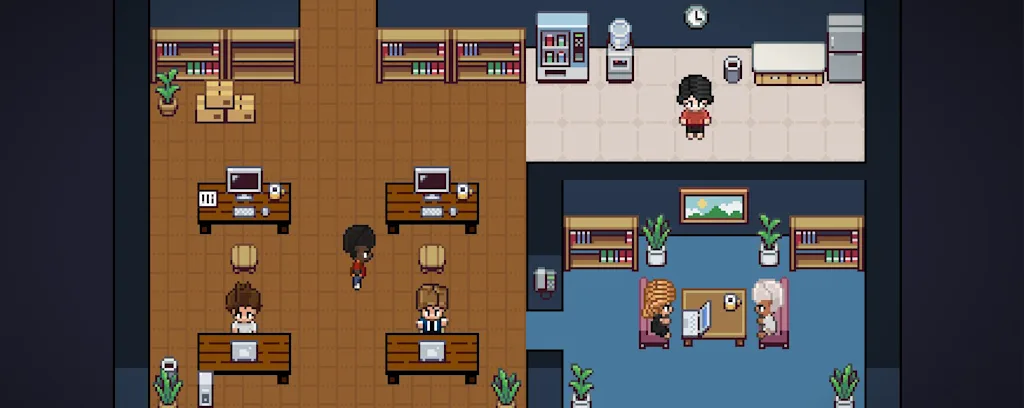
While it looks like an adorable 8-bit video game, Pixel Agents is not something you can play. Rather, it transforms the user experience of coding with Anthropic’s Claude Code agentic AIs by turning them into sprite characters who live, work, and interact in an office doing your bidding.
The extension draws directly from the language of video games because it’s something everyone understands. “I envision a future where agent-based user interfaces resemble a video game more than a traditional IDE,” he said in the Reddit thread introducing his tool. “Projects like AI Town have demonstrated the appeal of visualizing agents as characters within a tangible space, which I find much more engaging than just viewing endless lines of terminal text.”
How Pixel Agents works
The extension achieves this transformation by acting as a silent observer. Think of Anthropic’s Claude Code as a worker who keeps a detailed, timestamped diary of every action it takes: every file it opens, every command it runs, every moment it waits. These diaries are stored in a format called JSONL transcript files, essentially a structured log that records the machine’s activity in real time. Pixel Agents reads these logs continuously, without touching or modifying Claude Code itself, and uses the entries as triggers to update the state of the corresponding character, animating them on screen and making them “talk” using speech bubbles when needed.
Developers can customize the virtual office where these characters live to better suit their needs. A built-in layout editor lets them design their own workspace on a grid that can be expanded to up to 64 by 64 tiles, with furniture, walls, and floors arranged to taste. Then, each concurrent Claude Code session spawns one of six distinct animated pixel art character designs into that space. The layout persists across VS Code windows so the office retains its configuration between work sessions. The result is a spatial map of your entire active workload.
“Each character moves around, takes a seat at a desk, and visually represents the actions of the agent,” De Lucca describes on Reddit. “For instance, when coding, the character types; when searching for files, it appears to read; and if it’s waiting for input, a speech bubble appears.”
Love them bubbles
One of the most persistent frustrations in AI-assisted development is the blocked agent. That’s when a program that has paused its work to request human authorization (for example, permission to execute a potentially destructive system command) sits completely idle. It’s usually invisible inside a minimized terminal tab until the developer happens to notice it. Pixel Agents converts that invisible pause into a visual and audio event: an amber bubble over the character’s head, with an optional sound notification.
The extension also tackles a second, subtler problem: the spawning of sub-agents. Modern AI coding tools routinely break large tasks into smaller pieces, launching temporary child processes to handle discrete sub-problems before terminating.
In a text terminal, the birth and death of these ephemeral processes is nearly invisible and cognitively taxing to follow. Inside the Pixel Agents office, each sub-agent physically materializes as a separate character visually linked to its parent, then disappears with a dedicated exit animation the moment its job is complete. De Lucca says that the sub-agents “enter and exit with neat animations reminiscent of the Matrix.” That way, the workload hierarchy becomes something you can see rather than something you have to infer from logs.
The extension is free but the furniture and office tile graphics come from a commercial asset pack called ‘Office Interior Tileset (16×16)’ by an artist named Donarg, which is available on itch.io for $2. De Lucca has publicly called for community contributions of public domain art assets to fully open and extend the visual ecosystem.
Hopefully people will contribute. Pixel Agents is one of those happy ideas that solve a real problem in a fun way, making the invisible visible and turning the annoying into entertainment. Translating the abstract, parallel labor of multiple autonomous machines into a spatial, ambient picture that a human brain can monitor at a glance is definitely something to admire. Whether that constitutes the beginning of a broader shift in how we design interfaces for AI tools remains to be seen, but as a proof of concept, it is hard to argue with.

