






President Donald Trump’s latest branded foreign policy initiative takes its name quite literally.
When Trump announced on March 5 that he was firing Homeland Security Secretary Kristi Noem, he said she would be named special envoy for “the Shield of the Americas,” which sounds like it could be an eighty-sixed Marvel movie but is, in fact, the unofficial name of a new multilateral initiative targeting drug trafficking and cartels. On March 7, it was brought to life in the form of a summit held in Doral, Florida.
The summit included representatives from some Latin American and Caribbean countries, and was held at Trump’s golf resort just days after he ordered U.S. troops into Ecuador as part of a joint narco-terrorism operation. It was also held about two months after the capture of then-Venezuelan President Nicolás Maduro. At the summit, Trump called the group a “military coalition to eradicate the criminal cartels plaguing our region”; 17 nations signed on, paving the way for the U.S. to do elsewhere what it did in Ecuador.
In a presidential proclamation about the initiative, Trump said the U.S. will “train and mobilize partner nation militaries to achieve the most effective fighting force necessary to dismantle cartels and their ability to export violence and pursue influence through organized intimidation.”
It seems Trump felt this new war on drugs, which is expanding throughout the Western hemisphere, needed a brand to match.
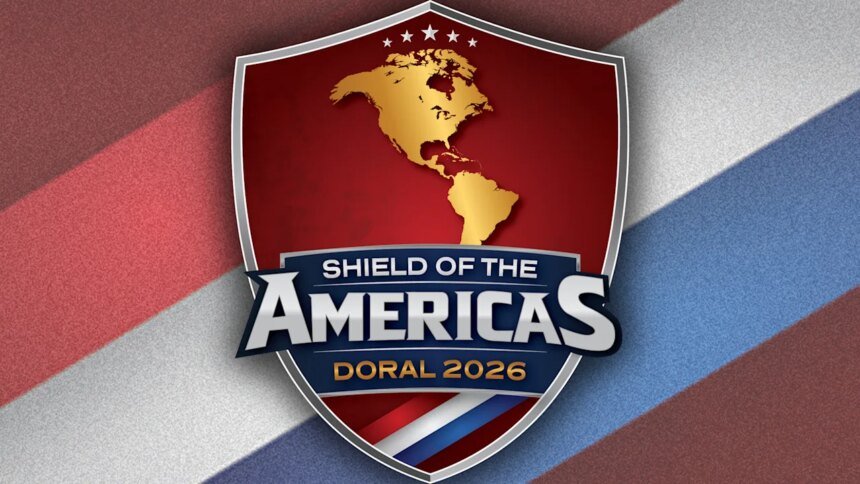
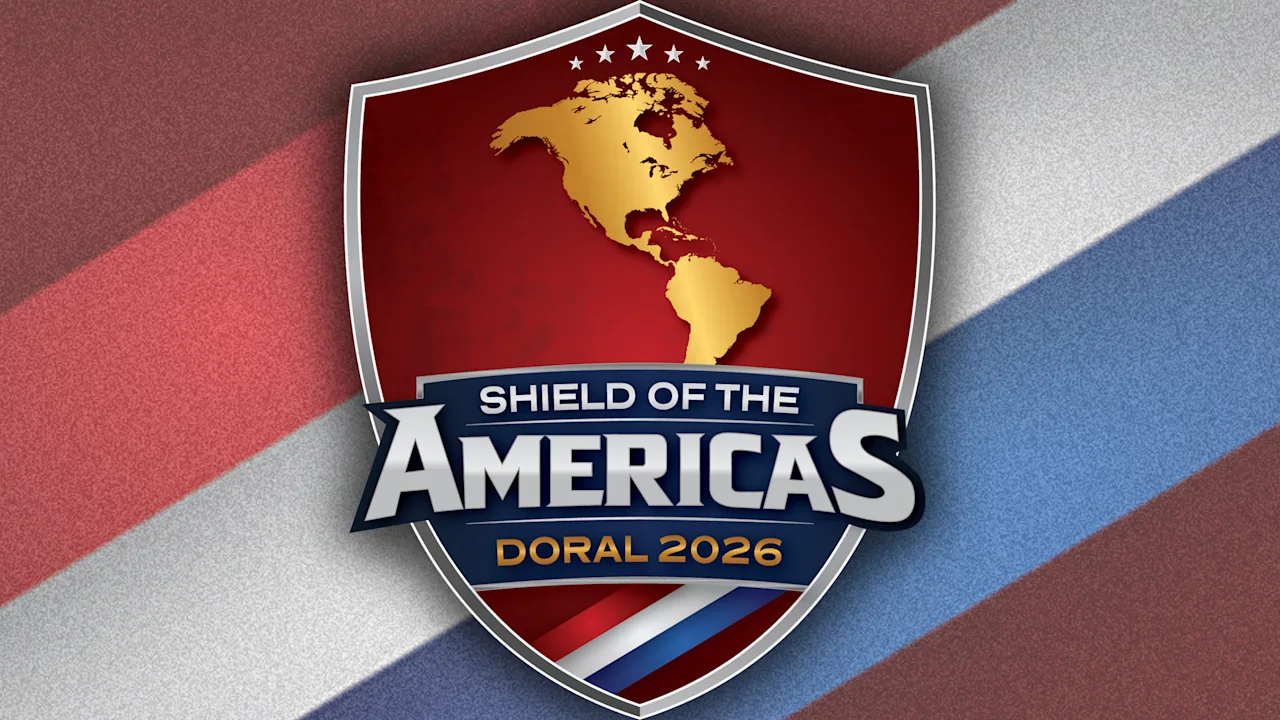
The logo is a red shield that frames a golden map of North and most of South America (its most Southern region is cut off by the initiative’s name, “Shield of the Americas,” in all caps). “Doral 2026” appears in metallic silver directly underneath the main wordmark, and angled red, white, and blue stripes sit directly below that. All the typography is set on a curved baseline, which is a common treatment for sports team logos. Gradients abound, although none share the same focal point.
While Trump’s domestic policy is getting a unified treatment under the National Design Studio, his foreign policy so far doesn’t have the same slick and standardized aesthetic. It does, however, follow a familiar theme of Trump’s personal brand: Make it gold.
A second example comes from Trump’s so-called Board of Peace, which he rolled out in January with a logo inspired by the United Nations emblem. Its visual identity borrows from the U.N. to give itself a look that aims to convey credibility, even though the group’s membership lacks longtime democratic allies and includes authoritarian regimes. But compared to the U.N.’s version, this map again has a gold, metallic wash that’s more visually indicative of Trumpian myopia than of long-standing democratic norms like governance through coalition.
The Shield of the Americas logo gives Trump’s hemispheric drug war its own visual brand, though the group’s name as it appears in the summit logo doesn’t actually show up anywhere in the president’s proclamation, which instead calls it “the Americas Counter Cartel Coalition.”
Technically, “Shield of the Americas” was the name of the summit, but helpfully for Trump, that name lends itself to more literal and evocative graphic design than the mouthful that is “Americas Counter Cartel Coalition.” While self-obvious, a graphic shield makes the idea of protection impossible to miss. All together, it’s exactly the sort of staging you’d expect from a reality-TV-producer-turned-president: flashy and direct.
With Shield of the Americas, Trump makes what’s actually an expansion of U.S. military force seem defensive—and gives his flagging foreign policy a newly gilded sheen.

