





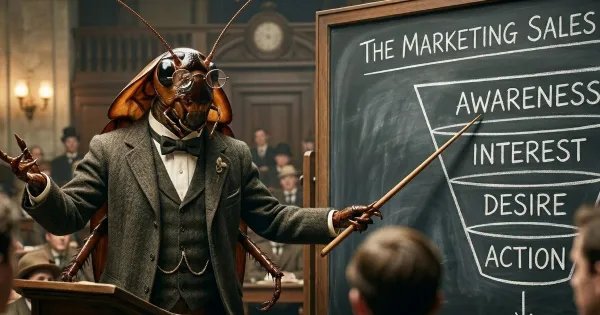

In 1898, a young Philadelphia ad man named Elias St. Elmo Lewis wrote something that would outlast almost everything else produced in the following marketing century. Working on life insurance campaigns, Lewis had noticed that the best salespeople followed a pattern. They grabbed attention, built interest, created desire, and then prompted action. He called it AIDA.
He didn’t call it a funnel—that visual wouldn’t come until 1924.
Fast-forward to last week at Amazon’s Immersion Day, where the centerpiece was a new AI-powered campaign type called Full-Funnel Campaigns. In Amazon’s own words, the goal is to “streamline the path from awareness to conversion.”
Amazon had organized its entire AI architecture around a concept Lewis sketched out with his pencil.
Tom Roach, the brand strategist and effectiveness expert at Jellyfish, captured the phenomenon well when he described the sales funnel as “the cockroach of marketing concepts.”
He meant it as a compliment.
The funnel survives everything thrown at it: academic critique, platform revolution, the endless march of Silicon Valley shamans declaring the next big thing.
Critique 1: The funnel is too generic
The first classic critique is that the funnel’s stages are too generic. Awareness, consideration, preference, purchase: what does that actually mean for a firm selling industrial lubricants to procurement managers in the Midwest?
If you’re running your marketing against a generic funnel pulled from a textbook, you’re doing it wrong. The solution is to build your own funnel.
In my consulting work and across the MiniMBA, I’ve always pushed clients and students to start with market research—talking to actual customers—and map a funnel that reflects how their specific market actually behaves.
A pharma company selling to oncologists runs a very different funnel from a mass-market beer brand. Custom funnels, built from real consumer insight, are one of the most powerful planning tools in the business.
Critique 2: The funnel is too linear
The second critique is that the funnel is too linear. Consumers don’t walk in an orderly line from unaware to loyal advocates. They jump around. They become aware of something, ignore it for two years, stumble on a Reddit thread, read three reviews, and buy on impulse while sitting on a train. Digital behavior makes this even messier.
But this argument fundamentally misunderstands what the funnel is. The funnel is not a description of the path any individual consumer took. It’s a snapshot of the entire market at any given moment, organized by proximity to purchase.
When I survey my market and find that 70% are aware of my brand, but only 20% have considered it recently, I don’t care how each of those people arrived at their position. I care about where they are right now, and what that gap tells me about where to invest. The consumer might have skipped consideration entirely to land at preference.

