



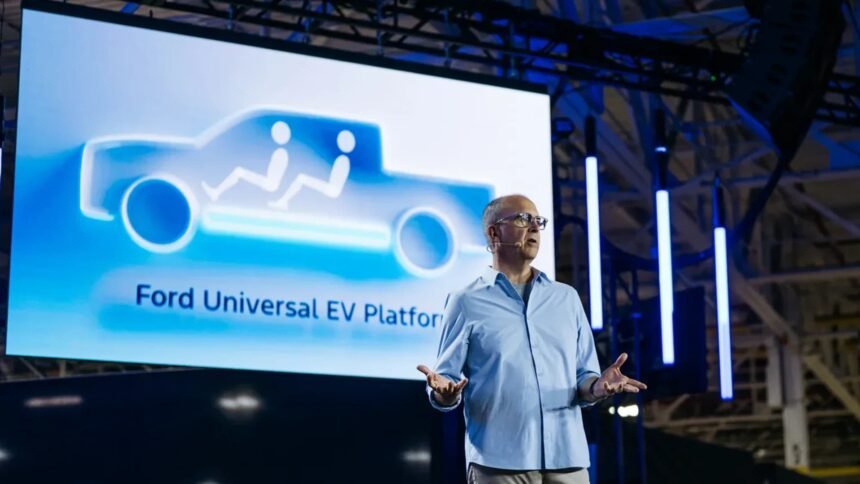

Doug Field, the chief EV, digital and design officer at Ford Motor, speaks at Louisville Assembly Plant as Ford shares its plans to design and assemble its “Universal Electric Vehicle” platform on August 11, 2025.
Courtesy Ford
DETROIT — Ford Motor‘s head of electric vehicles and software is leaving the automaker as it restructures its executives and operations.
Ford on Wednesday said Doug Field — chief EV, digital and design officer — has “elected to leave the company after a transition over the next month.” A release announcing the move mentioned a “next chapter” for Field, but the executive declined to disclose specific plans on a Wednesday call with media.
Field’s departure was announced in conjunction with Ford detailing a new executive structure that includes the establishment of a “Product Creation and Industrialization” organization at the company that will be led by Ford veteran and Chief Operating Officer Kumar Galhotra.
Ford said the new structure will integrate Field’s responsibilities with the company’s global Industrial System group to help the automaker hit certain goals, such as its target of an 8% adjusted EBIT margin by 2029.
There will not be a direct replacement for Field. Ford executives praised Field when the automaker brought him to the company in 2021 after previous leadership positions with U.S. EV leader Tesla and Apple. Ford CEO Jim Farley called his hiring a “watershed moment.”
His departure comes as Ford is preparing to launch a next generation of electric vehicles that Farley has said are as important as the company’s famed Model T.
Farley and Field on the call with media said the upcoming vehicle — a midsize pickup built on Ford’s “Universal Electric Vehicle,” or UEV, platform that’s due out next year — was in a solid position to continue in the new unit without Field.
Product Creation and Industrialization
Ford on Wednesday described the new Product Creation and Industrialization unit as an “end-to-end organization” that aims to “deliver one of the most intensive product, software, and services rollouts in Ford’s history.”
The automaker plans to refresh 80% of its North American portfolio by volume and 70% of its global portfolio by volume by 2029, the company said. That includes the UEV pickup truck, next-generation F-150 and larger F-Series Super Duty lineup.
That turnaround of products also will include new powertrain offerings and software, Ford said Wednesday.
By 2030, the company is planning for 90% of its global nameplates to offer electrified powertrains, including hybrids, extended-range electric vehicles and full EVs. It is also aiming to have 90% of its Ford’s vehicles by volume feature updated “electrical architectures, in-house developed user experiences and hardware, and next-generation over-the-air capabilities for continuous improvement in experiences and services.”
Ford said the new technologies will enable “the rapid rollout” of advancements to its digital experience for customers and BlueCruise advanced driver assistance system, with a “scalable path” toward a 2028 Ford goal to achieve eyes-off “Level 3 autonomous driving.”
SAE International, formerly known as the Society of Automotive Engineers, has characterized automated driving for vehicles from Level 0 to Level 5. The highest, Level 5, is a fully autonomous vehicle, with each stage from Level 0 adding more technologies and enabling human drivers to be more “out of the loop.”
Ford currently offers a Level 2 advanced driver assistance system, or ADAS, known as BlueCruise.
Leadership shakeup
Farley on the media call Wednesday with Field and Galhotra spoke fondly of Field’s work, calling him an “invaluable partner” who “has built a world-class team at Ford.”
However, many of Ford’s initiatives involving software and EVs did not perform as expected. Most notably, the automakers reported significant shortfalls in generation of software revenue and in December announced it would write down $19.5 billion related to a pullback in EVs and realignment of business priorities.
While several automakers have announced such impacts due to EVs, Ford’s write-down was much larger than its closest rival General Motors, which has announced roughly $7.6 billion in such charges.
In addition to Field leaving the company, Ford announced a series of other changes to its advanced vehicle development products and European manufacturing plans.

