





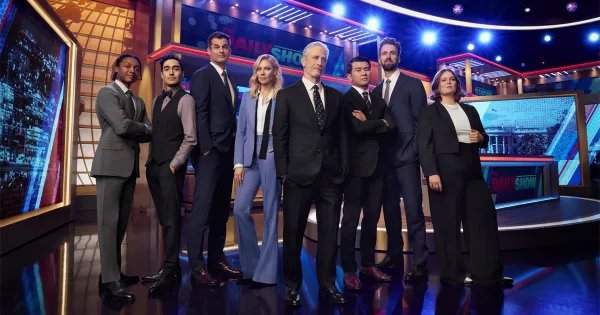

For younger audiences, The Daily Show is delivering much more than just one Moment of Zen.
Recently, the Comedy Central show achieved its best ratings among Adults 18-49 in more than eight years. The show is also increasingly connecting with those audiences on social, with Comedy Central noting that The Daily Show is the most-viewed cable program in 2026 so far, with 2.5 billion views, up 56% from 2025.
At ADWEEK’s Social Media Week on Wednesday, The Daily Show cast and producers talked about their social strategy and how the show was finding new audiences in today’s digital-first world.
First and foremost, The Daily Show has a dedicated digital team that produces content alongside the main show. According to Jocelyn Conn, a producer at The Daily Show, there isn’t a hierarchy, and viewership is a two-way street, whether it’s social funneling audiences to the main show or vice versa.
“Sometimes something we create will end up on the show that night, or something the show is creating or created will now end up on social,” Conn said, adding, “It’s all being seen by people in different areas of the internet, or on linear, on streaming. As long as there are eyes on it, I think we see it as the same.”
Josh Johnson, a host and contributor to The Daily Show, said that, in terms of creating successful content, playing to platform “hacks” such as creating content that only works in short clips could be detrimental to the show overall.
“If you are making a full-length show, but you’re only thinking about it in 90-second bites, you’ll probably not make a very good show,” Johnson said.
For Johnson, the best content doesn’t come from playing to algorithms or certain platforms.
“If you’re sitting down to talk about something that you really care about that’s happening in the world, I think that people will find that and, most importantly, share it,” Johnson said. “To me, the shares are more important than any sort of algorithmic tool or hack because the shares are your actual organic connection.”
Host and contributor Jordan Klepper also noted that some things “shouldn’t live in 20-second clips.”
“I got to do a special on Hungarian politics, which is a deep cut for a comedy network to do a special on, but that lived as a 30-minute special, which allowed us to make longer arguments to that,” Klepper said.
The comedian added that the show can lend itself to different conversations through its various segments. For instance, the host can make an eight-minute argument about the news of the day. Meanwhile, field pieces can provide a space to make a four-minute argument about issues happening in the country.

