




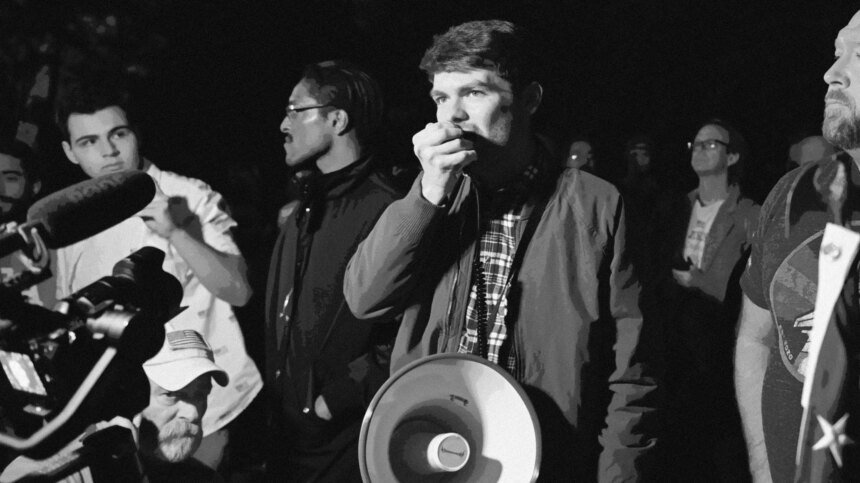

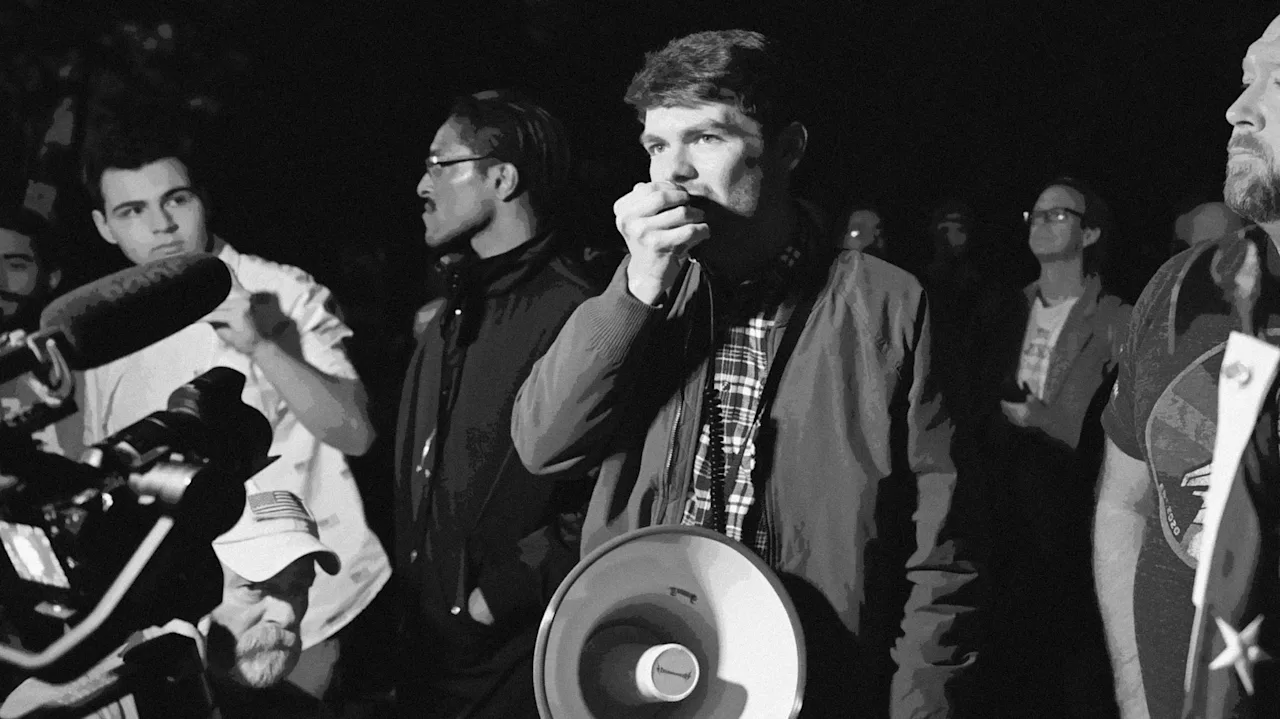
In late October, Tucker Carlson invited Nick Fuentes, a 27-year-old white-nationalist streamer, onto his popular podcast and Youtube show for a friendly interview. Fuentes has amassed a loyal following with hundreds of thousands of viewers who tune into the racist, misogynist, and antisemitic sentiments he voices in lucid monologues on his nightly show, America First. A talented broadcaster with a biting sense of humor and a combative persona, he’s tailor-made for the no-holds-barred environment of big-tech platforms—so long as he manages to stay on them. In 2021, he was booted from essentially every tech platform for hate speech, forcing him to start his own streaming service to host his show.
Where did Fuentes come from? Why are old-guard conservative institutions and media stalwarts alike catering to him—or even cowering before him?
The answer lies in how Fuentes has mastered the right-wing online swamps of the Trump era, and the increasingly porous boundaries between the extremely online right and the Republican establishment, explains Ben Lorber, an analyst at Political Research Associates, a group that monitors and studies the far right. “You can’t tell the story of Fuentes’s rise without telling the story of alternative tech platforms and transformations of large tech platforms,” Lorber says.
As the Fuentes interview rippled across social media, conservative sites and prominent figures on the right including Senator Ted Cruz and Jewish commentator Ben Shapiro, asked: What, exactly, had Carlson been thinking by platforming a figure like Fuentes?
Three days after the Carlson appearance, Kevin Roberts, the president of the Heritage Foundation, the storied conservative think tank that produced the Project 2025 roadmap for the Trump administration, weighed in. “I disagree with, and even abhor, things Nick Fuentes says. But cancelling him is not the answer, either,” Roberts said in a video on X, in which he also defended the right of conservatives to criticize Israel as well as Carlson’s decision to host Fuentes. Carlson’s critics, Roberts added, were “globalists” and part of a “venomous coalition,” language that many decried as trafficking in antisemitic tropes.
Within the halls of Heritage, Roberts’s video provoked an insurrection, forcing him to issue a lengthy apology condemning Fuentes. In a speech, Roberts explained that he’d wanted only to reach the disaffected young men that comprise Fuentes’s audience, many of whom identify as “Groypers.”
But the damage has been done. Heritage staff lambasted him at a town hall-style discussion. Numerous employees and a member of the board of trustees have resigned. The cochairs of their antisemitism task force, the creator of Project Esther, a campaign targeting pro-Palestine protestors, also announced they would be severing ties with Heritage. Last Thursday, Democratic Senate Minority leader Chuck Schumer announced he would introduce a resolution condemning Fuentes, and he called on his Republican colleagues to join him.
‘They have to engage’
Once, figures like Fuentes were relegated to the far-right fringes of the internet. Cassie Miller, an analyst with the Southern Poverty Law Center, explains that an older generation of conservative activists “learned to speak in dog whistles” to code racist appeals to voters. This model was pioneered by people like Lee Atwater, an advisor to Ronald Reagan and George H.W Bush, whose “southern strategy” infamously deployed euphemisms like “states rights” in place of explicit appeals to racism.
But acolytes of Fuentes grew up in an entirely different media and technology environment, one where the far right saw the rise of Donald Trump and his MAGA movement as a vehicle to seed their ideas into mainstream politics. “There are a lot of younger people, even within the institutionalized right, who are far more comfortable with the kind of overtly racist, transgressive language of someone like Fuentes,” Miller says.
Fuentes has built his profile through a command of the incentive structures of large tech platforms. “He forces people to contend with his views and feel like they have to respond to him. They have to engage in some sort of discourse with him, and it ends up platforming him and legitimizing what he’s saying,” says Miller. “That’s what he did here with Tucker Carlson.”
Short-form video has also proven to be a powerful weapon for Fuentes. His followers take bite-sized clips from his broadcasts and pump them out on X and other platforms. “You might not have context when you come into contact with it, and you might think that, well, he has some legitimate points,” Miller adds.
There’s also Fuentes’s ugly blend of fair critiques of Israel’s wanton slaughter of Palestinians with outright antisemitism, a rhetorical strategy since adopted by figures like Candace Owens and Carlson. “Carlson, Owens, and Fuentes, and others are all competing for the same kind of market on the anti-Zionist right,” Lorber says. “They’ve identified that almost as a growth market.”
Staying power
Fuentes’s proficiency across online platforms, and the way those platforms have changed in recent years, have allowed him to stage his comeback.
After Elon Musk purchased Twitter and renamed it X, he reinstated Fuentes’s account, where he now has over 1 million followers. His show went on to find a home on Rumble—a conservative competitor to Youtube with financial backing from Silicon Valley billionaire and Republican donor Peter Thiel, among others—where it is broadcast to thousands nightly.
All this has coincided with the slow death of once good faith efforts at hate-speech moderation by large tech platforms, Miller says. “A lot of his career, he’s been pushed to the margins of online spaces. But what we’ve seen is that he’s had really incredible staying power,” she adds.
That staying power in the online world may have already spilled over into the real world. Fuentes and others on the far-right like the pseudonymous author Bronze Age Pervert have advised their followers to “hide their power level” and infiltrate so-called “normie” conservative institutions.
Recently, right-wing writer Rod Dreher wrote of the remarkable prevalence of Groypers among the Republican party’s professional ranks in Washington, including, he alleged, in the Trump administration. Reports from Politico have revealed text threads of young Republicans and one Trump appointee sympathizing with Nazism, showing the embrace of Groyper-like ideology.
But trying to pinpoint the exact percentage of closeted Groypers might be missing the point. “There’s very little difference between whether someone is a dedicated Groyper, or whether they just agree with Fuentes’s politics independently of being one of his followers,” Lorber says. It might be better, Lorber says, to think of Fuentes “as a stand in for a worldview and a brand of politics—like an ambassador of the Gen Z radical right.”
On the rise
There is no reason to think that the recent controversy will slow Fuentes’s ascendancy within the GOP. Trump has long since made common cause with the extreme right. Trump infamously claimed there were “very fine people, on both sides” of the 2017 United the Right rally in Charlottesville, where men marched with tiki torches chanting “Jews will not replace us.” (An 18-year-old Fuentes was in attendance). In 2022, Fuentes himself attended a dinner at Mar-a-Lago with Trump and the artist formerly known as Kanye West.
Examples, in other words, are not hard to find. “Great Replacement ideology is now mainstream. Christian Nationalism is now mainstream, and antisemitism is rapidly becoming mainstream too,” Lorber says. “So for people like Nick Fuentes, the movement has caught up with him.”
As for Heritage, the fine print of Project 2025 reveals an extremist vision in its own right, one that seeks to transform the country into a Christian Nationalist autocracy. A softening stance towards Fuentes, in other words, doesn’t seem so odd. Drawing the line at outright Nazism is certainly preferable to welcoming it. But the time for condemnation may be long since past.
Fuentes, meanwhile, will keep posting and streaming, and likely continuing to bend the party to his will in the process. “He has a really clear understanding of the way the media environment works,” Miller says. “For Fuentes, it’s a huge victory just to have people say his name.”
The final deadline for Fast Company’s World Changing Ideas Awards is Friday, December 12, at 11:59 p.m. PT. Apply today.

