





Growing up in the small Ontario town of Port Elgin, Grant Cleland said playing hockey was simply “part of the culture.”
The “naturally competitive” Cleland took to the ice starting around age 5 and was even coached by former professional players along the way, continuing to play competitively through high school.
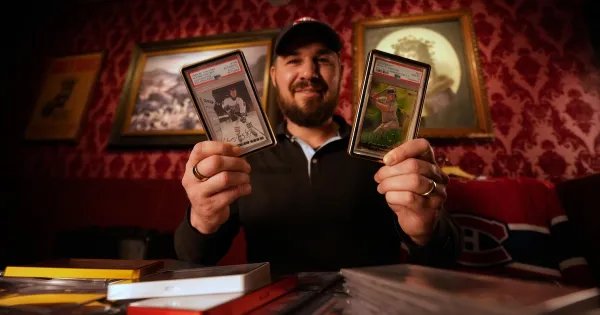
Even once he realized that playing hockey wasn’t going to be his professional destiny, Cleland kept one tradition from his years on the ice: collecting trading cards.
Now a creative director at Toronto-based full-service agency Fuse Create, Cleland described collecting cards as being as much a part of playing hockey as actually being on the ice. “As a kid, you grow up idolizing the players that you hopefully would one day want to be like,” he said. “And so part of that whole culture is trading, collecting, watching your idols.”
Cleland wasn’t given any pocket money growing up, so he would do extra chores around his family’s beef farm to earn money, then got a full-time summer job at age 14 working on the grounds crew at Saugeen Golf Club. He traded cards with his teammates, as well as at school, and even branching out into baseball cards.
His collection once reached over 2,000 cards, but he recently narrowed it down to about 800, including 389 graded cards (higher-value cards that have been professionally evaluated).
Besides getting packs at hobby shops, Cleland also attends about 20 events a year to buy, sell, and trade cards, from major ones such as the Sport Card & Memorabilia Expos held across Canada to player signings at local businesses.
These events have grown in number and scale in recent years after the field of card collecting exploded during the pandemic and further popularized by media like Netflix’s King of Collectibles series.
The influx has brought new energy to the hobby, and overall Cleland feels it’s made things more interesting.
“At the heart, collecting hasn’t changed for the core audience: finding cards that connect you to the game and its history,” he said. “What has changed is the economics around it. Parts of the hobby now resemble a casino, where booms, busts, and resale value can matter more than the cards themselves. But understanding when to buy, grade, hold, and sell adds another interesting dimension.”


