




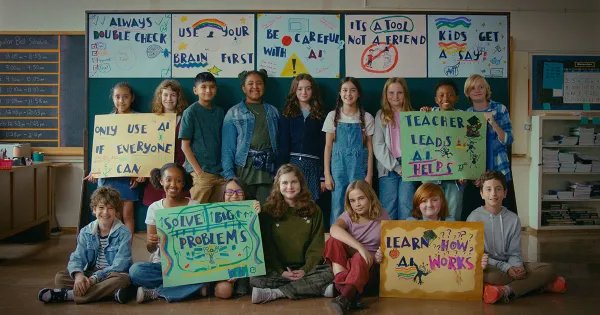

AI anxiety has already become cultural currency in 2026, with brands like Equinox portraying humanity as a luxury. But while the adults fret among themselves, one of the world’s most trusted brands, Lego, is making space for kids’ voices.
Lego Education, the arm of the Danish toy maker that develops classroom tools to teach science, technology, engineering, and math (STEM) skills using its iconic bricks, has unveiled “We Trust in Kids.”
The campaign highlights how most U.S. schools lack an AI policy, while promoting Lego’s new computer science and AI teaching kits for kids from kindergarten to eighth grade.
It’s underpinned by research from Lego Education and Edelman, which enlisted the help of 12 American children to write a survey about AI, which was sent to 800 kids across the U.S., Germany, South Korea, and Australia.
The study found that 65% of kids feel excluded from AI conversations, and 83% say adults control how it’s taught.
“Children all over the world had the same feeling of lack of agency,” Sean Tindale, head of brand at Lego Education, told ADWEEK. “With this campaign, we wanted to make sure kids weren’t leading the discussion, but still had a voice in the debate around how AI should be brought into the classroom.”
A further report garnered responses from 1,800 teachers. While 69% said AI literacy was critical for students’ futures, 40% said their schools weren’t equipped to teach AI responsibly.
Putting trust in kids
To bridge this gap, Lego Education has developed a poignant film directed by documentarian Lauren Greenfield (The Queen of Versailles, Always’ “Like a Girl”).
The four-minute short highlights how self-informed and socially aware children are about the tech shaping their future. It shows 15 real kids in a classroom discussing AI with a teacher and collaborating on a classroom-safe AI policy.
The video will run across Lego’s website, paid social, and influencer promotions. It will also be shared at global education conferences throughout 2026.
“Success for us would look like teachers, ministers of education, or superintendents changing their perception of AI as a scary tool that’s used to chat in class, or making people dumb to something that – given the right tools – can actually become a tool that computer science or teachers at schools can bring into the classroom and educate children about so that we can ready them for the future,” said Tindale.

