





Andy Sauer is no stranger to making waves in the beverage business. As the CEO of Garage Beer, he defied the odds by turning a small craft brewery into a national name, despite competing in an industry dominated by legacy players. Now he’s looking to shake things up in another popular beverage category: the soda aisle.
Sauer’s latest venture is a product called Roxberry, which he’s dubbing the “first modern kids’ soda.” The brand launched earlier this month at more than 2,200 Walmart stores, 450 Krogers, Meijer and Harris Teeter locations nationwide, and a handful of independent grocers. This “soda” is unlike the sugary drinks most consumers remember from childhood: It’s made primarily of carbonated water and fruit and veggie juice, contains just 5 grams of sugar from natural sweeteners, and has no artificial colors, flavors, or sweeteners. A four-pack costs $5.99.
In an era when a new category of better-for-you (BFY) soda brands for adults, like Poppi and Olipop, has exploded in popularity, Sauer says the options for kids have largely remained siloed in two main categories: Either they can drink “the same brands we grew up with,” like Capri Sun or Kool-Aid, which are packed with ingredients many parents would rather skip; or they’re stuck with healthier, less visually exciting options, like seltzer water. Roxberry aims to be a third option that’s a win-win for kids and parents.
Two-hit wonder
Sauer has experience turning a nascent RTD brand into a household name. Garage Beer, which he acquired in 2021 and relaunched in 2023, has shown triple-digit year-over-year growth, with sales increasing more than 500% in the 12 months ended in early April 2025, he says. It’s now valued at around $200 million and is continuing to grow, despite an overall slump in the beer industry, according to a September report from The Wall Street Journal.
In large part, Garage owes its success to a savvy marketing strategy: Its sleek branding, consistent dialogue with its target audience, and catchy slogan (“beer-flavored beer”) make it feel like an approachable craft beer for the everyman. Sauer is taking those lessons to Roxberry, which is prioritizing an in-depth brand story and centering everything on the phrase “Fizz for kids.”
“That old phrase, ‘Marketing is saying one thing a hundred times rather than a hundred things one time’ is very true for this brand as well,” Sauer says.
The idea for Roxberry struck back in 2022. With four kids of his own at home, Sauer noticed that his family frequently butted heads in the beverage aisle. His kids were interested in classic sweetened fruit drink brands like Kool-Aid, but he was hesitant to buy them due to their high quantities of sugar.
And so Roxberry came to life—first as a powdered mix-in before pivoting to a canned ready-to-drink format that mimics the soda brands kids already covet the most. The soda’s initial launch comes in the three most popular flavors in kids’ beverages overall: strawberry lemonade, citrus, and fruit punch.
“We did a lot of work to find out which fruits and veggies come naturally with a better mouthfeel, better sweetness,” Sauer says. “Working with raw strawberries, raw lemon, raw carrot—those things are going to give you more of a sweet flavor naturally so that you don’t have to add a lot to it.”
“Kool-Aid Man energy”
The first thing parents might notice when they see Roxberry on store shelves is that it looks nothing like the modern BFY brands they’re used to. According to Emily Heyward, chief brand officer at the agency Red Antler that led Roxberry’s design, that’s the point.
“When we built the brand for Roxberry, it was before the explosion of the Poppis and the Olipops, but I think they’ve tapped on something similar, which is that a lot of better-for-you brands—especially in the kids’ space—signal that they’re healthier just by being more boring,” Heyward says. “They strip out color, they’re matte instead of glossy, they’re very plain, to show that they’re different from the old-school brands that we grew up with.”
The result, Heyward says, is that most of the “healthy” options for kids on grocery store shelves just don’t look very exciting. To combat this trend, Sauer’s brief was to “bring back that Kool-Aid Man energy to the space.” Red Antler’s answer to that prompt is a brand that looks like it came straight from a sci-fi kids’ cartoon.
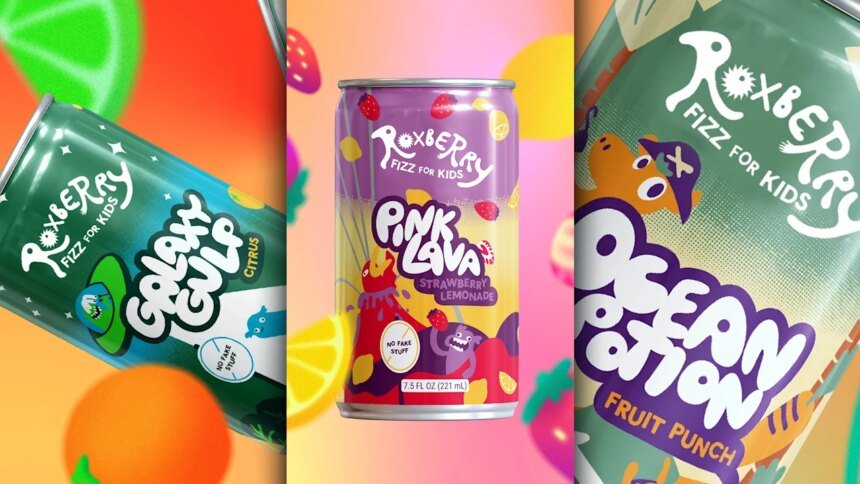
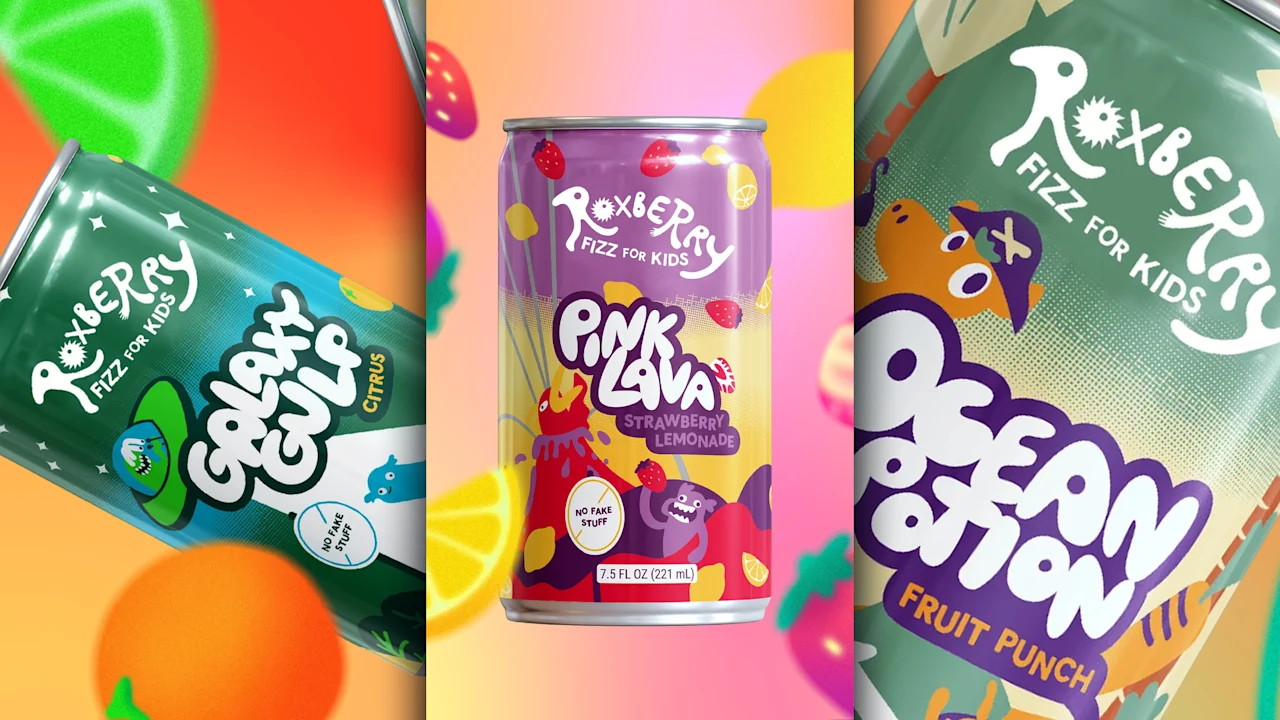
From the quirky flavor names Ocean Potion, Pink Lava, and Galaxy Gulp to the anthropomorphic characters and alien landscapes on the packaging, everything about Roxberry’s look suggests that it’s not just a beverage, but also its own universe.
“All of those characters that you see—and you just see them in little spots on the can—they have backstories, they have personalities. We went so deep, not because we’re planning to launch a TV show tomorrow, but because we wanted to ensure that we really had that richness,” Heyward says.
For example, Heyward adds, one character named Chomp Chomp is described as “loud, erratic, and entrepreneurial; an instigator who lives in the skies, makes deliveries, and creates crop circles.” Even if this character is never officially named, she believes the lore gives the brand depth.
While the majority of the Roxberry package is designed to entice shoppers with its bright, character-based imagery, smaller cues, like the phrases “No fake stuff” and “5g sugar” signal to parents that the beverage is not a typical soda. In essence, both Heyward and Sauer agree: Roxberry is designed with kids in mind first and parents second.
“We were looking at the love we all had for these character-driven brands growing up, and how they felt like part of our pop culture universe,” Heyward says. “Well, why has that gone away? There are brands for adults that have tapped into that nostalgia a little bit, but I think that the kids’ brands have really played it safe.” Roxberry’s high-octane look gives the healthier-for-you kids beverage category a much-needed branding sugar rush.

