





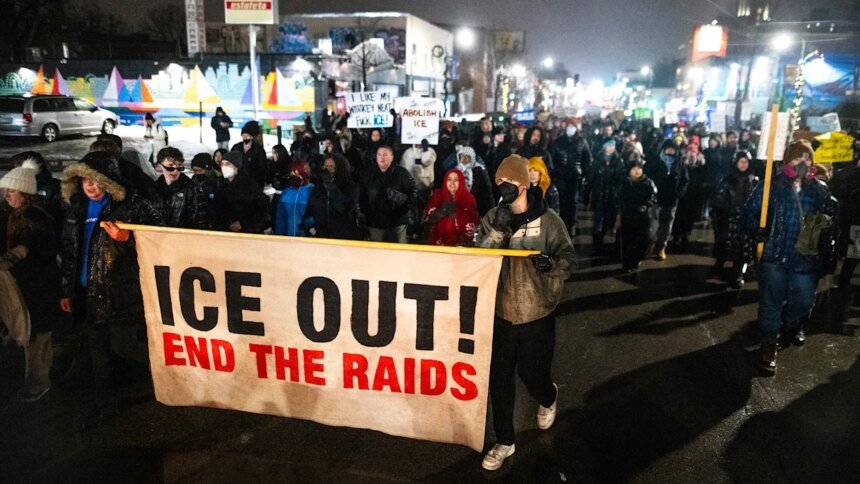

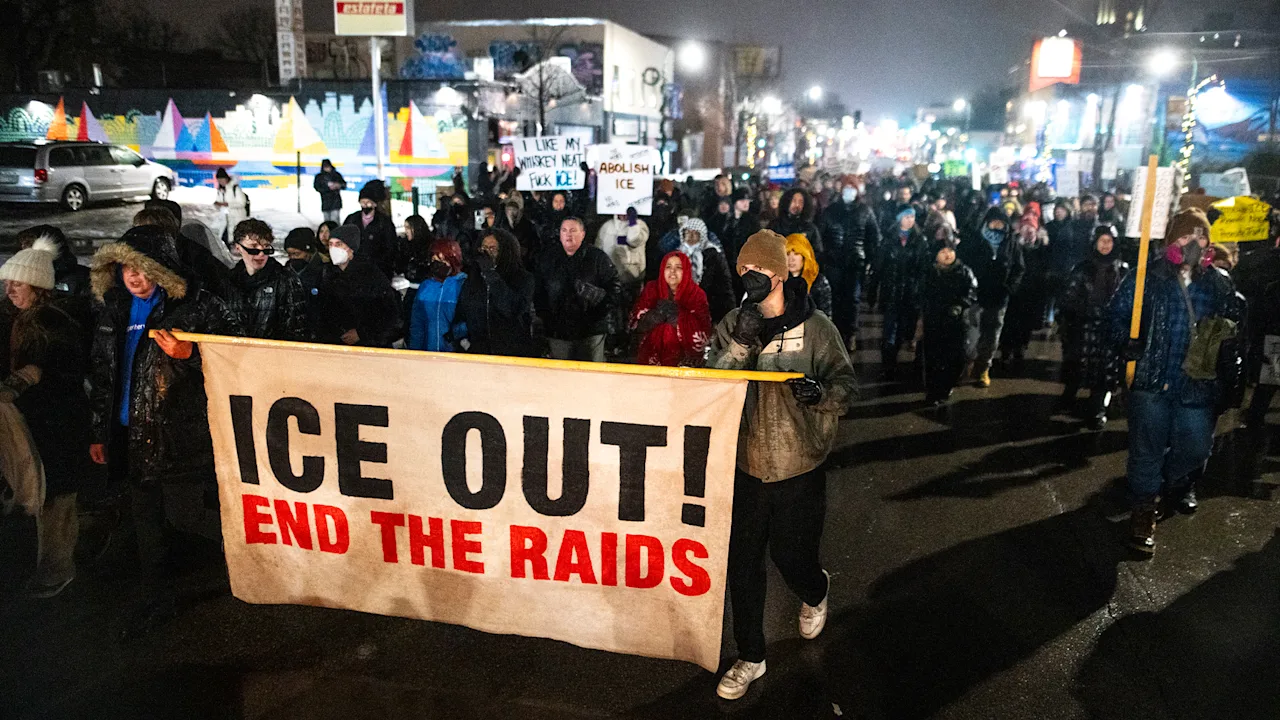
President Donald Trump took to social media on Thursday threatening to crack down on protests in Minnesota, as federal Immigration and Customs Enforcement (ICE) officers face off with protestors in the streets on Minneapolis following the death of Renee Nicole Good, who was fatally shot by an ICE agent.
The threat follows renewed clashes there overnight after a federal agent shot a local man in the leg after allegedly resisting arrest during a “targeted traffic stop,” according to CNN.
There are also reports ICE officials are going “door-to-door” in Minneapolis, showing up at people’s homes, which Vice President JD Vance said will “ramp up” as more ICE troops are deployed to Minnesota. So far, about 2,000 federal agents have been sent there, with another 1,000 more U.S. Customs and Border Protection agents expected to arrive soon, per CNN.
“If the corrupt politicians of Minnesota don’t obey the law and stop the professional agitators and insurrectionists from attacking the Patriots of I.C.E., who are only trying to do their job, I will institute the INSURRECTION ACT,” Trump posted on his social media platform, Truth Social.
This isn’t the first time Trump has threatened to invoke the Insurrection Act to crack down on protestors and widespread dissent against the policies and actions of his administration.
What is the Insurrection Act of 1807?
The Brennan Center for Justice calls the Insurrection Act “a vague and rarely used law that gives the president broad power to deploy the military domestically—but it’s not a blank check.”
“It’s a series of statutes enacted from 1792-1871 that in its modern form allows the president to use the National Guard or regular military to enforce the law in extraordinary circumstances like rebellion or failure of local and state law enforcement to deal with extreme chaos,” Chris Edelson, a political science lecturer at the University of Massachusetts, Amherst, tells Fast Company. “When the Insurrection Act is properly invoked in a real emergency, the military can be used for law enforcement.”
However, according to Edelson, who is writing a book on presidential powers, “there is no [current] legal, legitimate basis for Trump to invoke the Insurrection Act, which is designed to be used in a catastrophic situation, when there is rebellion or some massive breakdown in law enforcement. Nothing like that is happening right now in the U.S.—either in MN or elsewhere.”
But just because something is illegal, doesn’t mean Trump can’t do it.
“If he does illegally invoke the Insurrection Act, the question would be whether the military follows his orders, and whether anyone (i.e. Congress, the courts) stops him,” says Edelson. “The law of course is not automatically enforced—someone has to act when the law is broken.”
What has the Supreme Court said about the president invoking the Insurrection Act?
“There are no recent Supreme Court decisions on the Insurrection Act as it is rarely used,” Edelson says. “Before 1992, it was used during the civil rights era when there was violent opposition to desegregation and local/state law enforcement sided with white supremacists.”
There is a 19th century case called Martin v. Mott that is sometimes cited for the proposition that presidents have absolute authority to determine when to invoke the Insurrection Act. But some scholars, including Edelson, don’t think that’s the correct understanding of the case.
In other words, if the president invokes the Insurrection Act when there is no real emergency, Edelson and others believe that can still be challenged in court.
While the Supreme Court issued a recent ruling that Trump did not have authority to federalize and deploy the National Guard in Illinois, that case was decided under a separate statute, not the Insurrection Act.

