





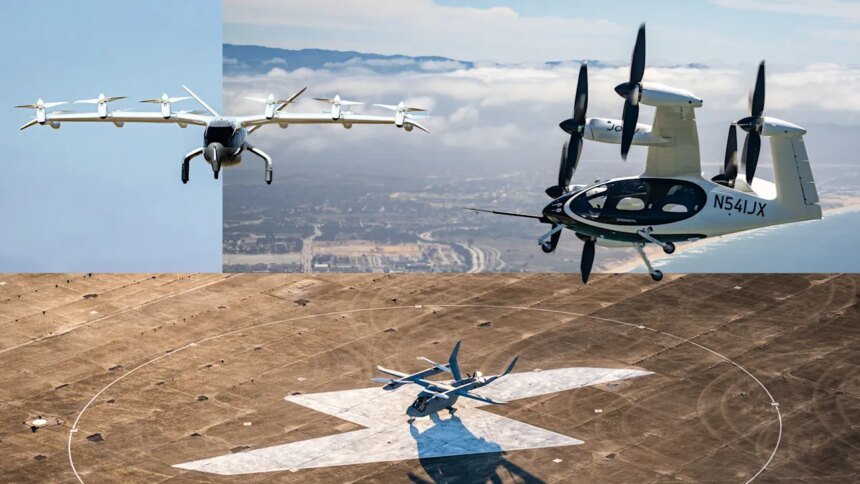

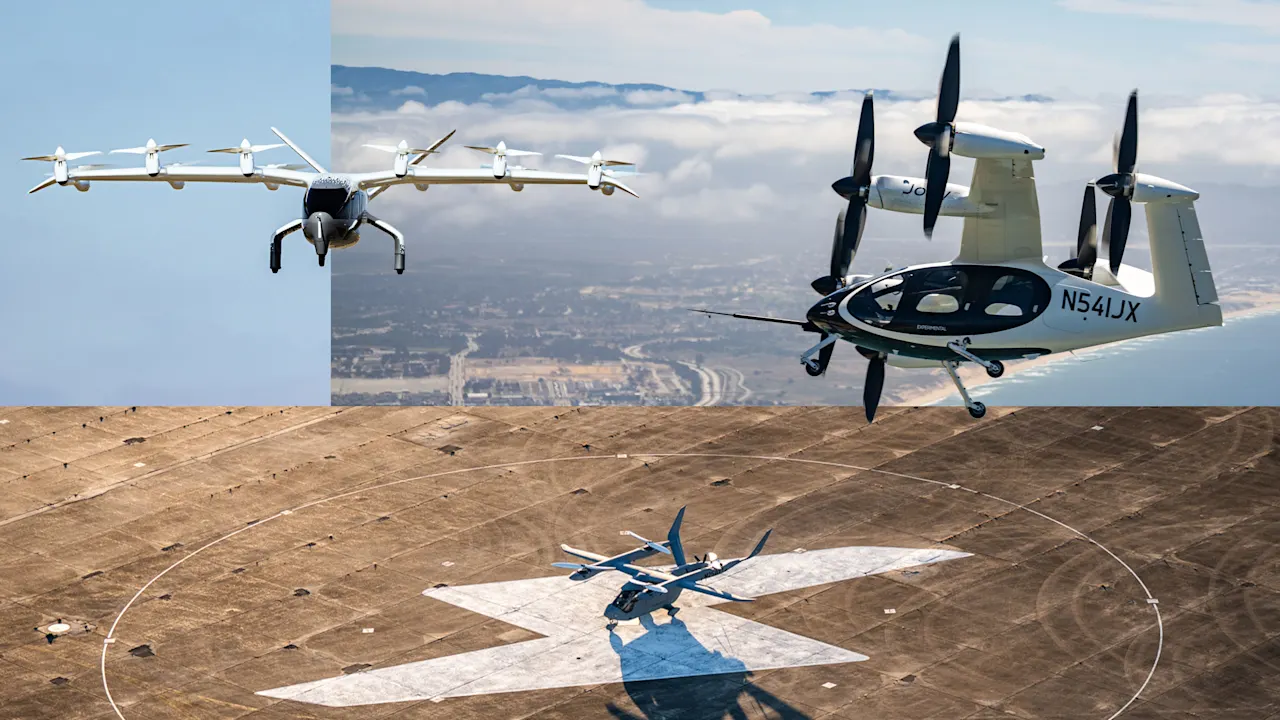
The U.S. Department of Transportation has approved eight pilot programs across 26 states that will allow eVTOL (electric vertical takeoff and landing) aircraft to begin real-world testing. The program will permit air taxi service in select cities, while data collected from participating companies will help the FAA develop regulations to scale the technology while keeping urban airspace safe.
“This is a defining moment for American innovation,” said JoeBen Bevirt, founder and CEO of Joby Aviation in a statement. “Instead of just reading about the future of flight, communities across America are going to be able to see it in the skies above their own cities this year.”
Pilot programs will take place in areas approved by the Departments of Transportation in Texas, Utah, Pennsylvania, Louisiana, Florida, and North Carolina, several of which cover multiple states. Additional pilots will be run by the Port Authority of New York and New Jersey and the City of Albuquerque.
eVTOL craft (or flying cars, in plainspeak) have been the stuff of science fiction dreams for years. The aircraft can take off and land much like helicopters, meaning no runway is required. They offer the hope of avoiding gridlock and rush hour congestion as well as the dream of getting to and from places at a much quicker pace. From Chitty Chitty Bang Bang to Back to the Future, generations have grown up believing they were only a few years away.
In recent years, major corporations have invested hundreds of millions of dollars in the technology in hopes of finally turning that vision into reality. Toyota, for instance, spent $500 million to buy into Joby in October 2024. Delta Air Lines is also an investor, putting $80 million into Joby. United, meanwhile, invested $10 million in Archer Aviation and $15 million in Eve Air Mobility in 2022.
Beyond the reduced stress they promise, flying cars are designed to be quieter than traditional aircraft, or even air-conditioning units. Because they are electric, they could also help reduce carbon emissions.
In addition, they hold the potential to be valuable tools for emergency response providers. In its announcement, the DOT outlined several potential uses beyond passenger transport, including cargo and logistics networks, emergency medical response operations, and offshore transportation.
“These partnerships will help us better understand how to safely and efficiently integrate these aircraft into the National Airspace System,” said FAA Deputy Administrator Chris Rocheleau. “The program will provide valuable operational experience that will inform the standards needed to enable safe Advanced Air Mobility operations. We appreciate the strong interest reflected in the many proposals we received.”
Beyond Joby and Archer, companies including Beta, Electra, Elroy Air, Wisk, Ampaire, and Reliable Robotics will participate in the pilot program.
With the prospect of wider operations on the horizon, competition among major players in the sector has intensified. Four months ago, Joby sued Archer for trade secret theft, alleging that a former Joby employee took proprietary information with him when he joined Archer.
Archer, on Monday, filed a countersuit against Joby, claiming the company, which was founded in 2009 in California, defrauded the U.S. government by concealing its “deep ties” to China and relying on a Chinese manufacturing subsidiary for critical components.
Alex Spiro, an attorney for Joby, tells Fast Company the company “doesn’t respond to nonsense.”
“Archer’s ludicrous and defamatory claims are nothing more than an irresponsible attempt to distract from Joby’s trade secret theft lawsuit proceeding against Archer,” he says. “Joby is a U.S.-headquartered company that operates with strict compliance across its supply chain, and the company has been fully transparent with the U.S. Government about its operations. Joby has no ties to the Chinese Communist Party and has not received grants or subsidies from Chinese authorities.”

