




The Bezos vs. Musk battle for satellite internet service is heating up
In what’s rapidly becoming the new space race: Amazon will start testing its high-speed internet service that it’s building out to compete with SpaceX’s Starlink service.
With a broader rollout planned for next year, Amazon announced on Monday some updates to its Leo network—including a new program that will see select businesses taking part in an “enterprise preview” of the forthcoming service. In turn, Amazon can collect feedback to tailor services for specific industries.
“Amazon Leo represents a massive opportunity for businesses operating in challenging environments,” Chris Weber, vice president of consumer and enterprise business for Amazon Leo, said in a statement. “We’ve designed Amazon Leo to meet the needs of some of the most complex business and government customers out there, and we’re excited to provide them with the tools they need to transform their operations, no matter where they are in the world.”
BILLIONAIRES IN SPACE RACE
Amazon Leo is part of the broader retail giant’s business, and not Blue Origin, the space technology company that was also founded by Jeff Bezos. It will compete with Starlink, which is owned by SpaceX, the space technology company founded by Elon Musk. That means the billionaires are competing both with space exploration and internet-from-space services for hard-to-reach places.

Since April, Leo has launched more than 150 satellites into space. By comparison, Starlink has more than 7,800 satellites in orbit, according to figures released this month by the company, along with more than 6 million customers worldwide—including major cruise lines and commercial airlines.
Some of the companies that have signed on for early adoption of Amazon Leo include JetBlue, Hunt Energy Network, and Connected Farms.
Amazon announced earlier this month that it had rebranded its low Earth orbit satellite network to Leo from Project Kuiper. The company said it plans to eventually launch 3,000-plus satellites as part of its mission to provide fast and reliable internet to customers beyond the reach of existing networks.
COMPETING FOR THE LION’S SHARE
For Leo, taking a bite from the lion’s share of this specific industry that’s dominated by Starlink may be diffuclt, but Amazon seems intent to compete at least on speed—if not price.
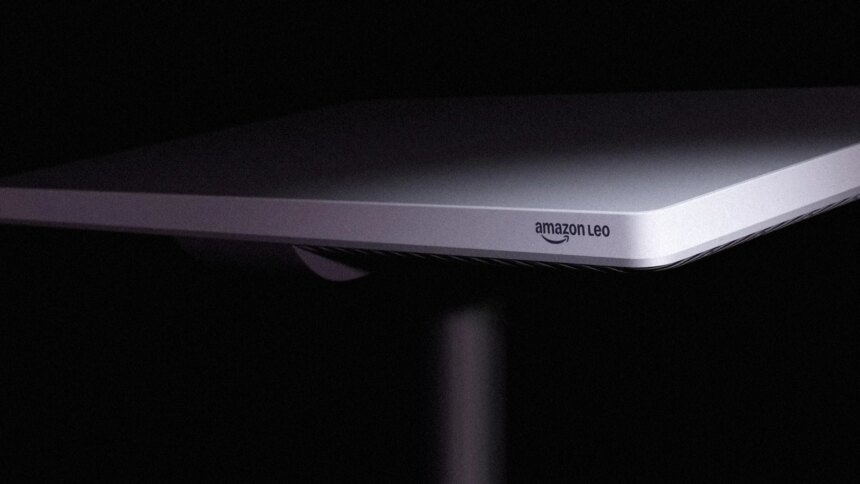
On Monday, the Seattle-based company showed off the final production design of Amazon Leo Ultra, the enterprise-grade terminal that will provide download speeds of up to 1 gigabits per second (Gbps) and upload speeds of up to 400 megabits per second (Mbps). By comparison, Starlink said earlier this month the median download speed across 2 million-plus active Starlink users during times of peak demand is nearly 200 Mbps as of July 2025.
How the two companies will compete on pricing is harder to know yet, as Amazon has yet to disclose pricing. Starlink prices its residential service starting at $40 per month and going up to $165, and business plans ranging from $65 per month to more than $2,150.
The final deadline for Fast Company’s World Changing Ideas Awards is Friday, December 12, at 11:59 p.m. PT. Apply today.

