



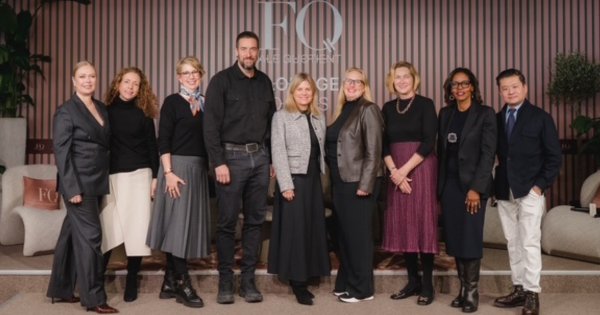

Day 1 of the Marketing Vanguard Inspiration Excursion centered on real talk about agentic AI in action, upskilling, and building the capabilities required for global influence — without losing sight of human fulfillment in an increasingly automated world.
With leaders including Antonio Lucio, EVP and chief marketing and communications officer at HP; Karin Timpone, CEO and founder of ClearPrompt LLC; Rachel Thornton, CMO of Adobe Enterprise; Bonnie Pelosi, CMO EMEA at Microsoft; Nic Brandenberger, CMO of Mammut; and others, the conversation quickly moved beyond hype.
A key takeaway: AI will ultimately define CMO value. But that value will only be realized if CMOs move beyond responding to AI and instead lead the agenda inside their organizations.
At the same time, many acknowledged that AI has a marketing problem. Anything labeled “artificial” immediately triggers skepticism. That’s why several leaders reframed the conversation around augmented intelligence — technology that amplifies human creativity and judgment rather than replacing it. And CMOs are uniquely positioned to champion it.

Day 2 built on that foundation, shifting focus to brand, growth, and alignment at the top. Against the backdrop of accelerating AI adoption, CMOs emphasized the need to continue championing brand as a growth driver. CMOs and CEOs must be aligned on shared metrics, shared data, and shared accountability amid shifting geopolitical, economic, and technological conditions.
With AI commanding executive attention, CMOs are navigating real trade‑offs between speed, innovation, and responsibility, while representing the consumer’s voice at the leadership table. This is where marketing’s influence expands, but also where scrutiny intensifies.
During a compelling closed-group dialog, our marketing leaders, including Workday’s Emma Chalwin, Ferragamo’s Michela Ratti, LinkedIn’s Jessica Jensen, Infosys’ Virmani, and ADWEEK’s Lee, reinforced that modern marketing leadership extends far beyond the marketing function.
The participants revealed their immediate needs: to rethink and redesign organizational mechanics; to better integrate AI, analytics, customer experience, and cultural fluency; and to redefine how marketing partners with the broader C‑suite to manage new levels of complexity.
One theme that came up particularly sharply, during a luncheon discussion held in partnership with EY and The Female Quotient, was that for there to be trust and transparency in the AI era, executives must be visible by posting often, particularly video, on LinkedIn and social media.
Marketing leaders are ultimately responsible for the deliberate elevation of the real and the human, as automation and artifice become more prevalent.

