





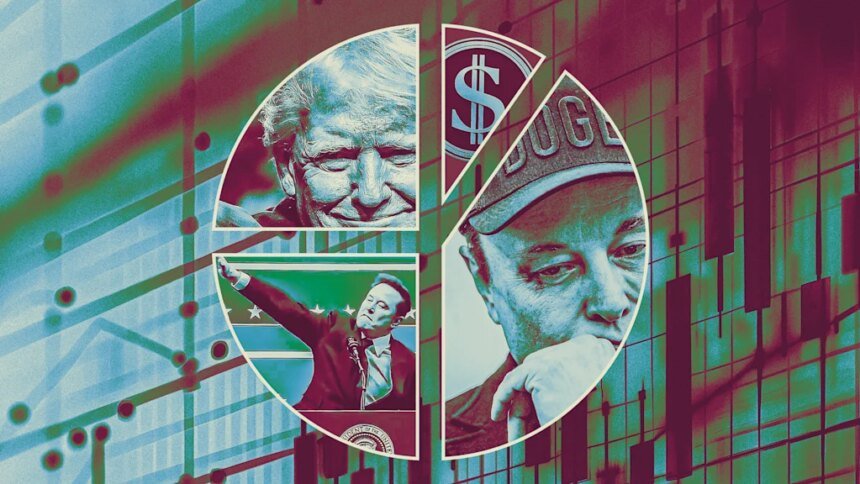

It’s official: DOGE, the Trump administration’s Department of Government Efficiency, has met an early end.
Even before Trump took office, DOGE was conceived of as an outside advisory board that would recommend government reforms and find $500 billion in annual spending to cut.
The day after Trump was inaugurated, the department was officially founded, with Elon Musk—CEO of Tesla and the world’s richest man—at its helm.
Within the first 100 days of Trump’s second term, DOGE played a central role in cutting hundreds of thousands of jobs; nixing funds to foreign food aid and medical research; overhauling longtime government cybersecurity systems; targeting federal diversity, equity, and inclusion (DEI) programs for elimination; and more.
But it seems like DOGE’s fate was ultimately to burn bright and fizzle out. After Musk departed from his leadership position amid a public feud with Trump, DOGE slowly faded from news headlines and the public consciousness.
Earlier this month, a Reuters reporter asked Scott Kupor, director of the U.S. Office of Personnel Management, about DOGE’s status.
“That doesn’t exist,” Kupor responded.
He added that DOGE is “no longer a centralized entity,” and Reuters found that several of the department’s former employees have moved on to other roles, including two workers who are now involved with the new National Design Studio.
The agency’s lackluster shutdown comes months ahead of its official conclusion, which was meant to be in July 2026, according to an executive order signed earlier this year by Trump.
Here, we take a look back at some of DOGE’s most egregious moves as the agency meets its untimely end.
DOGE shuts down USAID
One of DOGE’s first high-profile moves was to dismantle the U.S. Agency for International Development (USAID), a branch of the government dedicated to administering foreign aid.
At the time, Musk took to X to share that he had “spent the weekend feeding USAID into the wood chipper.”
In 2023, USAID managed over $40 billion of appropriations provided to around 130 countries, according to the Congressional Research Service. Of that amount, $16.8 billion went toward governance, while $10.5 billion went to humanitarian aid and $7 billion to health efforts.
The USAID shutdown has had devastating ripple effects, including wasting massive food stores amid a global hunger crisis and threatening Agent Orange cleanup efforts in Vietnam.
According to one recent analysis from Atul Gawande, a Harvard T.H. Chan School of Public Health professor and former assistant administrator for global health at USAID, the shutdown has already resulted in hundreds of thousands of deaths from infectious diseases and malnutrition.
Thousands of federal workers laid off
As part of its cost-cutting initiative, one of DOGE’s main focuses became eliminating federal jobs that it deemed to be redundant.
This included firings at the U.S. Department of Health and Human Services (HHS), the Food and Drug Administration (FDA), the U.S. Postal Service (USPS), and elsewhere. Kupor told The New York Times in an August interview that the DOGE cuts accounted for almost 300,000 jobs eliminated in total.
More recently, some agencies—like the General Services Administration—have begun asking former employees to return to work ahead of the end of the fiscal year.
DOGE reportedly gains unprecedented access to federal databases
After DOGE’s founding, the agency reportedly received unprecedented access to a number of government databases and computer systems, including the Department of the Treasury’s payment systems, sensitive Internal Revenue Service (IRS) data, Social Security records, and data held by the Department of the Interior.
In April, David Evan Harris, a chancellor’s public scholar at the University of California, Berkeley, told Fast Company: “It’s very unclear what kinds of security protocols the DOGE team is using, and if they are taking any steps to make sure that private data of government employees and U.S. citizens, and even confidential data about U.S. government programs, is not being turned into training data or retained improperly by any of these AI companies that they’re working with.”
According to a September report from Senate Democrats, Harris had reason to be concerned. The report alleges that DOGE “copied Americans’ sensitive Social Security and employment data into a cloud database without any verified security controls,” putting people’s personal data at risk of foreign hacks.
The final deadline for Fast Company’s World Changing Ideas Awards is Friday, December 12, at 11:59 p.m. PT. Apply today.

