





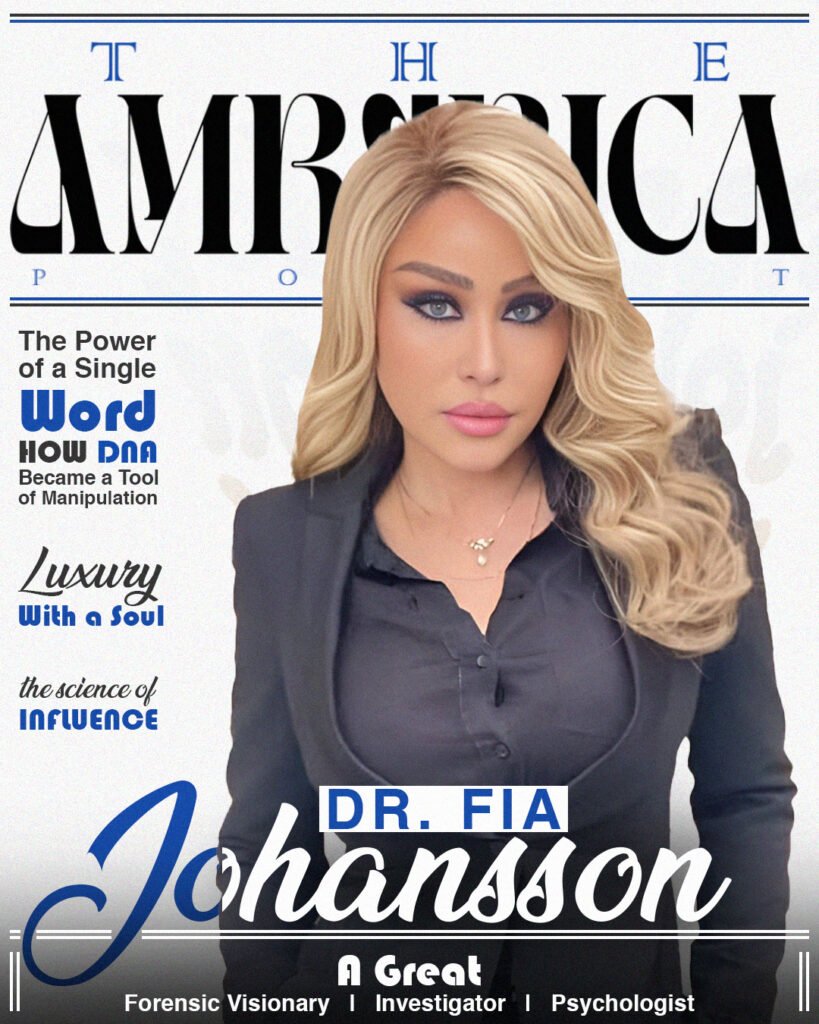
Dr. Fia Johansson, the visionary with many talents serves as a Forensic expert, Private investigator, Author and so much more
This is a world where trauma, identity and truth may intersect more frequently in digital spaces than ever. A single word may have the power to shift public opinion, influence emotions and perspectives and even derail critical thinking. Few understand this phenomenon better, much like how Dr. Fia Johansson does. She is a visionary with several hats on her head, serving as a forensic expert, forensic psychologist, private investigator, criminal behaviour analyst, author, producer, business strategist, and entrepreneur. Drawing on her extensive experience working with law enforcement agencies across the US and Europe, she recently came forward to shed more light on how DNA, typically a scientific term, became a psychological weapon in one of the most controversial identity stories in recent years.

The case involves Julia Wandelt, who falsely claimed to be a missing child and was later found guilty after hiding evidence under her mattress. This revealed the incredible power that emotionally charged language can exert on the public. As per Dr. Fia Johansson, the word ‘DNA’ wasn’t just a part of the narrative; it was something that controlled it. She emphasized how “Julia repeatedly used the word DNA as a psychological tool,” and added, “She didn’t need real results; she just needed repetition. Once people emotionally trusted that word, logic was often suspended.” She explains how the word ‘DNA’ in the public consciousness represents science, closure, and certainty. In the case of Wandelt’s narrative, despite the absence of actual scientific proof, it created an illusion of credibility. The repeated invocation of DNA activated cognitive shortcuts in listeners’ minds, making the story seem more legitimate than it ever was. In this context, DNA turned out not to be a scientific concept but a psychological trigger, which was designed to create trust and override doubt.
Powerful emotions like hope, fear, grief, longing, and empathy can naturally be invoked in identity stories. Julia Wandelt’s claims brushed upon all these emotions, making her story seem more compelling regardless of the facts. Dr. Fia Johansson pointed out how people wanted to believe in the emotional journey and how they connected with Wandelt’s pain, the longing and the desire for answers. And, hence, she emphasizes that once that emotional connection forms, inconsistencies get overlooked. This is where confirmation bias takes over. The more emotionally invested audiences become, the less likely they are to question contradictory evidence. In the case of Wandelt, empathy took over scrutiny until investigators uncovered physical evidence proving deception.
DNA symbolises authority and scientific truth for the general public, and the introduction of this single word allowed the story to spread rapidly, noted Dr. Fia Johansson. She underscored how easy it is to get carried away by the emotional aspects of such a powerful story. But once the word DNA is introduced, people assume scientific legitimacy, even when no testing has been done. This psychological effect shows how easily emotionally driven narratives can be used as a tool for manipulation. It also emphasises the importance of verifying claims before concluding, especially with stories involving trauma, identity or missing person cases.

According to Dr. Fia Johansson, the recent Wandelt case is a reminder of the need to balance compassion with critical analysis. She encourages the public to stay cautious and question narratives that lean heavily on emotional appeal or scientific buzzwords without providing proof.
Dr. Fia Johansson, beyond her investigative work has also been empowering women-led businesses. She finds passion in helping leaders overcome trauma and speaking globally on topics such as emotional intelligence, personal development, threat assessment, and the psychology of influence.

