




Want more housing market stories from Lance Lambert’s ResiClub in your inbox? Subscribe to the ResiClub newsletter.
Among the 24 price forecasts tracked by ResiClub in our final 2026 home price forecast roundup, the average prediction is a +1.43% increase in U.S. home prices in 2026.
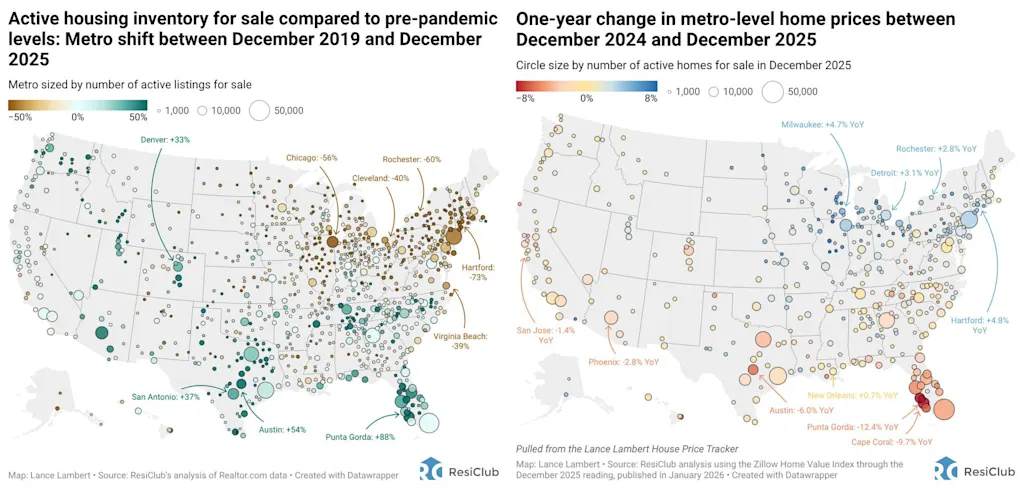
Keep in mind that roundup mentioned above looks at forecasts for nationally aggregated home prices. On a regional and neighborhood basis, home price swings can vary greatly from the national figure. For example, on a year-over-year basis, U.S. home prices as measured by the Zillow Home Value Index are up +0.1%, while home prices in the Hartford-East Hartford-Middletown, Connecticut metro area are up +4.6% and home prices in the Austin-Round Rock-Georgetown, Texas metro area are down -6.0% during that same timeframe.
To better understand how regional home prices may vary in 2026, ResiClub reached out to economists at Zillow—whose forecast of U.S. home prices rising by +2.1% in calendar 2026 is slightly above the average model—and economists at Moody’s Analytics—whose forecast of U.S. home prices rising by +0.8% in 2026 is slightly more bearish than the average model—to gather their metro-level home price forecasts.
Let’s take a look at the metro-level forecasts.
window.addEventListener(“message”,function(a){if(void 0!==a.data[“datawrapper-height”]){var e=document.querySelectorAll(“iframe”);for(var t in a.data[“datawrapper-height”])for(var r,i=0;r=e[i];i++)if(r.contentWindow===a.source){var d=a.data[“datawrapper-height”][t]+”px”;r.style.height=d}}});
When we published our final roundup of national home price forecasts for 2026, Zillow was forecasting +1.2% for 2026; however, over the weekend they slightly upgraded that to +2.1%.
Zillow economists write the following:
“With supply no longer as tight as it was during the pandemic, price gains are likely to stay modest. Buyers should see a bit more time and leverage when they shop, while sellers can still build equity, just at a slower pace than in past boom year(s) . . . Looking ahead, Zillow projects sales will strengthen in 2026 as mortgage rates trend lower and affordability improves. Existing home sales are forecast to reach 4.3 million next year, a 5.2% year‑over‑year gain. After two slow years, the recovery is expected to be led by the Southeast and West, where demand is more rate‑sensitive and is starting to rebound as borrowing costs ease.”
window.addEventListener(“message”,function(a){if(void 0!==a.data[“datawrapper-height”]){var e=document.querySelectorAll(“iframe”);for(var t in a.data[“datawrapper-height”])for(var r,i=0;r=e[i];i++)if(r.contentWindow===a.source){var d=a.data[“datawrapper-height”][t]+”px”;r.style.height=d}}});
The forecast by Moody’s chief economist Mark Zandi has U.S. home prices, as measured by the Moody’s repeat sales index, rising just +0.8% in calendar year 2026, followed by +1.5% uptick in 2027.
When I recently reached out to Moody’s Analytics chief economist Mark Zandi for his updated home price forecast, he said his long-term outlook for the U.S. housing market remains largely unchanged: He expects a prolonged period of stagnation as affordability gradually improves. Following the historic run-up in prices during the pandemic housing boom and the subsequent mortgage rate shock, Zandi believes resale activity/existing home sales will likely stay frozen for several more years.
“Affordability has to be restored for housing to regain its mojo,” Zandi told ResiClub a few months ago. “Flat home prices [adjusted for inflation] is the healthiest path forward—it’s the only way for incomes to catch up.”
Zandi expects nominal national home prices to move sideways over the next 12 to 18 months, with local variation: markets in the South and West, where building has been stronger, seeing some modest declines, while tight-inventory markets in the Northeast and Midwest remain more stable.
“The worst of the pain in the housing market might be now and in the next six to nine months. After that, things will begin to feel a little better—but not good,” Zandi told ResiClub in October. “The housing market will heal . . . but it’s going to take time—and a lot of patience.”
Over the next decade, Zandi projects U.S. home prices will rise roughly in line with inflation, meaning no “real” [adjusted for inflation] house price gains for around 10 years.
“We expect homes for sale to steadily increase as more existing homeowners need to sell for demographic reasons—death, divorce, children, job change—and lower mortgage rates help ease their interest rate lock. The [potentially] lower rates will also support housing demand, but the increase in housing supply will be even more significant, weighing on house price gains,” Zandi tells ResiClub.
What is ResiClub’s take?
The housing market is still working through a cyclical cooling phase, with many of the nation’s fastest-growing Sun Belt boomtowns undergoing a deeper recalibration after experiencing greater overheating during the pandemic housing boom. This adjustment period won’t last forever, and the long-term growth fundamentals—such as rising population—in many of these Southern markets remain attractive. However, in 2026, ResiClub believes the market is still within that normalization window (but we’re getting closer to exiting it).
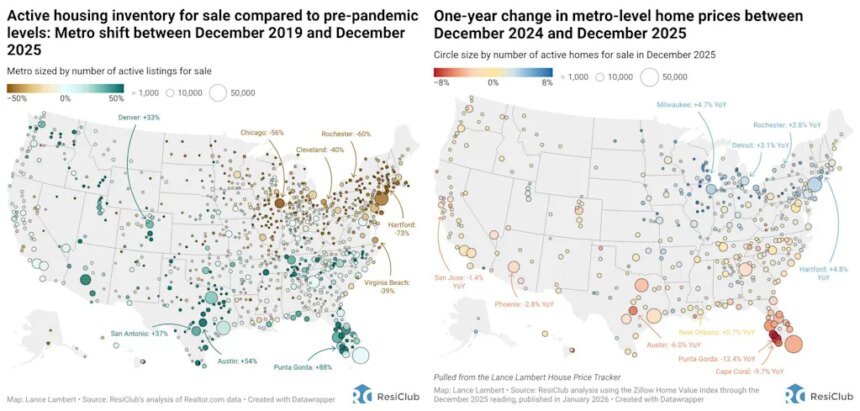
Broadly speaking, housing markets where inventory (i.e., active listings) has climbed well above pre-pandemic 2019 levels have experienced softer/weaker home price growth (or event outright declines) over the past 42 months since the pandemic housing boom fizzled out. Conversely, housing markets where inventory remains far below 2019 pre-pandemic levels have, generally speaking, experienced more resilient home price growth over the past 42 months.
Using active inventory/months of supply as a short-term guide, we expect the greatest pricing resilience in 2026 to be in Midwest and Northeast markets, while the greatest pricing softness is still likely in Gulf markets such as Austin and Punta Gorda, Florida. (I think both Zillow and Moody’s are a little too optimistic about Southwest Florida in particular, which I believe is still in correction mode—although it is starting to create some interesting buying opportunities.)
Regardless of how regional inventory (see our latest monthly inventory update here) or regional home prices (see our latest monthly home price update here) perform in 2026, we’ll be closely tracking the trends to keep you informed of any shifts.

