






When Levi’s CEO Michelle Gass was in Japan last summer, she and chief product officer Karyn Hillman wandered down the street from the brand’s store in Tokyo’s trendy Harajuku neighborhood to a small, unassuming vintage shop called BerBerJin. They took the stairs down into its cavernous basement, where it keeps racks and racks of its best denim finds, and began the slow, laborious task of searching for treasure. A couple of hours later, Gass walked out with a pair of 1947 vintage 501s and an even rarer 1952 trucker jacket.
“We tried on so many, many pairs of jeans,” Gass tells me over coffee in her San Francisco office in September. “You appreciate the nuances and beauty of denim, how it ages and how it’s worn. There are these incredible finishes that come as a result of people wearing it for 70 years. It’s so special.”
It’s the kind of experience that can only happen in Japan. When American Levi’s factories began modernizing their denim production lines in the 1960s and ’70s, Japanese collectors came to America to buy up as much vintage and deadstock denim as they could. (Japanese manufacturers bought the antique shuttle looms, sparking homegrown brands like Big John and Studio D’Artisan.) Levi’s created its Levi’s Vintage Collection—new replicas of historical designs—in the country in 1996. Recently, Levi’s cemented the relationship further, launching its “Made in Japan” Blue Tab collection, a premium line of trendy takes on classic Levi’s designs, last February.
Gass’s success in striking vintage gold in Tokyo last summer is also symbolic of a larger trend for the 172-year-old company: Most of its consumers are now outside of the U.S. This has been a blessing for the bottom line. At a time when U.S. retailers have been roiled by tariffs and global supply chain challenges, Levi’s is outperforming its peers, posting 14 consecutive quarters of direct-to-consumer channel growth. It’s a level of consistency its competitors undoubtedly envy; Gap posted its first annual revenue increase since 2022 last year (1%) after years of flat sales and declines.
Forty years ago, international sales accounted for just 23% of the company’s annual revenue. Now that figure is close to 60%. The increase is noteworthy, given how low the U.S., as a country, has plunged recently in international esteem.
According to recent Ipsos surveys, the opinion of America as having an overall positive effect on world affairs has fallen in 26 out of 29 countries over the last six months. Only 19% of Canadians see the U.S. as a positive influence, down from 52% six months ago. “The aesthetics of America from the past are not the aesthetics of America for today,” says University of Michigan marketing professor Marcus Collins.
In September, Levi’s leadership in the U.K. acknowledged as much, saying that “rising anti-Americanism as a consequence of the Trump tariffs and governmental policies” could drive British shoppers away. The company avoided much of the impact from tariffs in 2025, thanks to a diversified supplier base across 28 different countries and minimal exposure to China, with less than 1% of its goods sold in the U.S. manufactured there. But it’s not immune: Gass said in October that the company will be raising prices on some of its products next year.
But the company’s success overseas shows that though the brand of America might be struggling—riven at home and distrusted abroad—the quintessential brand of Americana that Levi’s represents is thriving. Sales in foreign markets are generating double-digit year-over-year sales growth for the company. In a July interview with CNBC’s Jim Cramer, Gass said the brand is “on fire” in Europe, especially among younger consumers, pointing to Paris, Barcelona, and Milan.
Gass’s vintage shopping spree reveals something else as well: that the woman at the helm of Levi’s grasps the intimacy of the relationship between people and their jeans. Fit, color, wash, age—they all add up to something ineffable for the wearer: identity. Merging heritage and quality with values of inclusivity, Levi’s is the ultimate ambassador for a certain kind of classic American cool, earning its spot on this year’s list of Brands That Matter.
Since arriving at Levi’s two years ago, Gass has been rewiring the company into what she calls “the world’s definitive denim lifestyle brand,” with a target of $10 billion in annual revenue, a significant jump from the $6.4 billion the company generated in 2024. It entails growing the women’s category (from 40% today to 50% of total sales); accelerating the company’s direct-to-consumer business (currently about 47% of sales); streamlining its manufacturing supply chain; and expanding its brick-and-mortar footprint of 1,200 owned and operated stores by 250 locations over the next five years, particularly in high-growth regions like India, Korea, the Philippines, and Thailand. This will better help the company control the consumer experience and how wholesale partners market Levi’s.
“Our brand is actually bigger than our business right now,” says chief marketing officer Kenny Mitchell. Levi’s has a market cap of $8.36 billion—tiny compared to an American retailer like Nike ($107 billion). It’s small even compared to Lululemon ($21.19 billion), a company with higher margins and a more developed DTC operation. (Denim, a more mature market than athleisure, has traditionally had lower margins and more competition.) “Our job,” Mitchell says, “is to get our fair share.”
Mitchell was on vacation in Paris to celebrate his wife’s 50th birthday in early 2024 when he started to hear the rumors: When Beyoncé’s new album, Cowboy Carter—the follow-up to her chart-topping Renaissance—dropped that March, it would include a track titled “Levii’s Jeans.”
He immediately called Gass, who was barely three months into her CEO tenure. (She had been hand-picked for the role by her predecessor, Chip Bergh, after spending five years running Kohl’s and 16 years before that at Starbucks, eventually overseeing the European, Middle East, and Africa business.) “It was the biggest gift,” she recalls. “I really could not believe it. Like, how in the world, or the universe, did this happen?”
Beyoncé clearly harbored affection for the brand, which had offered sponsorship support to Destiny’s Child in the early 2000s, featuring ads with the group wearing Levi’s Low Rise Jeans. (She also famously wore a custom pair of Levi’s cutoffs during her Coachella set in 2018.) For Gass, the song was a double win: Not only did it position the brand at the center of culture, it also offered a direct appeal to women, a critical component of Gass’s growth strategy for Levi’s. She and Mitchell formed a team to brainstorm a joint campaign they might pitch to Beyoncé, if they got the chance.
Levi’s “is known for a lot of good things, but agility hasn’t necessarily been one of ’em,” says Mitchell, a veteran of McDonald’s, Gatorade, and Nascar, who joined the company in June 2023 from Snap. The quick response “showed what’s possible,” he says.
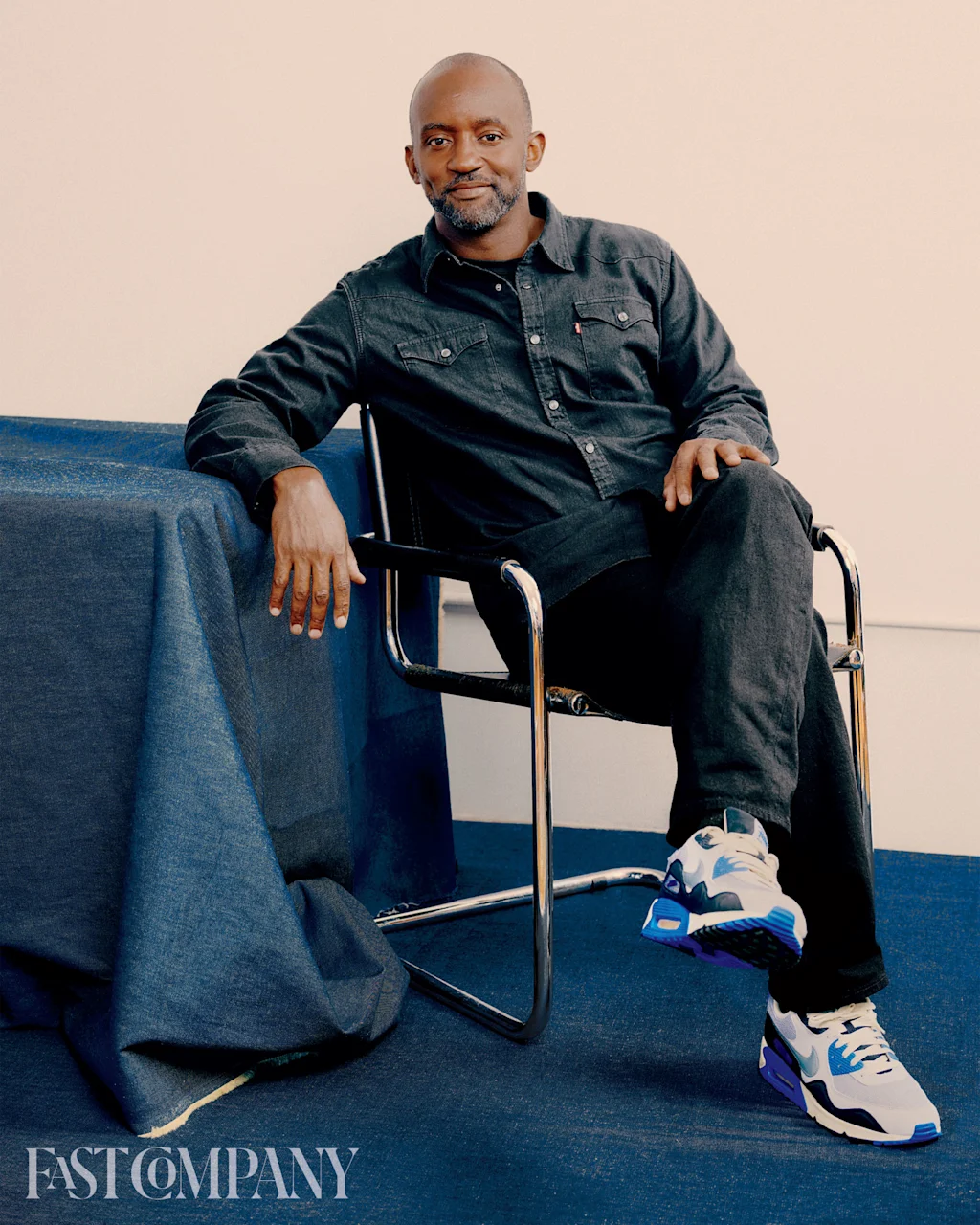
When the album came out in late March, Levi’s quickly changed all its social handles to include the extra “i.” (Fans were excited, too: The brand’s posts attracted 3 billion impressions within a month of the album’s release.) Then Mitchell called Beyoncé’s team at Parkwood Entertainment; they’d seen the social swap and loved it, which led to talk of an official collaboration. Between September 2024 and August 2025, the parties would release three lushly produced video ads, all of which drew on the brand’s history while re-situating Levi’s within contemporary America. In a company press release to announce them, Beyoncé described Levi’s as “the ultimate Americana uniform.”
Beyoncé’s embrace of Levi’s was unique, but stars have been aligning themselves with the brand since the 1930s, harnessing its working-class, Western roots to signal, and burnish, their own rebellious, down-to-earth image. John Wayne in Stagecoach. Marlon Brando in The Wild Ones. Elvis Presley in Jailhouse Rock. James Dean in Rebel Without a Cause. Elizabeth Taylor in Giant. A pair of 505s adorned the cover of the Rolling Stones album Sticky Fingers. Bruce Springsteen’s 501-clad backside graced the cover of his 1984 album Born in the U.S.A. (in a photo shot by Annie Liebovitz).
President Ronald Reagan, no marketing slouch himself, liked to wear Levi’s while working on his ranch. He often talked about America being “the shining city upon a hill,” a beacon for the rest of the world. Over the decades, that light has been a swoosh, the golden arches, an apple, a Coke bottle, and, yes, the iconic little red tab that identifies a pair of Levi’s.
Mitchell recently returned from India, where he was visiting with two new Levi’s brand ambassadors: musician and actor Diljit Dosanjh and Bollywood star Alia Bhatt. “I can’t think of a lot of brands that have that dimension,” he says of the variety of international cultures baked into its partnerships. Levi’s direct-to-consumer sales in Asia, including India, grew by 14% in Q1 2025.
When Gass delivered the undergraduate commencement address at her alma mater, Worcester Polytechnic Institute (WPI), in Massachusetts, last May, she spoke about growing up in Lewiston, Maine, and the jobs she had before college, including working at a bread factory and bagging groceries at the local Shop ’N Save.
Sitting in her office on the seventh floor of Levi’s headquarters on a September afternoon, with a stunning view of San Francisco’s Bay Bridge, she smiles thinking about those old jobs, especially “being a bun sorter at the bread factory,” she says. “It was for Burger King buns, no joke, that would come down the conveyor, and you’d have to make sure that they were all lined up properly, toss the bad ones, and make sure it didn’t get jammed up. I had a total I Love Lucy moment with hamburger buns that was really true. Buns were flying everywhere.”
In her speech to WPI’s graduating class, Gass, who’d received a partial scholarship to attend the school, charted her path from chemical engineering major to leader of an iconic brand like Levi’s by identifying five principles that were instilled in her during her time at the school in the late ’80s: Ask the question; It’s science and imagination; It will be hard; The right distance between two points may not be a straight line; and Consider the impact.
Asked today how these principles apply to her work, she offers an example that illustrates principle one. Early in Gass’s tenure as a marketer at Starbucks, in the late ’90s, the company was still using red and white straws, like every other fast-food joint. She asked the question: Why don’t we have green straws, to match the company’s logo? That question prompted a company-wide look at small branding opportunities.
Years later, after her almost 10-year stint at Kohl’s, Gass became Levi’s president in 2023, under then-CEO Bergh. While touring stores and offices around the world, she wondered, Where are all the denim skirts? “Shouldn’t Levi’s be the destination for the best denim skirt, like the 501 of a denim skirt?” she recalls asking Bergh. “It seems so simple, but it was not part of our core line.”
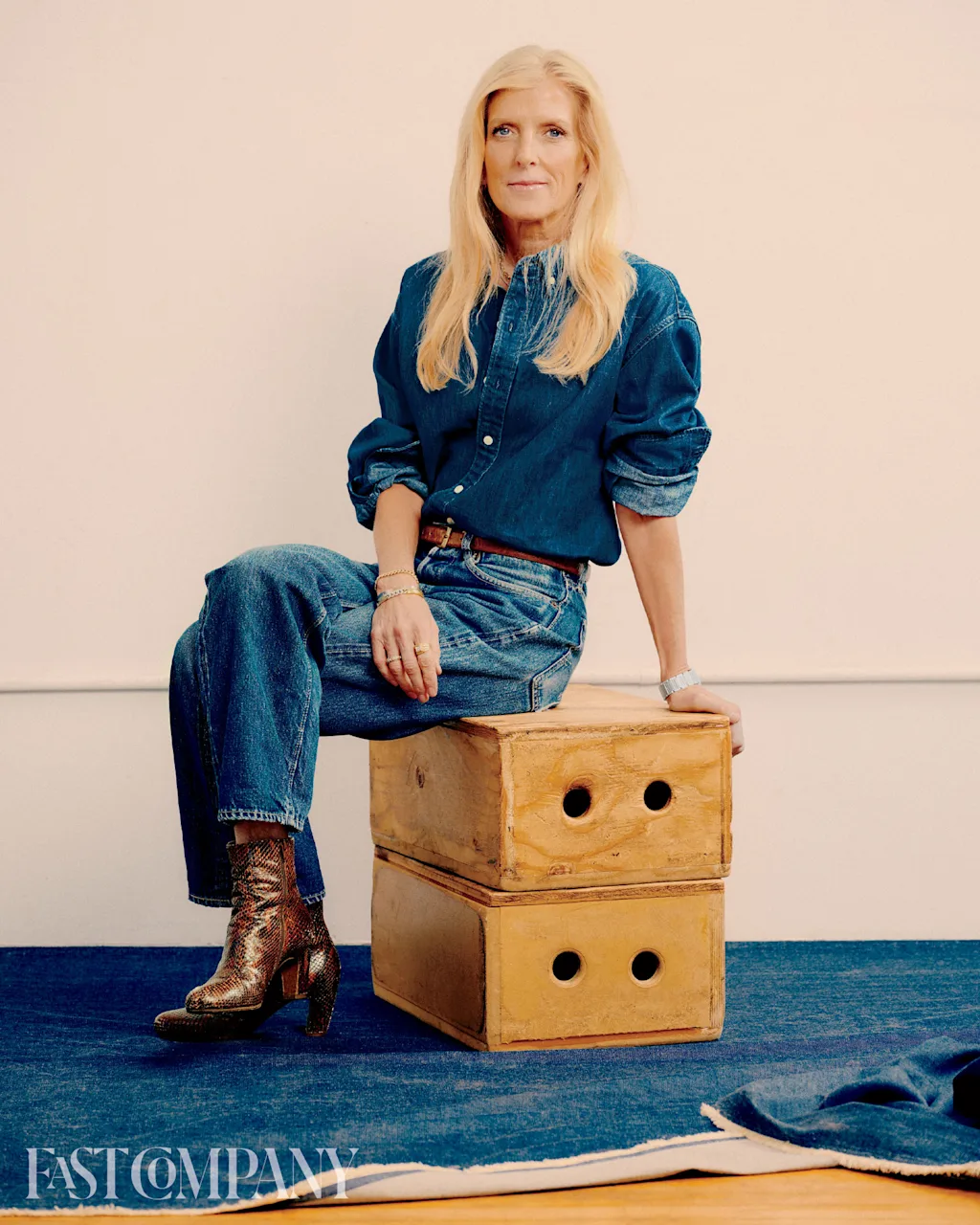
The strategy she and Bergh developed for transforming Levi’s into a fuller “denim lifestyle” brand entailed expanding the women’s category beyond jeans, which means skirts and tops.
Karyn Hillman’s office is packed with five different racks of clothing samples, which she uses as inspiration for new products. Wearing a pair of vintage 1950s men’s 501s, a brown leather jacket over a chambray blouse, and boots, the Levi’s product head exudes the company’s denim lifestyle ambitions. She is positioning the brand as something of a personal stylist, helping shoppers make good-looking decisions—the logic being, who knows what goes with 501s better than Levi’s? “We have to keep answering that question day after day,” Hillman says. “Why would you buy that top, and why from us? And what makes it ours?” As of Q3, tops comprise about 22% of the company’s overall business, up 9% that quarter year over year.
Meanwhile, Gass unified regional product teams within one group focused on design and merchandising, which helped Hillman and her team develop functional new materials. A new line of denim thread called Thermodapt, for example, can now be found in certain jeans and jackets (like the 501s and trucker). Thermodapt contains hollow-core cotton yarn designed to wick away moisture, trap warmth, and improve breathability in the heat. It’s something increasingly important to customers in a warming world, especially in Asia.
The rest of the “denim lifestyle” plan—which also involves bolstering the company’s direct-to-consumer business, opening fully owned brick-and-mortar stores (particularly in Asia), and simplifying its supply chain and manufacturing operations—has involved difficult decisions. Last year, the company discontinued its sub-brand Denizen, originally launched in 2010. It sold another sub-brand, Dockers, for more than $300 million to Authentic Brands Group. These moves reduced staff in the company’s headquarters by 44 people. Closing a production factory in Poland and a distribution center in Kentucky eliminated nearly 1,000 other jobs. “One of the most important jobs of a CEO is resource allocation,” Gass says. “Now Levi’s is more focused.”
Levi’s will need that focus to navigate a landscape that is increasingly volatile. Last summer’s controversy surrounding American Eagle’s campaign with Sydney Sweeney (“Genes are passed down from parents to offspring. . . . My jeans are blue”) is a prime example. When social reactions objecting to the slogan’s eugenic undertones went viral, the right pounced. President Trump called the American Eagle ad “fantastic” and the “hottest ad out there.” American Eagle decided to do absolutely nothing, sticking with the campaign. In September, the brand reported that between the Sweeney spot and a Travis Kelce collab soon after, it had attracted 700,000 new customers and boosted the stock price, but Q2 comparable sales still slid by 3% compared to the year before.
“We are operating in a very complex environment,” Gass says, “but what gives me great confidence to navigate this time is that we have so much history and heritage around our values.”
The company began when Levi Strauss, a German Jewish immigrant, worked with tailor Jacob Davis to apply copper rivet reinforcements to tough denim in 1873, making the first manufactured waist overalls. Its social efforts began soon after that. Strauss started endowing college scholarships for women at the University of California, Berkeley in 1897. The company operated racially integrated factories in California during World War II and opened one of the first integrated factories in the South—in Blackstone, Virginia—in 1960, four years before the Civil Rights Act outlawed workplace discrimination. In various marketing campaigns over the last few decades, Levi’s has often depicted itself as offering something for everyone. In a 2024 campaign, it called itself “the unofficial uniform of progress.”
Earlier this year, as corporate DEI programs were being shuttered, suppressed, or de-emphasized to avoid undue negative attention, Levi’s did what it has always done. The company launched its annual Pride product collection, sponsored Pride events in San Francisco, and continued its donations to the Stonewall Foundation and the Trevor Project. In April, a conservative think tank called the National Center for Public Policy Research formally submitted a proposal to shareholders calling for the company to “consider abolishing its DEI program, policies, department, and goals.” More than 99% of shareholders voted to reject the proposal.
[carousel_block id=”carousel-1764951032757″]
“We did advocate for our position on diversity and inclusion,” Gass says. “We did maintain our Pride sponsorship. This is who we are. And in times like these, it’s important to be consistent. It’s the right thing to do, it’s part of our history, but it’s critical for business. Having a diverse workforce allows you to make better business decisions. I’ve seen that time and time again.”
In August, Levi’s released a multimedia campaign starring Grammy-winning musical artist Shaboozey and chef Matty Matheson (who is also an actor and producer on The Bear) that exuded full-on, sun-soaked Americana vibes with a surrealist twist. Like Beyoncé’s commercials, theirs—quirky odes to the Western shirt, 501s, and the trucker jacket—evoke the history of Levi’s and of the American West. But they’re filmed through a modern lens (and maybe on shrooms?), blurring the line between heritage and hipster.
Shaboozey’s music does something similar, straddling the disparate worlds of country and hip-hop. He is a Black artist drawing acclaim in a genre largely dominated by white artists and audiences, and his success is a living example of how expansive Americana can be. “It’s knowing where you’re from, not being scared to journey into new territories,” he says, and “understanding that at the center of everything, it’s the same heart, soul, and spirit of whatever it is you represent. I think for Levi’s, across any decade or trend, the soul and the heart remains the same.”
Shaboozey says he’s been collecting Levi’s denim for as long as he can remember. “I’ve bought and sold and spent way more than I should on jeans,” he says. “It is part of my whole brand. My Twitter handle has been @ShaboozeyJeans since 2016.”
He was thrilled earlier this year to visit the “Haus of Strauss,” the nondescript bungalow near the Chateau Marmont on L.A.’s Sunset Strip that opened in 2022 as a place for artists, stylists, producers, managers, and others in arts and entertainment to check out the denim brand’s best and even get customized pieces. (There are now outposts in Paris, Mexico City, Tokyo, and London.) If you see Ryan Gosling in Barbie wearing a Levi’s vest, it wasn’t a paid sponsorship—it’s because of the relationship with his costumer. “Or artists come through before Coachella to pick outfits. It’s an investment,” CMO Mitchell says, “but it’s a part of how we stay connected to culture and subcultures.”
Beyoncé is a tough act to follow, but the NFL has gifted Levi’s with another potential megawatt moment: Super Bowl LX. The game will take place at the Levi’s Stadium in San Francisco in February, and perhaps even more importantly, so will the Super Bowl halftime show. It will be broadcast to more than 180 countries, with a total worldwide audience of more than 200 million. Once again, Mitchell says, “We will be in the center of culture.”
The scheduled performer? Bad Bunny, whose politics of inclusion align with the company’s values, and who has drawn public scorn and ridicule from conservatives all the way up to President Trump and Mike Johnson, who disagree with his politics and lack of English lyrics.
The spotlight will offer a powerful opportunity for all three parties—Bad Bunny, Levi’s, and America itself—to assure global audiences that there is still a lot to love on these shores.
And it’s a high-profile chance for Levi’s to grow its business to be as big as its brand, finally. Gass believes it can be done; 172 years of history give her confidence. “We know who we are, we’re clear in our values, and we always want to be on the right side of history.” Plus, she says, “At times like these, consumers go to brands that they recognize and trust. Levi’s is one of those brands.”
Bad Bunny, whose real name is Benito Antonio Martínez Ocasio, is no stranger to Levi’s products. At the 2023 Grammys, his pared-down outfit—a Uniqlo tee and Levi’s 501s—drew rhapsodic reviews from no less than Vogue. Will he sport a Blue Tab Canadian tuxedo on the 50-yard line?
“I’m not going to break any news,” Mitchell says, “but I think your instincts are good.”

