





Like your weird uncle, nobody knows exactly how AI engines choose the sources they cite. But experiments are starting to point to ways you can get on their radar.
And as consumers increasingly turn to AI search for product and service recommendations, you really want to be on their radar. (Ironically, unlike your weird uncle, who you try to avoid.)
Today, I’ve got one such experiment that contributed to a 642% increase in citations by AI tools like ChatGPT.
And to the delight of you word nerds, it’s all about semantics. But first, everyone’s favorite part: The disclaimer!
The sum vs. the parts
Before you go any further, it’s important to know that this tactic is just one piece of a wider playbook our Growth team lovingly calls the “everything bagel strategy.”
“Our experimentation hasn’t [shown that] this one tactic is the key to better AI visibility,” says Amanda Sellers, HubSpot’s head of EN blog strategy. “What we’ve found is that the sum of the parts is what’s good for AI visibility.”
But if I covered all of those parts at once, this would be a novel, not a newsletter — so think of this more like part 1.
A little why behind the AI
“A human might be able to tell you what the sentence ‘Paris is cool’ means,” Sellers says. “But an AI engine without [immediate] context wouldn’t know if we’re talking about Paris, France, or Paris Hilton.”
AI tools can sound very human, but the way they understand language is very different from us.
Keeping with Sellers’ example about Paris, before reading, you would know from the start whether an article you clicked on was about travel tips or one about celebrity gossip. That context would be all you needed to understand the word “Paris.” AI models need a little more handholding.
One way to coddle their cold, metallic hands is with a framework called “semantic triples.”
As simply as I can explain it: Semantic triples are a writing pattern that creates context using the sequence subject – predicate – object.
If you also pushed third-grade English out of your brain to make room for Lord of the Rings trivia, here’s a very quick recap of what those mean:
- Subject: Who or what a sentence is about.
- Predicate: Information about (or the action of) the subject.
- Object: The noun or pronoun that receives that action.
A real-world marketing example might look like: “HubSpot (subject) can automate (predicate) email marketing (object).”
With only one sentence, I’m able to quickly guide a bot to connect HubSpot with email automation. Why does that matter?
“We want HubSpot to be associated with ‘marketing automation,’ so that when someone asks ChatGPT, ‘What’s the best marketing automation platform?’ we’re mentioned in that conversation.”
Semantics in action
During the experiment, Sellers’ team took key information on pages that they wanted AI models to understand, and rewrote it from paragraph format into a bulleted list of semantic triples.
Below is a snapshot from Sellers’ recent INBOUND presentation that highlights what that content looked like before and after the changes.
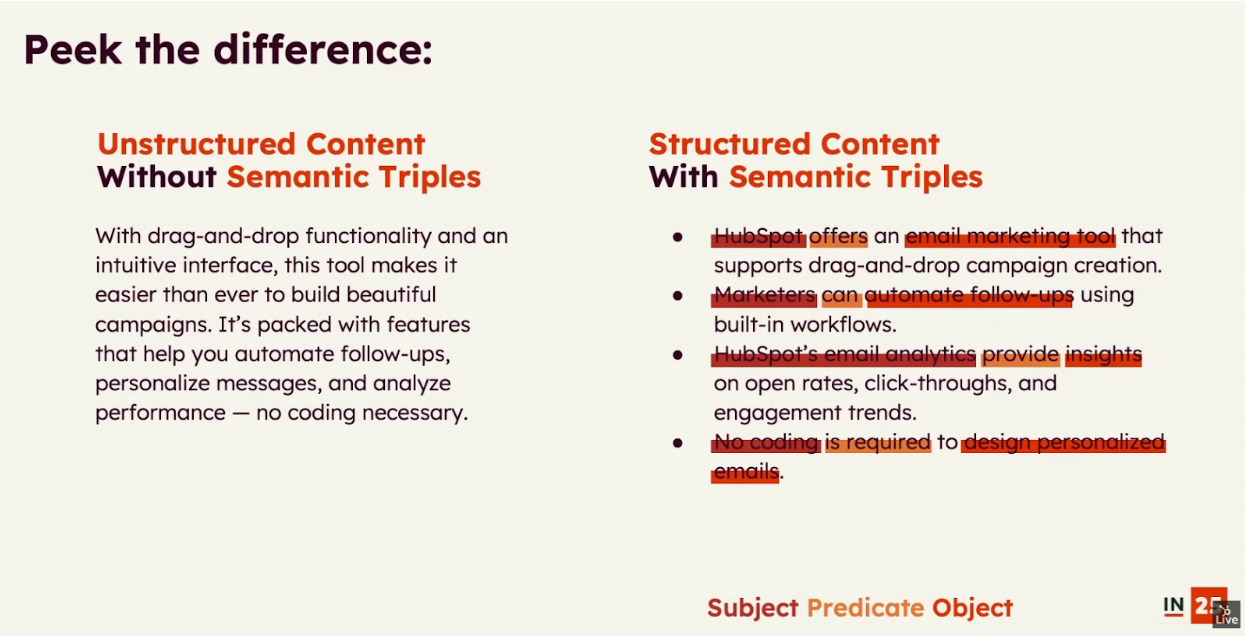
In conjunction with the other “everything bagel” ingredients (like schema, backlinks, etc.), this tactic helped to increase mentions of HubSpot in AI answers by 58%, and the number of times HubSpot pages were cited by AI by 642%.
Now, to some of you, this may just sound like very basic good SEO, and you’re not wrong.
“It’s very important to have a stable SEO foundation to have good LLM visibility. But while semantic triples are beneficial for SEO, they’re necessary for AEO.”
To others, this may sound like really annoying content for a human to read. And you’re not entirely wrong either. Done poorly, semantic triples can read like the overoptimized garbage that dominated early SEO.
Luckily, Sellers offered up some practical tips on how to effectively use semantic triples without effectively alienating your audience.
Triple Tips
1. A little goes a long way.
“We need to find the happy medium between having the content be easily understood [by AI],” and having content that’s still enjoyable for humans to read. With a laugh, Sellers advises using the benchmark, “Would reading this as a human make me throw my phone in the pool?”
Instead of cramming semantic triples all over the page, she suggests tossing in one triple for each core concept along the way.
2. Target humans and bots with the same content.
You might think you could get around the need for the first tip by simply writing separate content for AI engines and for your human audience. Sellers advises against this.
If AI or search engine crawlers discover your human-focused content, they may decide to penalize both pieces of content for being overly similar.
But worse is what happens when your human readers stumble over your bot content. A reputation for crappy content is hard to shake.
“We’re really trying to do a feed-two-birds-with-one-scone approach, because we have a massive readership that actually cares about what we write.”
3. Use answer-first phrasing.
Both humans and bots like to skim, and your content, however amazing, isn’t the exception. Your job is to make sure they can quickly get key information while skimming.
To that end, Sellers recommends using answer-first phrasing.
So instead of a sentence like “According to recent research, pizza is delicious,” you might rewrite it as, “Pizza is delicious, according to recent research.”
A warning: Both human and software editors absolutely hate this. Do it anyway. This is a structure I absolutely insisted on when I was leading the HubSpot Blog’s user acquisition program.
4. Don’t bury the lede.
Similar to putting key info at the front of a sentence, you also want to make sure your semantic triples appear early within paragraphs.
Again, this makes it easy for human skimmers to quickly get the information they’re looking for. But for bots, it’s even more important, because they often take chunks of content out of context.
“Writers need to be conscientious about the order of sentences, so that if an LLM came and took this one paragraph, it’s enough to represent the idea.”
4. Think about mid-funnel and bottom-of-funnel content.
Product reviews, product comparisons, and listicles are all great places to employ semantic triples. Readers expect this kind of content to be simple and blunt, so semantic triples don’t feel out of place.
It’s also a natural opportunity to connect your brand to a product category, to certain features, or even… to your competitors.
“You want your entity to be associated with similar entities. So, for example, we want HubSpot associated with Salesforce or MailChimp. That way, any time an AI engine mentions a competitor, it would be remiss to not also mention us in the same breath.”
How to check your AI visibility using AEO Grader
If you’re not sure where you stand in the eyes of the answer engines, it’s super easy to find out using HubSpot’s free AEO grader.
I sat down to write a How-To for you, and realized it’s so easy it would almost be insulting.
Just plug in four simple answers, and you’ll get ranked in areas like brand recognition, sentiment, and share of voice for the three most common AI search tools. You then have the option of providing your email address to get a detailed report of insights and recommendations.

