


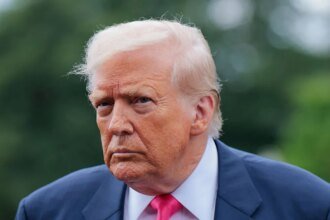


Under President Trump, it’s becoming clear that doing business with China is fine — under the right, lucrative conditions. In a post on Truth Social, the president said this week that his administration will allow Nvidia to sell one of its most powerful AI chips, the H200, to China. The H200 is said to be up to six times more powerful than the H20, the most powerful chip Nvidia had won approval to sell to China.
Washington and Beijing are currently in a tight race to lead AI and robotics research, and are locked in direct competition to apply the technologies in defense and intelligence. The Biden administration and much of Silicon Valley agreed that limiting sales of the most powerful AI chips to China was one lever the U.S. could pull to give it an advantage, and protect its own security. But Nvidia and its ally, AI czar David Sacks, have been lobbying the Trump administration all year to remove restrictions on chip sales to China, whose economy is the second-largest in the world — and a huge chip market.
Now, Trump has been persuaded to sell H200s to China — provided that the chips are routed through the U.S. for a “security review” and that the U.S. gets a 25% cut of the sales. “I have informed President Xi of China that the United States will allow Nvidia to ship its H200 products to approved customers in China and other countries under conditions that allow for strong national security,” the president posted to Truth Social. Notably, the agreement won’t apply to Nvidia’s most powerful chips, Trump says: the new Blackwell GPUs and the forthcoming Rubin GPUs.
The Wall Street Journal reports that Trump’s decision came following a meeting last week with Nvidia CEO Jensen Huang, where they reportedly discussed H200 chip sales. “It’s representative of Trump policy, which seems to be based on whomever was in his ear last and not part of a coherent strategy,” says Alex Jacquez, who was special assistant to President Biden for economic development and industrial strategy at the National Economic Council.
Huang reportedly speaks to Trump regularly. Earlier this year, he talked to the president about selling Blackwell GPUs to China. But when the president raised the issue with his cabinet, the idea was shut down over national security concerns.
In August, Huang agreed to give the U.S. a 15% percent cut in exchange for permission to sell a lower-performing chip, the H20, to China; Xi soon advised Chinese tech companies not to use the chips, citing security concerns.
Coming at a cost
Even factoring the 25% U.S. cut on H200 sales, the agreement is likely a huge win for both Nvidia and China. And the win could come at a cost to the U.S.

