






For over 40 years, “Mac vs. PC” has been technology’s most iconic rivalry. Yet in many ways, it’s been an indirect one. Apple, being Apple, has mostly stuck to computers with four-digit price tags—a rarefied territory where it can make the products it wants to make, not just the ones a given price point allows. Meanwhile, one of the best things about Windows PCs is that there’s something for everyone, including folks who don’t have a ton of money to spend.
Every once in a while, though, Apple does ship something whose identity is defined by its attractive cost. I can’t think of any example more potentially impactful than its latest laptop, the MacBook Neo. It goes on sale tomorrow, in two versions whose prices—$599 and $699—are both unprecedented for a new Apple portable. I’ve been spending a few days with a review unit supplied by the company.
Though the cheapest Windows laptops are still far cheaper, the Neo makes the Mac vs. PC debate relevant to a much wider swath of computer shoppers than before. According to third-party research, the Mac presently accounts for a little under 9% of computer shipments, a share that has grown but not exploded over the past decade. By putting a Mac within reach of more people, the arrival of the MacBook Neo could goose that figure in a way that few other developments could.
Already, the Neo answers a question that people have been wondering about for eons: If Apple were to build a MacBook on a tighter budget, how would it turn out? It’s no shocker that it’s less lavishly equipped than its pricier stablemates, sometimes in totally obvious ways. On the Neo, MacBook features we thought were standard—like MagSafe and a backlit keyboard—aren’t available at all.
But even if the MacBook Neo is a tad basic by Apple standards, it retains the overarching virtue that makes a MacBook a MacBook: niceness. In no way does it look or feel like a cheap laptop. The attributes that shape the experience most—screen quality, keyboard and trackpad comfort, audio fidelity—retain a premium feel. MacOS has sufficient processing power from the A18 Pro CPU (formerly an iPhone Pro chip) and 8 GB of RAM to perform everyday tasks well.
There are certainly competent Windows laptops in the same price range as the MacBook Neo, many of which have more storage, larger screens, or features wholly unavailable on a Mac, such as touchscreens. Niceness, however, is harder to come by in Windowsland—especially since plastic, rather than the Neo’s aluminum, is the case material of choice. The Neo’s closest counterpart might be Microsoft’s 13″ Surface Laptop, but it’s a $900 computer, not a $600 or $700 one.
Different yet familiar
When Apple offers multiple variants of a product at different price points, the dividing lines can get murky. For example, the iPad Air—which I think of as the iPad Almost Pro—starts at $400 less than the iPad Pro. But it tops out at $1,099, which is $100 more than the base Pro.
By contrast, the MacBook Neo is not a MacBook Almost Air. With a price differential of $400 between the most expensive Neo and cheapest Air, there’s no way it could be. I can’t imagine many people who can reasonably afford a MacBook Air opting for a Neo on the grounds that the differences between the two computers are insignificant. That’s probably good news for Apple, which would not benefit if MacBook Air buyers migrated en masse to the Neo.
Then again, Apple smartly didn’t go out of its way to make the Neo feel like a lesser computer. It’s slightly chunkier than the smaller Air model, and its 13″ screen shaves off .6″ of display real estate, which is enough to notice without turning the Neo into a mini-laptop like the old 11.6″ MacBook Air or 12″ MacBook. But the 2.7-pound weight is identical to the 13.6″ Air, the industrial design is comfortably familiar, and the claimed battery life—up to 16 hours—is only a little less epic.
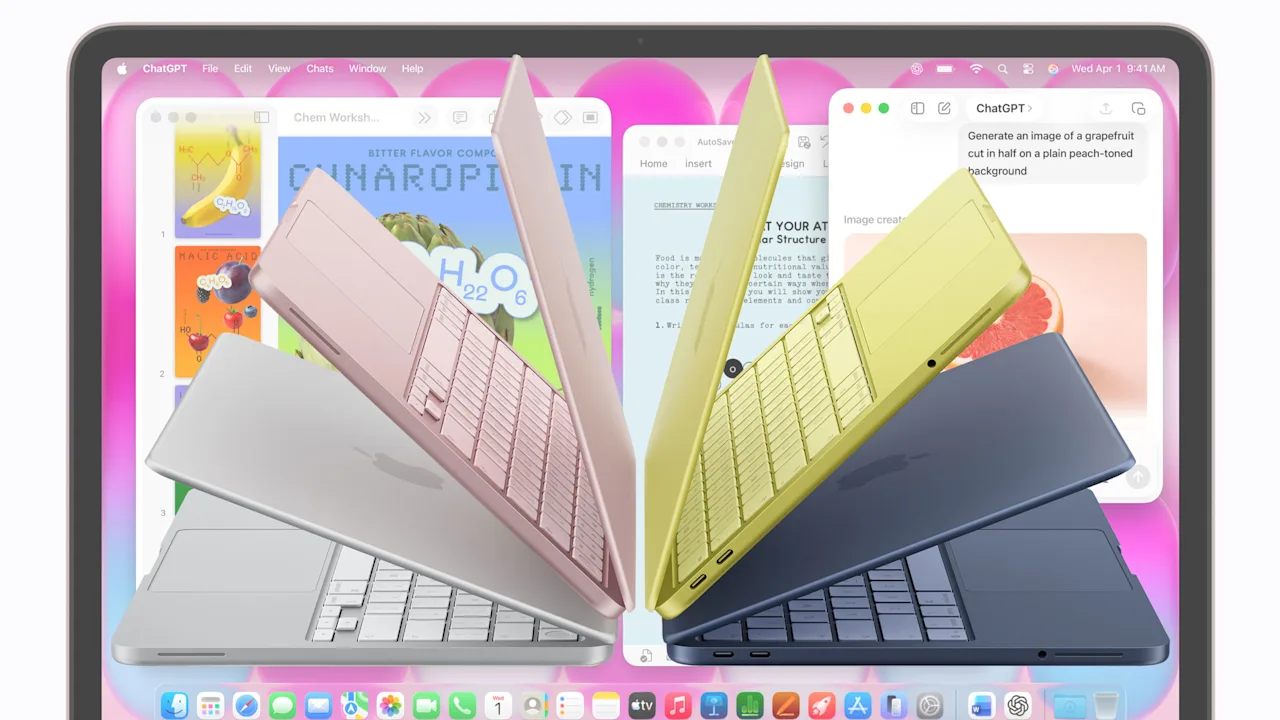
The big differences are visual: The Neo comes in a slightly more playful selection of colors, with matching almost-white keyboards rather than the Air’s black one. My review unit is “Citrus,” which seemed to vamp between being a pale yellow and various subdued shades of green depending on lighting conditions.
When it comes to features and tech specs, Apple appears to have worked its way through a list of the MacBook Air’s capabilities and asked itself: Which of these might a relatively casual, cost-conscious user be willing to live without, or maybe not even notice is missing? For example, the Neo’s display, though pleasing, lacks advanced features such as True Tone technology, which adjusts color temperature on the fly. The Neo uses an older version of Wi-Fi, and one of its two USB-C ports runs at only USB 2.0 speed, a 26-year-old standard. It lacks MagSafe charging and has a camera that doesn’t support the Center Stage subject-centering technology.
These all strike me as eminently sensible compromises to grind down the Neo’s component costs. I was, however, bugged by the absence of Touch ID on the $599 unit I tried. Reacquainting myself with the need to type my password again and again wasn’t fun, and I kept absent-mindedly jabbing at the key where the Touch ID sensor would be if it were available. (The $699 model adds the feature and doubles the storage to 512 GB.) As someone who spends too much time computing when I should be sleeping, I also winced a little at Apple’s decision to omit keyboard backlighting.
Of course, you may have an entirely different set of items you deem essential or utterly dispensable. Apple was never going to please everyone. But it’s struck a reasonable balance, and given itself a few logical ways to upgrade any future generations of the Neo that may come along.
As for what it feels like to run macOS on a laptop with a smartphone-class chip and a modest amount of RAM, Apple seems to have provided the MacBook Neo with sufficient oomph to get by. I’ve been using a bunch of apps I depend on for real work, such as Microsoft Teams, Airtable, Microsoft Excel, and Hey email. I also performed some light image editing in Photoshop. The Neo was never overwhelmed. If I’d tried to push it to its limits, it might have been—but if you’re the kind of person who’s likely to push a computer to its limits, the Neo is not for you in the first place.
The Neo may also not be ideal if you’re the type of person who thinks of a new computer as a long-term investment. Typically, I recommend that people buy machines they can grow into, with a bit more RAM and storage space than their present needs absolutely demand. The $699 Neo’s 512 GB of storage is worth the $100 premium, but neither version provides much headroom for tomorrow’s needs. If Apple comes up with some sensational Apple Intelligence feature a few years hence—one involving AI that runs on-device—will the Neo be able to handle it as well as an Air, or at all? I’m not sure, and Apple might not be, either.
Overall, though, the MacBook Neo is one of Apple’s best recent products, even though its innovation is all about thoughtful cost control, not new features. Along with being a compelling option for anyone shopping for a laptop in its price range, it’s the perfect Mac for kids and other loved ones who might otherwise have inherited a dented, poky hand-me-down. I would not be startled to see it fly off shelves.
If it’s a hit, makers of Windows PCs will surely take notice. Historically, they’ve done some of their best work when they’ve felt Apple’s competition most keenly, which is one reason why Windows laptops magically get slicker when they hit the MacBook Air’s price zone. Similarly, the Neo’s influence could lead to more polished Windows portables in the $600-$700 range. It would be a win for everyone concerned if the whole category got a little less plasticky and a little more, well, nice.

