





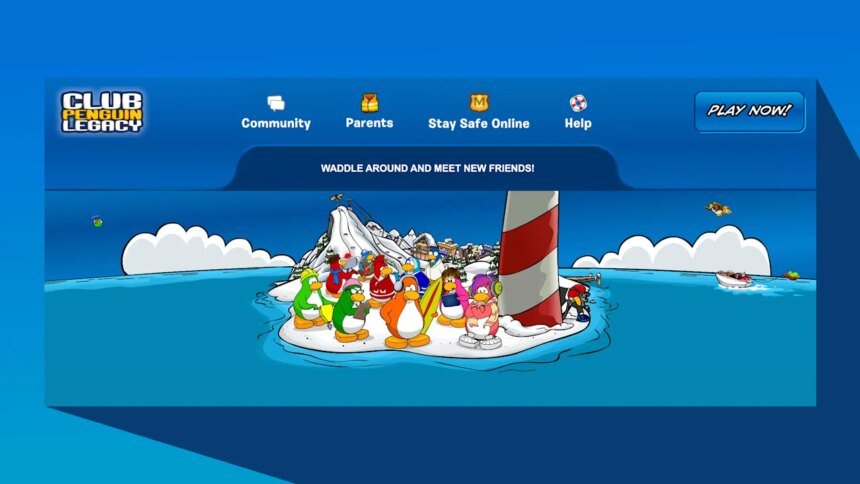

For many tweens of the 2000s, Club Penguin was the place to be. Players created penguin avatars, dressed them up, and roamed a virtual world of igloos, ski lodges, and mini-games. There were puffles, Tamagotchi-like pets to care for, and bustling servers where you could chat with friends, surf through a mine, or lob a virtual snowball at a stranger. At its peak, the game drew hundreds of millions of users and offered an early taste of social media for a generation of kids.
Disaster struck in 2017, when Disney, which owned the platform, shut it down, citing declining popularity and falling revenue. The company pointed users to a new game, Club Penguin Island, but that, too, was discontinued soon after. Since then, several attempts have been made to revive the Antarctic metaverse. Club Penguin Online was eventually overrun with racist and antisemitic content, while the unsanctioned Club Penguin Rewritten surged during the pandemic before being taken offline, leading to arrests in London.
Still, Club Penguin hasn’t disappeared. A volunteer team of coders and moderators now runs Club Penguin Legacy, which has been online for more than four years. Fast Company spoke with two members of that team, who say they’re focused on preserving both the nostalgia and the safety-first moderation that defined the original. Today, their labor of love supports roughly a million users.
“We want to honor what made the game so meaningful when we were growing up playing it. So, you know, trying to honor how the game felt, how people interacted, and the community that it created,” Karalyn, a director and developer for Club Penguin Legacy, tells Fast Company. “We’ve always been adding new events, parties, and other content.”
This interview has been edited for length and clarity.
How did you get into this?
Karalyn: I joined the team back in January of 2023; I was the director for the game in 2024 and 2025. I have a degree in electrical engineering, but do software engineering as my main goal.
Mey: I joined the team in January 2024 as a developer, and ended up in more of a lead developer role later that year. I am self-taught with programming and most of the skills that I use on this team, but I’m really proud to be part of it and happy to be here.
Is this your full-time job?
Mey: For both of us, it’s definitely close to a full-time job. It’s not our main job, so it is more of a labor of love, but it’s something that we definitely put a lot of time and effort into. We have about 15 people. It’s a slew of moderators, designers, software engineers, community support representatives.
How do you go about bringing an old game like this back to life?
Karalyn: For the technical aspect, it’s not just creating the same gameplay and creating that same game engine. You have to think about actually having it ready for production and having it ready to serve a whole bunch of users. If somebody wanted to re-create it . . . you have to have the core mechanics for the game. There’s a lot of talented engineers out there that I’m sure can kind of reverse engineer how to do something like that.
Because Club Penguin emphasized safety so much, that was something that was one of our top priorities. So having a whole team of moderators to ensure safety in the game was something that you had to think about as well. It’s not just the actual code that has to be engineered, but like the whole production of what they were doing. A lot of us grew up playing Club Penguin. We were fresh home after school to log in and explore this exciting, magical world. It wasn’t just a game. It was more like a community. And so I think when the original shut down and that space disappeared . . . there are not that many spaces that are balancing simplicity and safety and social connection.
Mey: It really depends on the scale of the game. Our game is a world with over a million users, with over a thousand people at times playing together. But some games out there are, like single-player, very simple, and there are a lot of tools, even for hobbyists, to kind of tackle that level of game.
How does this stay afloat? Do you take donations?
Karalyn: We don’t actually take any money from our community. It’s entirely self-funded. We’ll never ask people to pay. There are no advertisements, no memberships, nothing like that. It’s completely free to play. We try to keep it pretty lean. We have a small team, and we’ve had to make infrastructure improvements in order to continue to stay lean and reduce operating costs so that we can still serve the thousands of players that we’re seeing daily.
How many users are people who played the original versus those who are coming to this for the first time?
Karalyn: We definitely see a mix of players. I think it highlights what Club Penguin Legacy is doing right. Because on one side, you have people who grew up with the original game, and they know the nostalgia, the familiarity, the comfort, and they are familiar with that lore that we have. And then we also have a good mix of people who never experienced the game before, but they’re here because the game offers them a sense of connection, escapism.
How much time are people spending on Club Penguin Legacy? How long does a typical session last?
Karalyn: Some people want to log in. They want to do their daily tasks. They got to feed their puffles. They want to check out the catalog and see if there’s anything new. But for a lot of people, they will stay on for an hour or two, chatting with friends, catching up, and just kind of remembering that sense of community.
Mey: It’s kind of nice to go into our game and see the same faces day after day, like you can join pretty much any time of the day and see some people sitting around town talking. There’s a lot of our core community that really just kind of has it as a social tool in the background for them.
Do you know how many puffles are still alive on Club Penguin Legacy? People are going to read this who played the original and wonder what happened to their puffles.
Mey: There are currently 213,749.
Meta seems to be giving up on the metaverse. OpenAI is shutting down Sora. It’s interesting that a lot of platforms die, but Club Penguin is surviving.
Mey: Our game is a metaverse of sorts, for sure. For a lot of other kinds of platforms, there’s one thing we have over them, which is that they didn’t have their start in 2005, 2008. They don’t have that strong background that we get to fall back on. A lot of them are having to keep up with new trends and new changes in what’s popular and what makes sense, like AI.
A lot of people, like a lot of our older players, obviously, are willing to stick with it for what we already have. And I think a lot of our newer players come in and recognize that they don’t have to worry about us suddenly changing and then losing something that they found.

