



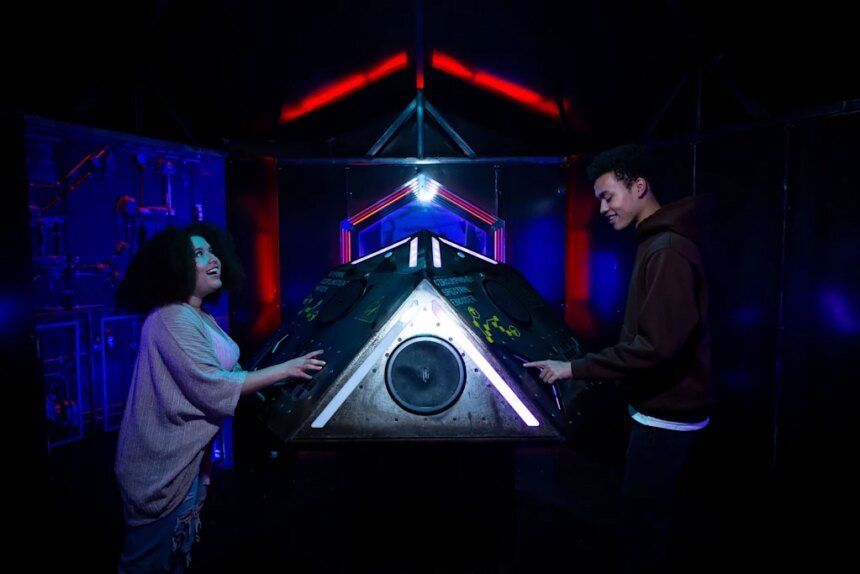

When the art collective Meow Wolf opened the doors of its very first immersive exhibition, House of Eternal Return, on March 18, 2016, it had roughly 100 employees, less than $1,000 in its corporate bank account, and a dream. Ten years later, the company employs more than 1,000 people, operates five permanent exhibitions (with two more on the way), and has welcomed more than 13 million visitors.
Meow Wolf’s early history reads like a tale of cosmic fortune: In 2008, a group of New Mexico-based artists got sick of the local art establishment; founded their own collective to host parties, rock shows, and art installations; and eventually parlayed that experience into a series of massive, surrealist fun houses backed by A Game of Thrones author George R.R. Martin.
As of 2022, Meow Wolf had amassed more than $200 million in investment capital. The company has undergone two rounds of layoffs since then—one in April 2024 and another in December of that same year—while moving forward with plans to expand its exhibition footprint. Meow Wolf declined to share current investment figures or annual revenue totals with Fast Company.
Plenty has already been written about the whirlwind of those early days. But now, looking back on it all, it’s become clear that Meow Wolf represents something much bigger than the sum of its trippy, psychedelic exhibitions. The company presaged, and in some ways kick-started, the boom of the “experience economy,” a concept business strategists Joseph Pine and James Gilmore invented in 1998 to describe a shift in consumer desire from goods and services to more intangible “experiences,” like adventures, sensations, and memories.
The experience economy is no longer a theory; it’s a flourishing business: Everyone seems to be cashing in, from the inflatable art-centric Balloon Museum to the golf-meets-art-meets-cocktails establishment Swingers and the recent immersive production of The Phantom of the Opera.
In 2022, the immersive entertainment industry was valued at more than $61 billion. In 2025, consulting firm Grand View Research more than doubled that figure to nearly $138 billion, projecting the sector will be worth a whopping $1.024 trillion by 2033. In other words, the experience economy has officially hit the mainstream.
Now, according to Vince Kadlubek, one of Meow Wolf’s original founders and its current “chief vision officer,” another big shift is coming. He believes that nascent tech and younger generations are kick-starting the “transformation economy”: the final step in Pine and Gilmore’s theory, wherein consumers are seeking not just an experience, but a personal, emotional, or spiritual outcome. They want to participate in something, and to be changed. Meow Wolf, Kadlubek says, has a plan to be ahead of that curve once again.
I sat down with Kadlubek to discuss Meow Wolf’s 10th anniversary and what’s next for the experience economy. In our conversation, he shared:
- What makes Gen Z and Gen Alpha seek different experiences
- What Meow Wolf believes is the next big play
- How Meow Wolf is doubling down on the physical world in the era of AI
- What to expect in the transformation economy
Meow Wolf may have already forged an impressive brand story, but if Kadlubek has anything to say about it, the best is yet to come.
“I think that we’re on the precipice of being able to have a next-generation storytelling ecosystem that is one-of-one in the world,” he tells me. “It’s crazy for me to say that, but that’s what the goal’s always been, and we’re literally on the doorstep of being able to achieve that.”
Why digital natives are natural sleuths
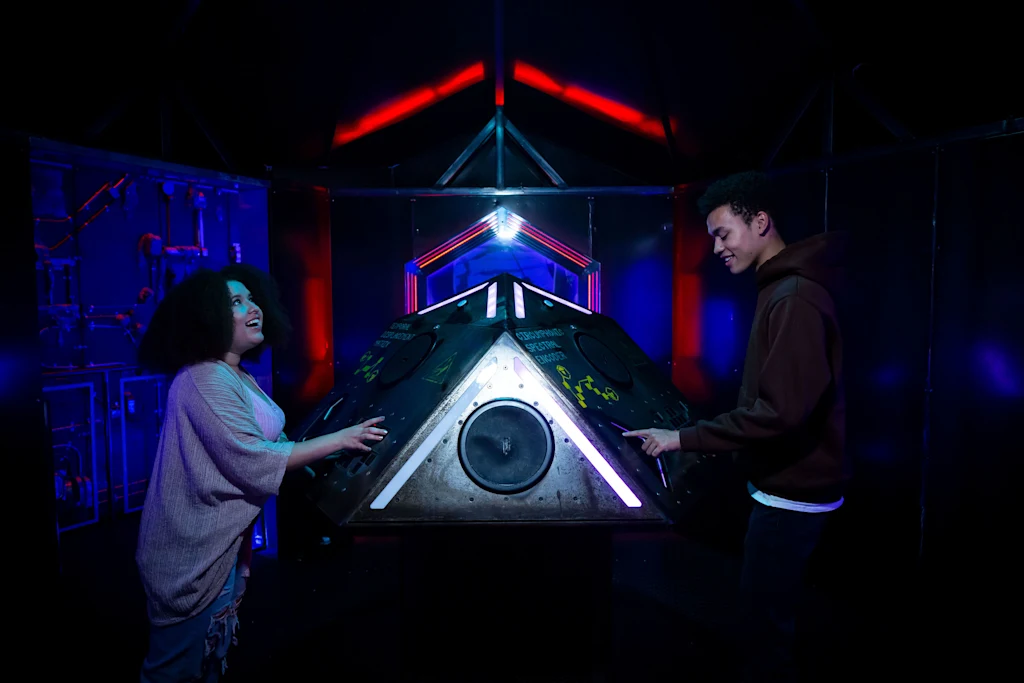
At Meow Wolf’s Denver exhibition Convergence Station, visitors can hunt for tiny pink clues hidden in darkened nooks and crannies. They’re following a trail of breadcrumbs left by the station’s genetically modified rat boss, Plotzo, to break into a secretive “pizza vault.” Anyone who manages to successfully follow the crumbs gains an access code that allows them into the vault, where they’re greeted with angelic music and an open pizza box, containing a note from Plotzo himself, resting on an elevated plinth.
This may sound like a game of Mad Libs, but for followers of the Meow Wolf universe, it’s more likely to sound routine. In dedicated Reddit forums, Facebook pages, YouTube videos, and on Meow Wolf’s own website, fans have dedicated hours of their time to understanding each of the exhibition’s worlds, their characters, and how they might overlap.
According to Kadlubek, when House of Eternal Return opened in 2016, the team incorporated a few Easter eggs and rabbit holes for visitors to follow. But for the most part people were more inclined to simply observe the various psychedelic artworks and pose for pictures in their favorite spots. As Meow Wolf’s target audience has shifted to include a greater percentage of Gen Zers and Gen Alphas, though, those behaviors have shifted. One might expect for a post-TikTok-era audience to be even more inclined to whip out their cellphones in exhibitions—but Kadlubek says something much more interesting is happening: Young Meow Wolf fans want to dig into the lore.
“I think with these younger generations, Easter egging and questing and lore hunting is just part of how their brain develops. . . . It’s like a native aspect of how they perceive the world,” Kadlubek says. For millennials and Gen Xers, he continues, it’s hard to even comprehend the experience of growing up with the internet at your fingertips, whereas growing up with conspiracy theory media, YouTube rabbit holes, and niche Reddit forums has primed digital natives to act as self-motivated sleuths. They’re used to following any thread of information to its logical end point, and they’re seeking that out at Meow Wolf.
That shift requires a strong story.
Why Meow Wolf is investing in the lore
As Meow Wolf’s physical presence has expanded over the past several years, the collective’s lore has morphed into something like the exhibitions themselves: a layered, wacky tangle full of unexpected details.
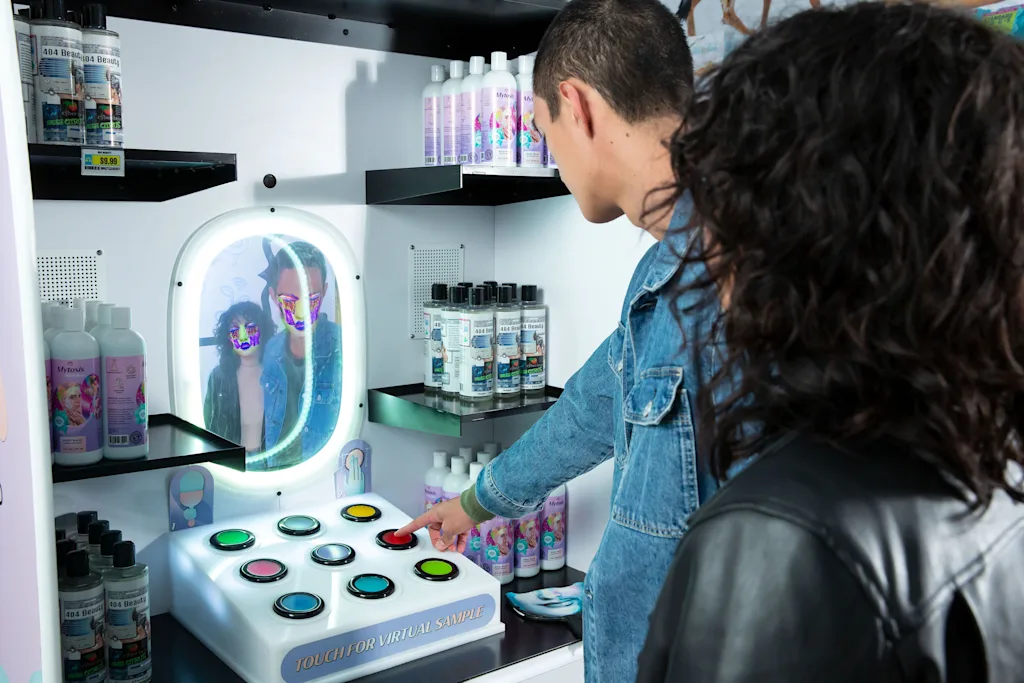
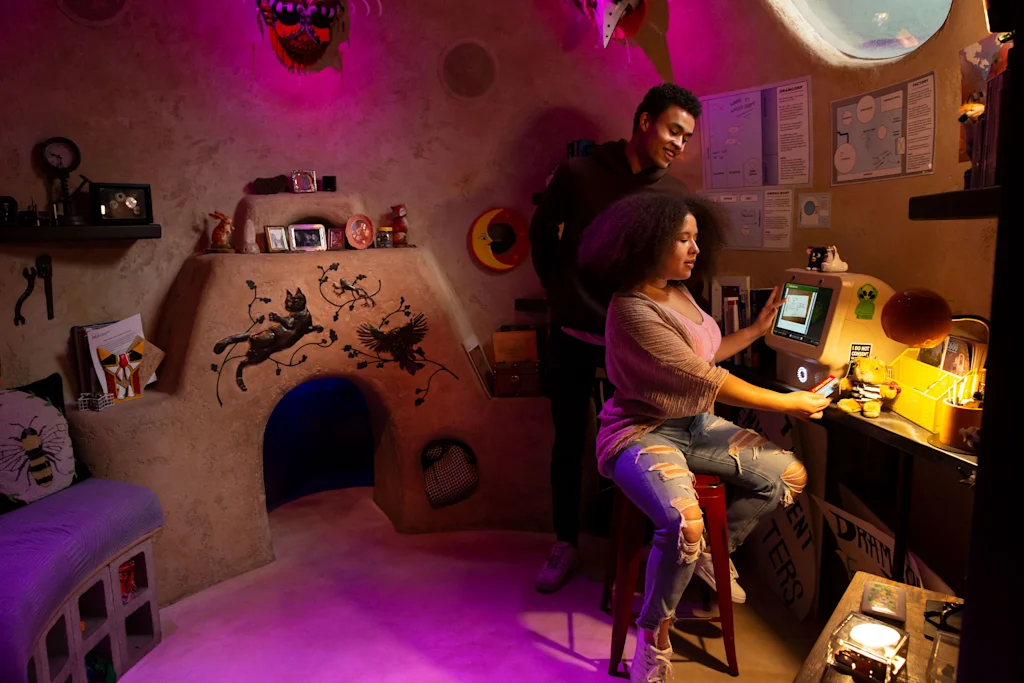
Each Meow Wolf location operates with its own world and theme—a haunted Victorian mansion, a radio station full of strange characters, and a surreal supermarket, to name a few—but they’re tied together by certain characters and story threads that make them part of one interconnected multiverse. Every time a new exhibition is added to the portfolio, Kadlubek says, it’s a new opportunity for the team to draw its younger audience in with a bigger, more nuanced story.
In the past, Meow Wolf fans have engaged with this story in online groups and through small scavenger hunts at the exhibitions. Recently, though, the Meow Wolf team has moved from passively inviting visitors to conduct their own Easter egg hunts to actively facilitating them. Over the past couple of years, they’ve been prototyping something called “questing” at the company’s Denver, Dallas, and Houston locations.
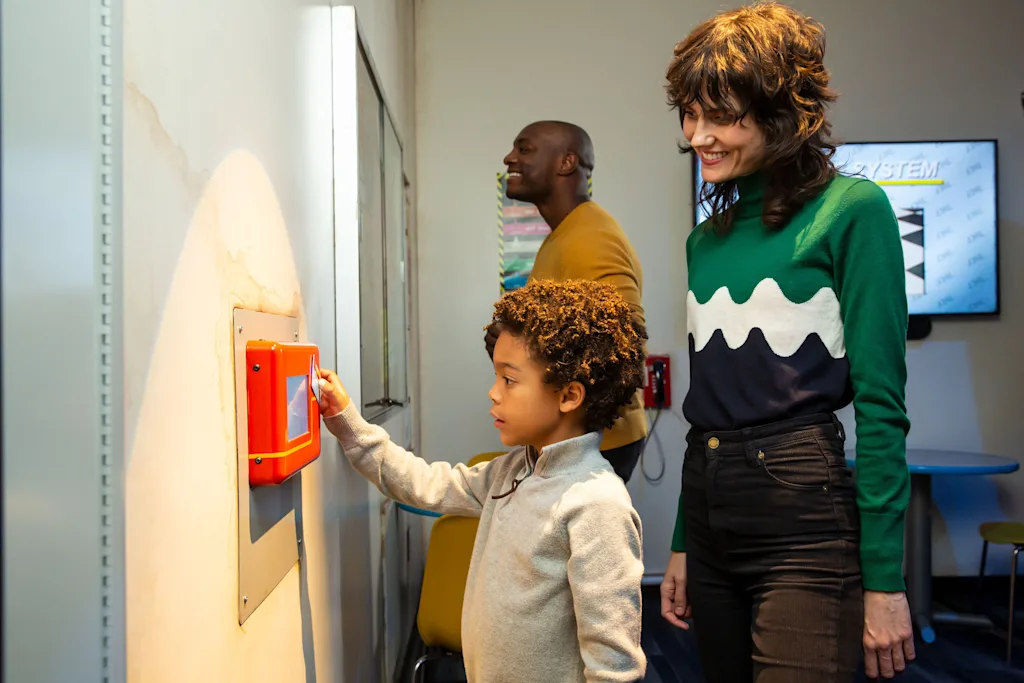
Questing essentially gives fans a way to act as “players” in the Meow Wolf-verse. They log into a web app that guides them along a journey with around 10 interconnected puzzles and codes to decipher. Each step of the way, players’ phones serve as a road map; everything they’re actually doing—from sifting through cryptic documents to placing a phone call on a pay phone or plugging in a broken kiosk—is located in the physical world. Once they’ve solved the quest, they’re rewarded with a response from the exhibition, like access to a pizza vault-esque hidden room.
This approach encapsulates Meow Wolf’s stance on incorporating new tech in its immersive experience: Devices should always point the visitor back to the exhibition, not the other way around.
“We don’t want people to just be looking at their phones,” Kadlubek says. “The phone is there as a pause screen, in video game terms. Sometimes you have to press pause and look at the map, your inventory, and the next step on the quest, but you don’t always want to be pressing pause on the pause screen. You want to be in the game.”
Kadlubek says the team is currently working to make quests more embedded at its existing locations. And for its upcoming spaces—one in Los Angeles, opening in late 2026, and one in New York, opening in late 2027 or early 2028—quests have been built in from the very beginning. Little has been revealed about the storylines of the two new exhibitions, but Kadlubek says the L.A. plotline will focus on a character who has traversed the multiverse, letting fans begin to make sense of some of the lore that links every exhibition into one mysterious story.
Why the physical world matters even more in the AI era
Beyond questing, Kadlubek has even loftier goals for the future of Meow Wolf’s interactivity. In June 2025, the company announced a collaboration with Niantic, the company behind Pokémon Go, to test how augmented reality might be implemented within exhibitions. Kadlubek wants to establish hyper-accurate location services to allow the physical world to respond to a player’s position—like by playing a video just for them on one of the exhibition’s embedded TV screens, for example.
The Niantic partnership is also a component of an initiative called “Beyond the Walls,” which aims to move some of Meow Wolf’s magic outside its exhibition spaces and into the real world (it’s unclear exactly what that might look like, though Kadlubek hopes it will involve actual art objects in the natural environment, not just digital interventions). The team is also working on a physical board game and a graphic novel in the Meow Wolf universe.
Even when it’s dabbling in AR, Kadlubek says Meow Wolf’s focus will always be on directing its players back to the real world. In the age of AI, investing in physical experiences over digital add-ons might seem like a gamble. Kadlubek believes it’s Meow Wolf’s biggest strength.
“In a landscape where traditional media is having a really difficult time finding its footing and finding where the business model is, and AI is this huge existential threat to all digital content creators, I think we’re really lucky to be building in the physical realm,” Kadlubek says.
He sees AI content as a fundamental issue of supply and demand. When AI can produce an infinite amount of content, he argues, it will begin to lose all meaning and value. The physical world, on the other hand, “will always be novel, because AI is not going to be able to touch it—and novelty is where value is.”
What to expect in the transformation economy
Over the past few years, Kadlubek has watched Meow Wolf’s visitors signal that they don’t just want to be visitors in the Meow Wolf-verse; they want to become part of it. He sees this shift as a sign that the experience economy is giving way to the transformation economy. As it turns out, Pine, one of the strategists behind the original term, agrees.
In an excerpt from his new book, The Transformation Economy, published on February 3—nearly 30 years after he invented the concept—Pine announced, “The transformation economy is here. . . . Now the economy is shifting from experiences to that final offering, transformations. From creating memories to achieving aspirations. From ephemeral events to lasting change. From time well spent to time well invested.”
Meow Wolf’s intense investment in its lore and interactivity is anticipating that consumer desire for a deeper purpose. Its new questing layers are designed to elevate fans from visitors to players. As more players continue to flock to the experience economy sector, Kadlubek believes that investment in lore will set Meow Wolf apart.
“We know that there’s a lot of immersive experience, and pop-ups, and short-term experiences these days, and a lot of them are pretty cheap, just to be frank,” Kadlubek says. He clarifies that he’s okay with that; in any medium, there’s bound to be a range of different expressions. But Meow Wolf is looking to create a premium experience.
“We want to create experiences that are truly awe-inspiring, and that I think hopefully becomes a distinction for us,” he says. “People will start to be like, ‘Yeah, these are all immersive experiences—but Meow Wolf is this whole other level.’”

