



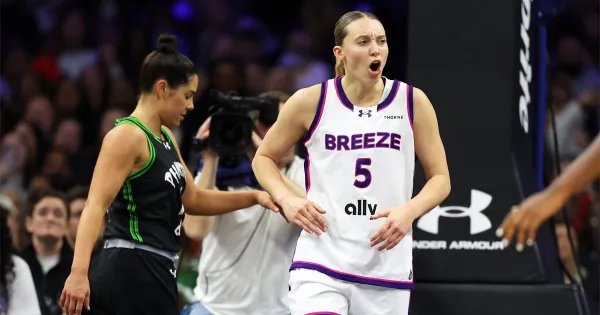

Women’s sports investment is growing, and it’s scoring big for advertisers.
In a new “Women’s Sports Playbook” report from WPP Media, in partnership with EDO, Adverteyes, and VideoAmp, which aims to be a guide for brands to invest in women’s sports, the companies reveal that recent ad growth in women’s sports is driving results. That includes finding a 79% year-over-year increase in ad impressions for women’s sports and 20% higher engagement with ads than on non-sports broadcast and cable.
Showcasing the impact, while analyzing ads from major brands, the report found that Ally Financial’s ads delivered 85% higher engagement when aired during women’s sports compared to broadcast and cable average outside of live sports.
“What it illuminates is what we have been saying for the last five years that we’ve been heavily investing in women’s sports, which is that this is good business,” Andrea Brimmer, CMO, Ally Financial, told ADWEEK. “It makes exceptional sense as a marketer, and it drives really accretive business results. And I think that a report like this brings the receipts.”
And those receipts are leaving an impression.
According to the report, investment in women’s sports is estimated to be up nearly 70% year over year, with the total spend reaching about $127 million. Meanwhile, ad airings have increased nearly 30% to nearly 30,000.
Additionally, audiences watching women’s sports are especially attractive to advertisers, as fans overindex for households with incomes of $200,000 or more. Meanwhile, reaching those audiences authentically with athlete-led, human, and culturally aligned creative drives higher emotional engagement, attention, and brand recall than generic creative, the report states.
Martin Blich, executive director and U.S. head of sports partnerships and investment, WPP Media, said the report comes on the back of WPP’s previous pledge to double client investment within the women’s sports marketplace, a pledge it made and quickly surpassed in 2024.
“This is about taking what was, three plus years ago, a cultural movement, and now, lending credit to the fact that it is one of the highest growing performance environments within media,” Blich said.
Getting in the game
Interestingly, as the women’s sports marketplace grows, it also brings out the competitive side of brands.
“On one hand, I’m really happy about it,” Brimmer said of the increase in brand interest. “On the other hand, it’s going to be difficult for those of us, like Ally, State Farm, AT&T, and Google, who were the early investors, because we’re going to get priced out of things that we’ve historically held onto.”
Of course, Ally isn’t going anywhere and continues to make strides in newer women’s sports leagues, recently teaming with Scripps Sports to bring the Professional Women’s Hockey League’s first-ever nationally televised game in the U.S. on March 28.

