



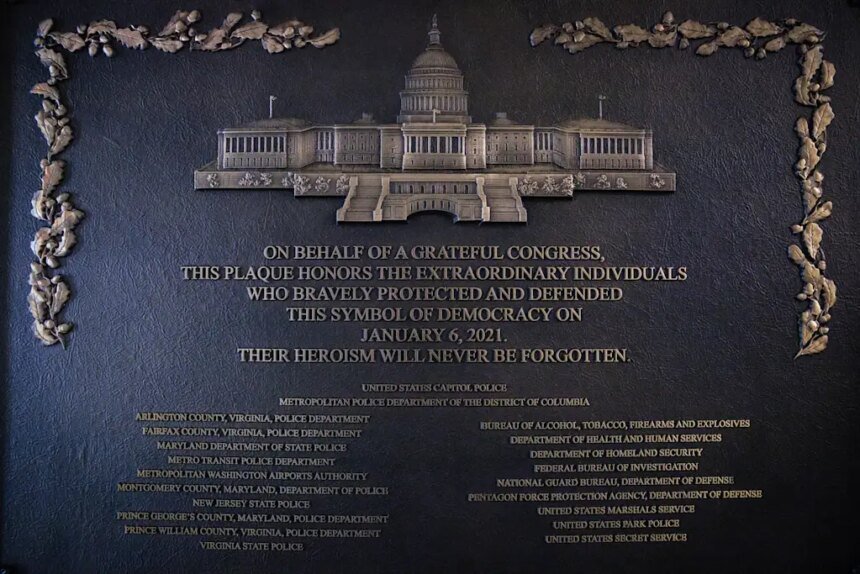

In March 2022, Congress passed a law mandating that, to commemorate the law enforcement officers who responded to the attack on the U.S. Capitol on January 6, a plaque needed to be placed on the western front of the Capitol building listing each of the officers’ names.
The law stipulated that this plaque should be up within a year. As of early 2026, though, the finished plaque was collecting dust in the depths of the Capitol’s basement next to a pile of tools and maintenance equipment.
For the past three years, the plaque’s future has become caught up in a game of partisan cat and mouse. After leadership in the House shifted to Republicans in 2023, multiple Democrats claimed that House Speaker Mike Johnson purposefully stalled the plaque’s installation. Johnson failed to give the go-ahead for its installation to the Architects of the Capitol, the steward of the Capitol building that was charged by Congress with commissioning and mounting the plaque. These delays continued for so long that two of the officers involved in the attack, Harry Dunn and Daniel Hodges, sued the Architects of the Capitol last summer.
Finally, on March 7, the plaque went up—albeit inside a hallway without public access—and it was all thanks to one clever design add-on: a tiny QR code.
A commemorative plaque gets caught in design drama
Before the plaque finally made its way to the Capitol, most Democrats who spoke on the matter were of the mind that Republican leaders were strategically delaying its display as much as possible. Oddly enough, Johnson tried to refute these claims by shifting the blame onto the plaque’s actual design.
Back in May 2025, House Minority Leader Hakeem Jeffries said in a news conference that the reason for the delay was that Republicans, “directed by their puppet master Donald Trump, have been told, ‘Try to erase January 6 as if it has never happened.’” But in an interview with PBS on January 6, a spokesperson for Johnson said that the plaque could not go up “because of logistics,” claiming that they had not found a way to fit the 3,000 officers’ names onto the plaque.
Presumably, Johnson’s team was referring to the original language of the March 2022 law, which stated that the Architect of the Capitol’s plaque needed to list the names of “all of the officers of the United States Capitol Police, the Metropolitan Police Department of the District of Columbia, and other Federal, State, and local law enforcement agencies and protective entities who responded to the violence that occurred at the United States Capitol.” This constraint, they appeared to argue, made the project “not implementable.”
“Honor is a social—that is, public—recognition”
But Johnson’s hesitance to approve the plaque’s installation was ultimately overridden in early January, when Senators Jeff Merkley and Thom Tillis helmed a resolution ordering the plaque’s display, which was passed unanimously in the Senate.
When the plaque finally did make it to the walls of the Capitol, the Architects of the Capitol addressed Johnson’s design concerns with a simple fix: a tiny QR code, set in its own frame next to the plaque, that links to a list of all of the officers present on January 6. According to a report from The Washington Post, that list goes on for 45 pages.
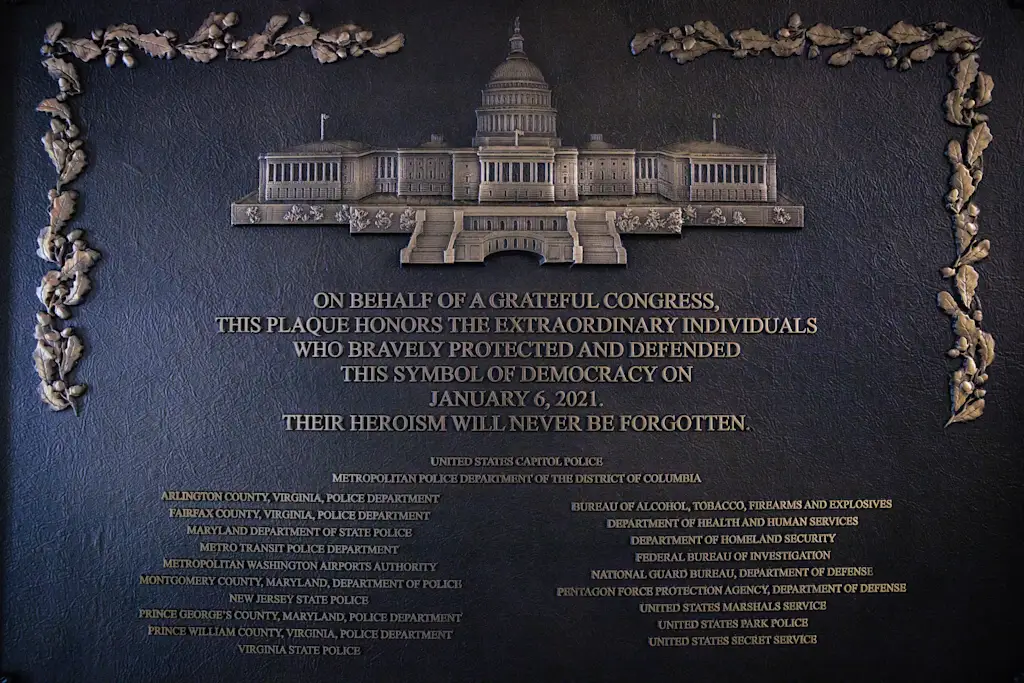
[Photo: Getty Images]
The plaque itself is a fairly small bronze rectangle that includes an image of the Capitol building with the phrase, “On behalf of a grateful Congress, this plaque honors the extraordinary individuals who bravely protected and defended this symbol of democracy on January 6, 2021. Their heroism will never be forgotten.” Beneath it is a list of the law enforcement departments who lent their help during the attack.
For the two officers who sued the Architects of the Capitol, this outcome is too little, too late. “This is a fine stopgap, however they are not yet within full compliance of the law and the weight of a judicial ruling would help secure the memorial against future tampering,” Hodges wrote on Twitter. “Our lawsuit persists.”
On March 10, Hodges and Dunn filed a motion asking a judge to allow their lawsuit to proceed. The document argues that the plaque, which was hung inside a pair of Capitol doors, should’ve been affixed to the exterior of the building per the original law, and that its current location keeps it out of the public eye.
“Honor is a social—that is, public—recognition,” the filing reads. “Hidden from all visitors, the current location is no different than the basement the plaque was kept in for years.”

