




Warren Buffett drinks five cans of Coke a day, not as a brand exercise, but because at the age of eight, he tried his first Coke and never really stopped thinking about it. He declared Cherry Coke the official drink of the Berkshire Hathaway annual meeting. Berkshire owns 400 million Coca-Cola shares worth north of $20 billion. None of it feels like strategy. It feels like a man who loves his product and has never once had to pretend.
Buffett works as a brand ambassador for the same reason Kempczinski does not: his consumption is entirely unconditional.
He doesn’t drink Coke because he owns shares. He owns shares because he drinks Coke.
Akio Toyoda didn’t just drive his own product—he raced it. Every summer, he would disappear to the Nürburgring and compete in the 24-hour endurance race as “Morizo,” because Toyota’s leadership considered the whole enterprise an embarrassing distraction.
There was no factory support, and no official entry. He sourced a second-hand Toyota Altezza, modified it himself, and lined up against development cars from Porsche and BMW. He was overtaken by all of them, repeatedly. Later, he described the humiliation of competitors screaming past him as a defining experience in his leadership journey, and the start of the re-invention of Toyota’s performance division.
Contrast that with Mark Zuckerberg. In 2016, a photo of his MacBook emerged showing his laptop camera and microphone jack sealed with masking tape. This is the CEO of a company that built its entire business model on the premise that sharing your life with the world is natural—a company that faced congressional hearings over surveillance concerns.
Those little slices of black tape said everything that Zuck’s testimony didn’t. What Zuckerberg the CEO does at work differs from what Mark gets up to when he heads home.
There’s a simple brief to any CEO suddenly confronted with that most dangerous of things: their own product. Consume it.
Not once a quarter for a comms team. Regularly, privately, like a normal human being. Eat the burger. Drink that soda. Drive the car. Because in that moment, your product isn’t telling you something about your company. It’s saying something about you.
Buffett and Toyoda built great companies partly because they closed the distance between their lives and their products. It made them better leaders.
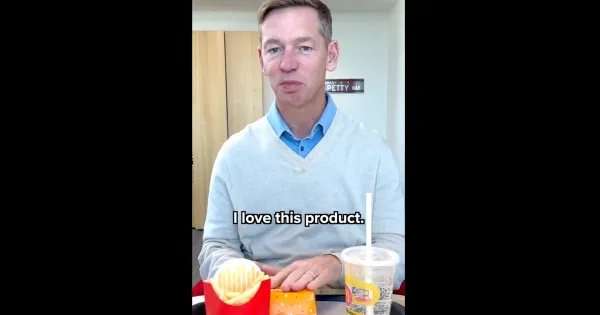
Let’s rewind the tape. Same burger. Same CEO. Different version.
Kempczinski opens the box. He doesn’t describe it. He doesn’t call it a product. He says three or four lines. Then he picks it up with both hands—because that’s what you do with a Big Arch—leans forward slightly so the sauce doesn’t hit his shirt, and takes a proper, committed, three-inch bite. He chews. He doesn’t perform the chewing. He just chews.
Maybe he says something, maybe he doesn’t. He doesn’t wave it around. He doesn’t talk about “this thing” like he’s handling evidence. The video ends with him nodding, half the burger still in his hand. It’s the kind of nod that says this is good. That this is all getting eaten. That he wants to be nowhere else than right here, right now. Running McDonald’s, eating McDonald’s. CEO and product in perfect harmony all from one single bite.

