




The job of a headline is to draw attention to the article beneath it. When a headline instead draws attention to itself, it feels as wrong as a carnival barker cursing out passersby.
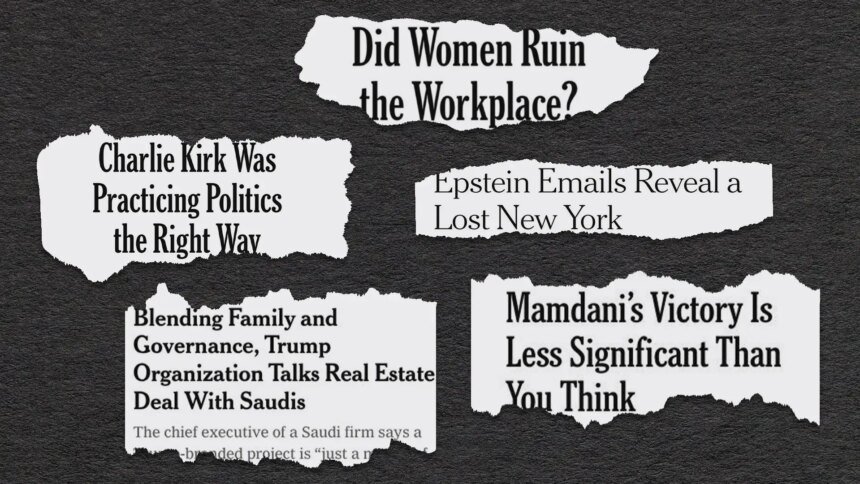
The New York Times, which remains among the world’s load-bearing newspapers, has published plenty of stories in 2025 with that rogue carnival barker vibe. “Why is someone screaming this at me?” would be a natural response to headlines like “Did Women Ruin the Workplace?” which NYT ran earlier this month, inspiring an apoplectic backlash that forced editors to change it to the only-slightly better “Did Liberal Feminism Ruin the Workplace?”. Since that controversial header is one of many quickly corrected misfires from the Paper of Record this year, maybe something else is going on beyond avant-garde attention-grabbing.
It’s nothing new for New York Times headlines to undergo embarrassing post-publication edits, presumably after someone got yelled at. What feels different now is that headline debacles appear to be arriving more regularly in the second Trump term—and nearly as often on the News side as on the Opinion side, despite each division having its own separate editors. Even longtime media critics like the NYT Pitchbot account on social media agree this has been a particularly cursed year for NYT headlines. The question is: To what end?
Headline mismatch
Sometimes, a headline is bending like a tortured circus contortionist to avoid stating the obvious. A recent News story offered the phrase “Blending family and governance” to describe Donald Trump enriching himself through business ventures while being the actual president. A froth of piping hot internet outrage swiftly followed. NYT then changed the headline to “Trump Organization Is Said to Be in Talks on a Saudi Government Real Estate Deal,” which sounds blessedly less like a story about finding innovative business loopholes for presidents.
“The Times has this problem where they are afraid to say things frankly,” says the anonymous person behind the long-running X and Bluesky account, NYT Pitchbot, which regularly mocks the framing of stories in NYT and The Washington Post.
Other times, the headline might be at odds with the story it’s hyping up. Amid ongoing revelations about the extent to which Jeffrey Epstein claimed Trump knew about his sex trafficking empire, a News story from last week took an arch tone in describing the fallout from recently unearthed Epstein emails and the broad, powerful network of people with which Epstein held sway.
It was then saddled with the unfortunate headline “Epstein Emails Reveal a Lost New York,” which provoked a digital jetspray of bile on social media. Judging from the headline, one might reasonably conclude it was a wistful lament for a golden age of sex crimes in the city. (It was later changed to “Epstein Emails Reveal a Bygone Elite.”)
Over on the Opinion side, plenty of headlines seem expressly designed as ragebait, practically begging Bluesky users to screenshot them into viral infamy. (More so than usual, even.) The same week readers were greeted with “Did Women Ruin the Workplace,” for instance, one of the writers credited with that piece authored a column bearing the headline “Mamdani’s Victory is Less Significant Than You Think.” That headline arrived the morning after Zohran Mamdani’s win in New York’s mayoral race, before anyone could credibly claim special knowledge about its significance or lack thereof. It did not go down smoothly online, which felt like the entire point.
With headlines like these being a predictable pattern this year, in both News and Opinion, it’s no wonder the Times is so easily memeable. Social media users are forever “fixing” the paper’s headlines—a genre of dunk even the White House oafishly attempted earlier this year.
A growing trend
When an NYT headline is especially galling, followers of the NYT Pitchbot account tend to tag its creator—either to make sure he’s seen the offending headline, or to suggest a past NYT Pitchbot post may have willed it into existence.
According to the person who runs the account, this year has been heavy on such occasions.
“Even bigger than ‘Did Women Ruin the Workplace’ was ‘Charlie Kirk Was Doing Politics the Right Way,’” the anonymous creator tells Fast Company, describing the headline of an Ezra Klein op-ed NYT ran the morning after the polarizing MAGA influencer was killed. “[It was] the worst ever. That had the biggest response from my readers that I have ever seen.”
Although the person behind NYT Pitchbot claims The Washington Post generates more forehead-slapper headlines than the Times these days, at least there’s a simple explanation for that lapse. In the leadup to Trump’s electoral victory in 2024, owner Jeff Bezos pulled the paper’s planned endorsement of Kamala Harris, and he’s since announced sweeping changes to the opinion section, giving it a more Trump-friendly bent. Amid an exhaustive exodus of talented writers, one remaining columnist recently boasted, “We’re now a conservative opinion page.”
But what’s the New York Times’ excuse for producing headlines that seem scientifically engineered to cause a nuclear meltdown on Bluesky?
Traffic watch
One possible explanation is that the editors are indeed aiming for maximum outrage. A hate-share gets just as much as much traffic as any other kind, after all, and modern media incentives heavily favor the pot-stirring headlines NYT keeps cooking up.
“I think that they think the dumb headlines encourage people to click through,” adds the creator of NYT Pitchbot.
It’s hard to argue with the strategy’s apparent success. There’s only so many times one can see the same screenshot of a headline furiously posted online before clicking to find out whether the outrage is warranted or overblown. (Your mileage may vary.)
If the explanation is as simple as clicks-at-all-costs, though, it’s truly a sorry state of affairs for the world. The New York Times is still the crown jewel of legacy media, with all the authority and hefty subscriber base that come with it. If even the upper echelon of journalism is subject to the whims of algo-bait, SEO sorcery, and dying digital readership, what chance does any publication have? As TikTokers, substackers and AI podcasters map out the future of news–and the president attempts to hold dominion over it—legacy media has a responsibility to stay tethered to an era of concise language and a shared reality in its stories and their packaging.
In 2025, NYT has too often fallen short of that low bar.
When a headline describes the anti-vaxx Secretary of Health as “hitting his stride” just days after a second Texas child died from a disease the U.S. officially eliminated 25 years ago, it’s failing its readers.
When a headline uses “Trump says” to uncritically pass along the president’s preferred framing, it feels like capitulation.
And when a headline grossly underplays the gravity of a U.S. president threatening his political enemies with death, it’s practically daring him to give it a go.
In a recent piece, the NYT editorial board used 12 metrics to illustrate that the U.S. is well on its way to becoming an autocracy. If the News editors who contributed to that piece believe its findings, they might agree this moment urgently demands political, scientific, and moral clarity. If the Opinion editors also believe our democracy is backsliding, they might admit it’s the worst possible moment to ask regressive questions about women in the workplace for hate-clicks, something they likely wouldn’t have done just a year or two ago.
In the meantime, both groups seem to be ushering in a world where the New York Times’ continued existence is less significant than you think.
The final deadline for Fast Company’s World Changing Ideas Awards is Friday, December 12, at 11:59 p.m. PT. Apply today.

