



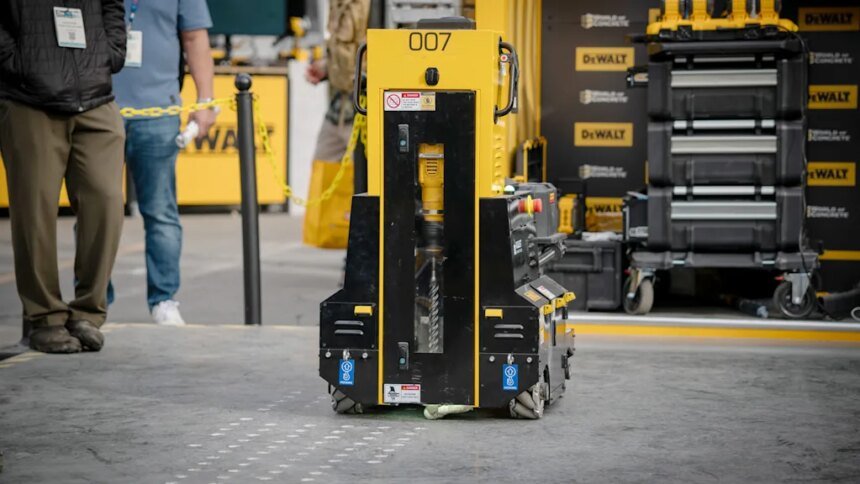

To anchor the long rows of server racks that power the artificial intelligence boom, every data center needs thousands of holes drilled into its concrete floor. It’s a precise part of the construction process that has required workers to bend over with handheld drills for hours at a time grinding meticulously placed holes into thick pads of concrete.
Now, there’s a robot doing it up to 10 times as fast.
Tool brand DeWalt has just revealed a downward-drilling robot that can autonomously roam the floors of under construction data centers to drill the thousands of holes that are necessary for installing server hardware and other building elements. Developed in conjunction with August Robotics and tested on data centers being built by an unnamed “hyperscaler” tech company, the autonomous robotic drill has been used to pop more than 90,000 holes into the floors of data centers, all without human involvement.
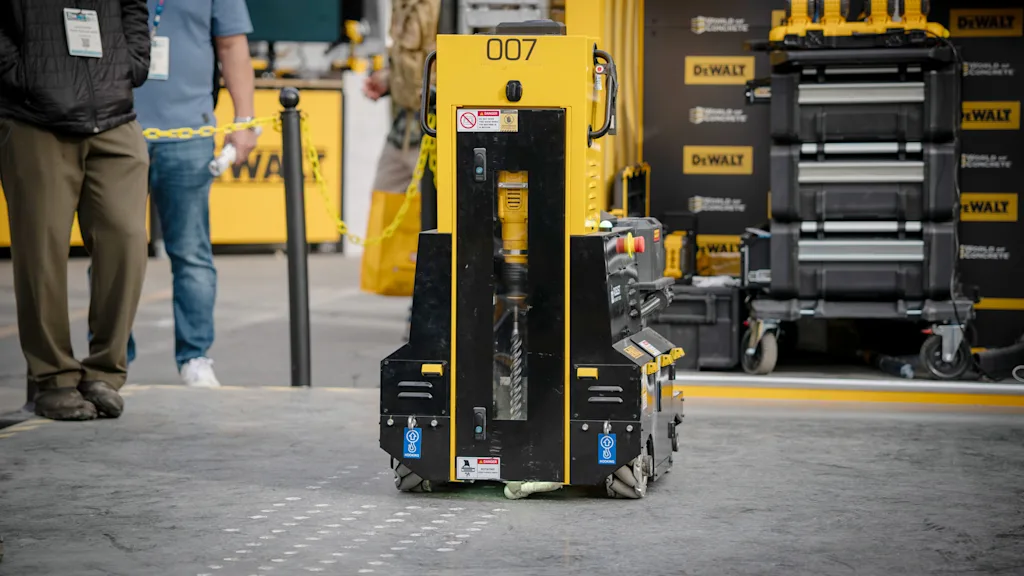
A task that can take human workers up to two months in a large data center can now be handled by a fleet of three or four robots in a matter of days. “That is so critical from a construction perspective, because they can’t move to the next stage of construction until this is done,” says Bill Beck, president of tools and outdoor for Stanley Black and Decker, the parent company of the DeWalt brand.
The pace is striking. For a smaller hole less than 1 inch wide and 2 inches deep, the robot can locate and drill one hole every 80 seconds. For a larger hole, 1 inch wide and 8 inches deep, it can finish a hole every 180 seconds. During its pilot phase, the robotic drill managed an accuracy rate of 99.97%. And because the robot is capable of operating 24 hours a day, project timelines can be drastically slashed.
Making this process faster is increasingly important as data centers balloon in size. From single buildings to sprawling campuses, data centers are taking up vast amounts of space and becoming increasingly complex to build. “They’re huge slabs of concrete,” says Beck. With upwards of 10,000 holes needed to be drilled in each one, the job can be daunting. “And they’ve got to be perfect,” Beck says. “You can’t have the hole be a quarter-of-an-inch off.”
That would make it seem like a hard job to want to do, but that’s assuming there are even enough people to take on the role. One analysis suggests there is currently a shortage of more than 500,000 skilled laborers in the construction industry. And workforce shortages are the leading cause of construction delays, according to a recent survey from the Associated General Contractors of America.
The robotic drill offers an alternative. It also offers significant cost savings. Beck says it could cost about $65 per hole for this drilling work to be done by human crews. Using a fleet of the autonomous drilling robots developed by DeWalt and August Robotics, that cost comes down to about $20 per hole.
DPR Construction, the largest data center contractor in the U.S., is prioritizing this drilling robot for testing and validation in 2026, according to Tyler Williams, the company’s field and robotic innovation leader. He says the technology has “real potential to reduce ergonomic strain on craft teams, boost productivity, and generally make the onsite experience better for people.”
“Ultimately, everything we’re doing here is about supporting our customers, many of whom are focused on speed to market,” Williams says. “These kinds of methods are changing how projects get built and helping customers see returns on their capital investments sooner.”
DeWalt and August Robotics have been piloting this technology for the past few months and believe the robotic drill is ready for wider adoption. It will be commercially available by mid 2026. As the scale of data center construction increases, especially among hyperscaler tech companies like Meta, Google, and OpenAI, there’s likely to be pent-up demand.
“They’ve got money, and they want to go as fast as they can,” Beck says. “They know it’s a race in terms of getting these data centers up and making sure they’ve got the capacity to be able to compete from an AI perspective. So their big push obviously is how fast can you go?”
For at least this one part of the job, the answer is much, much faster.

