





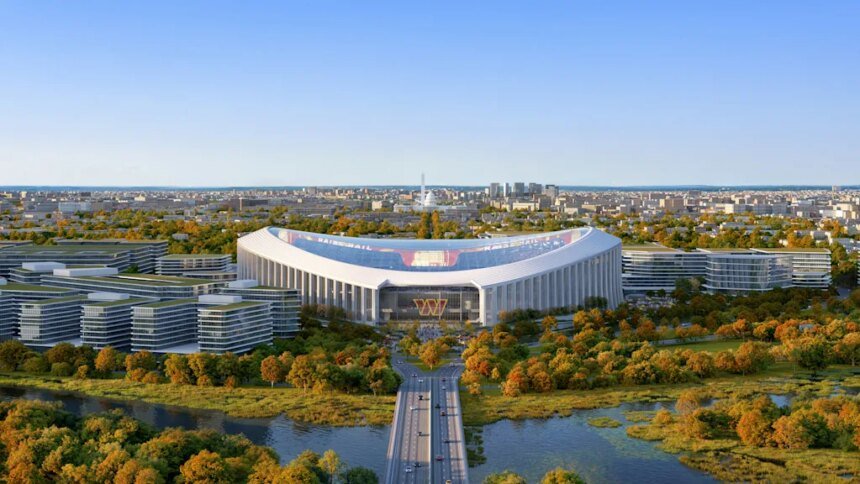

With a ring of massive columns and seating for more than 70,000 people, President Donald Trump may be getting the football stadium of his dreams.
Renderings have just been released of the proposed design for a new stadium for the Washington Commanders NFL team, and the aesthetic is right in line with an architectural style the Trump administration has been championing with increasing passion. The stadium is an oval of dozens of white columns recalling the classical-influenced architecture of some of the capital’s most recognizable buildings.
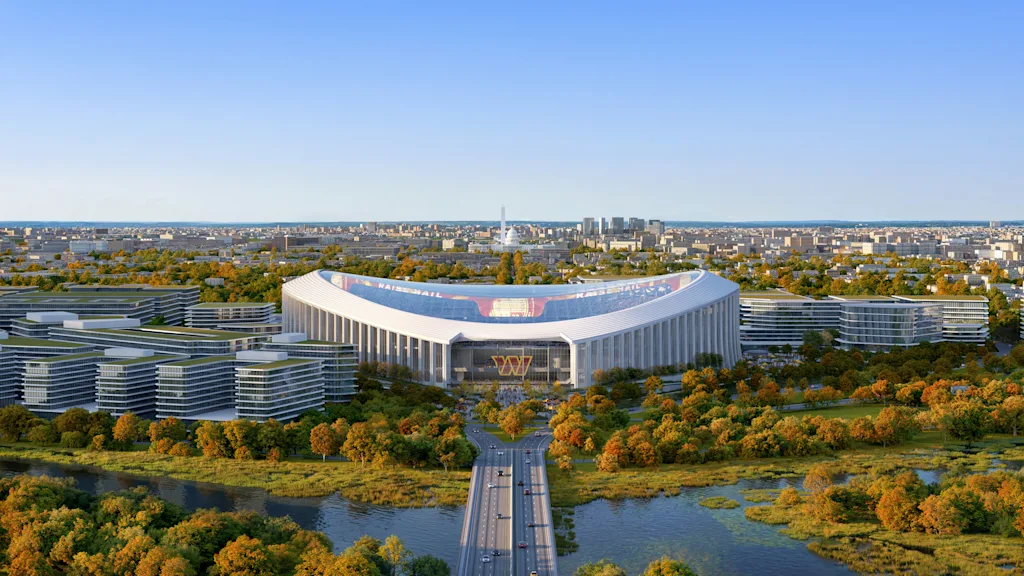
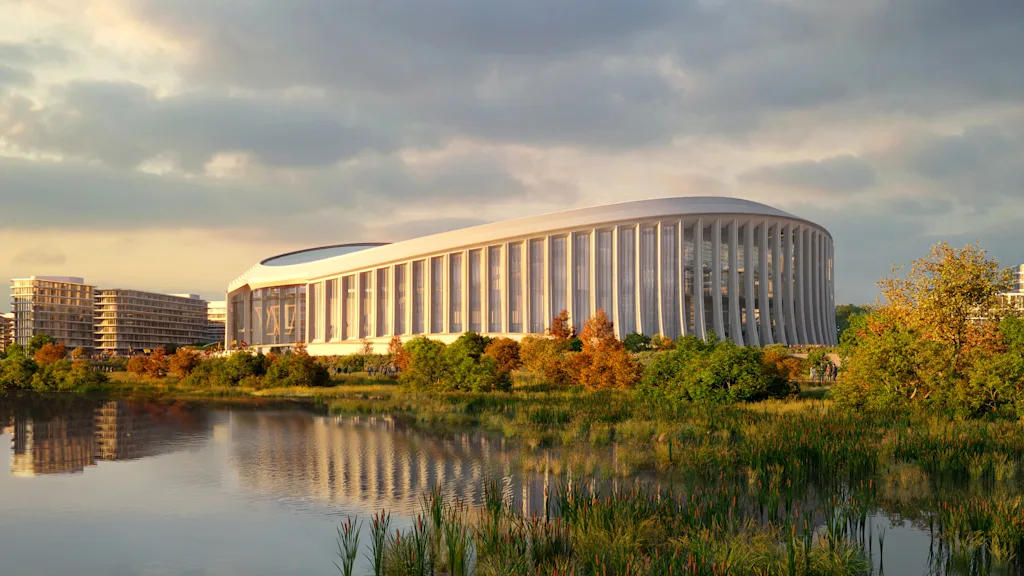
Designed by the architecture firm HKS, the stadium’s concept takes one of the most familiar elements of classical architecture—the column—and turns it into the defining feature of the building. Cascading around the stadium’s perimeter with heights upward of 100 feet, the columns are topped by a concave ellipse, also a marble-like white, that holds a semi-transparent roof. Glass between the columns offer views into the structure, which would glow from within during events.
The stadium’s design is a reflection of the Trump administration’s desire for an official embrace of the classical and neo-classical architecture that has typified federal buildings since the earliest days of the republic. Drawing influence from the columns and pediments abundant in the buildings of ancient Greece and the Roman empire, this classical architecture style can be seen at the White House, the Capitol Building, and the Supreme Court, among many other buildings across the city and country. It’s a style the Trump administration has sought to reassert as the federal standard, issuing executive orders in both of his terms to make classical architecture the preferred style for new federal projects. The group behind this effort, the National Civic Art Society, has been working for decades to convince national leaders that traditional design, not the modernism that emerged in the postwar years, is the most appropriate style for federal architecture.
Trump’s architectural preferences
Trump, the longtime real estate developer, has made this a key part of his agenda. His desire for more classical architecture has trickled down through Trump appointees to the agency that oversees the design of all significant projects in Washington D.C., the National Capitol Planning Commission (NCPC).
NCPC chair Will Scharf, appointed to the commission in July 2025 by Trump, recently called on officials from the Washington Commanders to ensure the new stadium “incorporates architectural features in keeping with the capital more generally—classical, neoclassical elements.” Speaking at a recent NCPC meeting, Scharf said, “I think really going back to classical antiquity, arenas and stadiums have played a vital role in the urban cityscape… I think there were several decades in American history where we unfortunately really got away from that, much to the detriment of the fan experience.”
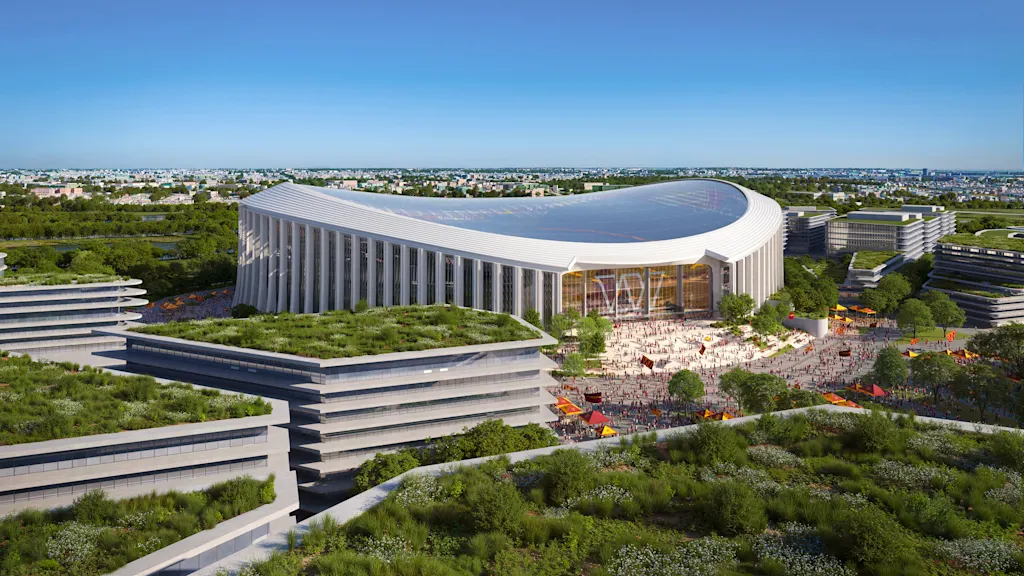
The stadium would sit on the site of the demolished Robert F. Kennedy Memorial Stadium, the team’s former home. That site aligns directly with Washington D.C.’s L’Enfant Plan, the city’s 1790 urban plan that criss-crossed the area with diagonal axes and carefully configured views of buildings like the Capitol, the Washington Monument, and the White House. Trump’s preference for classical architecture in the capital is beginning to influence development in the city. Under the NCPC’s authority, the stadium project could be its most imposing expression.
The design from HKS shows a willingness to play along. In a press release, HKS global venues director Mark A. Williams says the project’s design was guided by its “significance of place.”
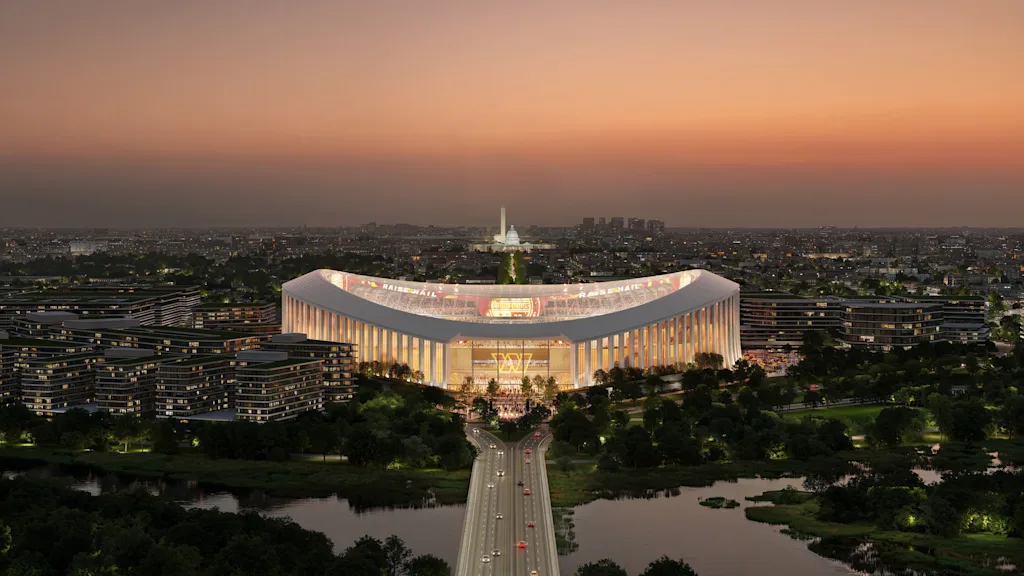
“Monumental in presence, grounded in the L’Enfant Plan, and scaled to the urban fabric of the District, the stadium design will be a bold civic landmark that carries the city’s architectural legacy forward in a way that is confident, dynamic, and unmistakably Washington, D.C.,” he says.
It could also become unmistakably Trump, as the president’s architectural preferences reverberate through the capital. (Trump has also called for the stadium to be named after himself.)
Construction on the Commanders stadium could start in 2027, with an opening date in 2030, a year after the constitutionally mandated end of Trump’s final term.

