




For the first time since 1972, astronauts are on their way into deep space as part of NASA’s Artemis II mission.
The mission sees the Orion spacecraft carrying four astronauts to the moon, where they will orbit it, gathering data for future Artemis missions that will see humans touch down on the moon’s surface once again.
But unlike in 1972, you don’t have to be a space agency to track the latest lunar mission. NASA has an interactive online tool that lets you see where the Orion spacecraft is and follow it as it performs its maneuvers through space. Here’s what you need to know.
This NASA tool lets you track the Artemis II mission
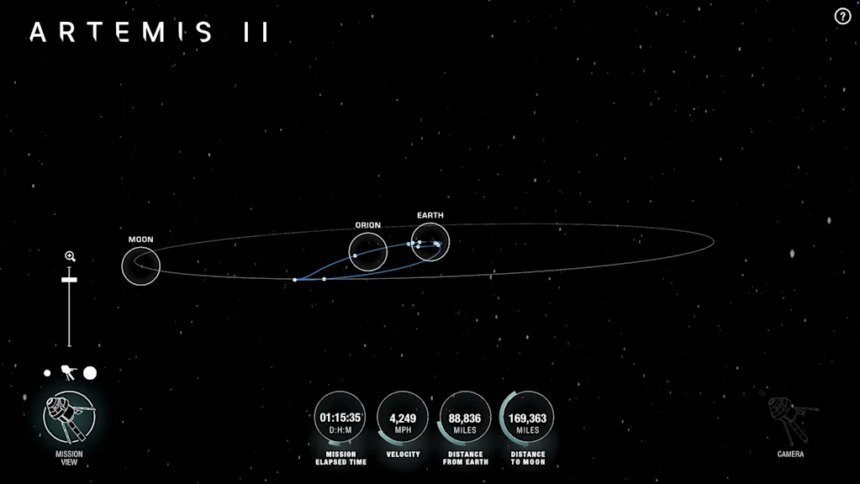
NASA has launched a site called the Artemis Real-time Orbit Website, which offers an interactive space map that lets you track the Orion spacecraft in real time.
The tool shows three bodies: that of the Earth, the Moon, and the Orion spacecraft, and tracks where they are in relation to each other.
It also visualizes the complete path the Orion is scheduled to follow on its 10-day mission.
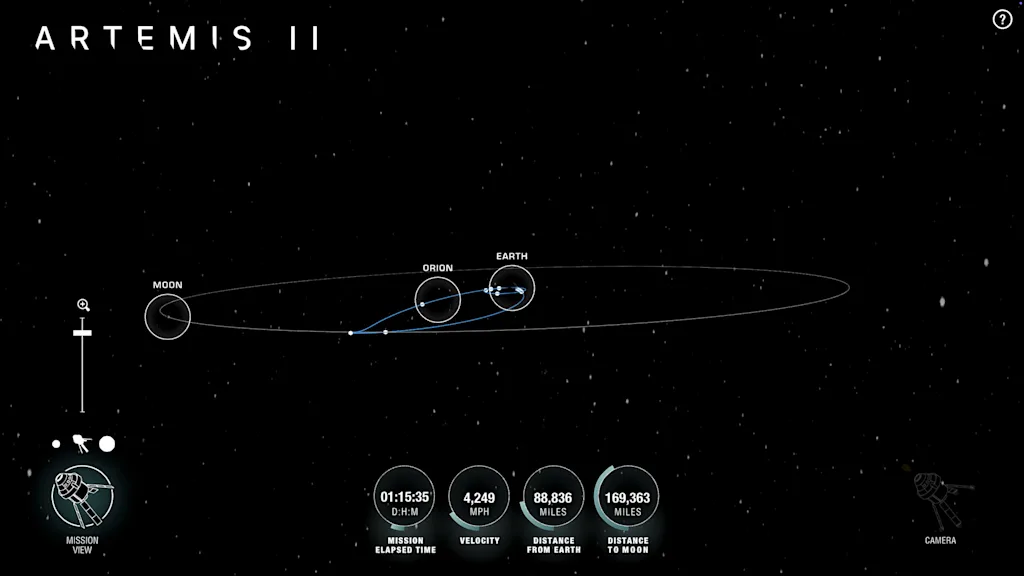
You can think of NASA’s Artemis Real-time Orbit Website as Google Maps in space. It offers tools to zoom in and out on any of the three heavenly bodies, and you can click and hold to drag the map’s axis.
Another cool feature is “Spacecraft View,” a virtual camera that lets you see an interactive digital reconstruction of the Orion up close.
You can also click on any of its four solar array wing (SAW) cameras, which are actually on the spacecraft, to see a digital reconstruction of what those cameras see. (If you want to see the real camera feeds, check out NASA’s Artemis II live mission coverage on YouTube.)
How far is Orion from Earth and the Moon?
In addition to being able to visibly track the Orion’s trajectory through space, the map also displays real-time data, including how long it has been since the mission commenced (about 1 day and 15 hours, as of the time of this writing), the velocity of the Orion (currently around 4,300 MPH) and its distance from earth and distance to the moon.
Given the spacecraft’s speed, those distances change rapidly. As of the time of this writing, Orion’s distance from the Earth is 86,683 miles, and its distance to the Moon is 170,847 miles. But those numbers change by about 1 mile every second.
When will Orion reach the Moon?
While Orion will not actually land on the moon. It will fly by it.
Currently, Orion’s lunar flyby is expected to take place on Monday, April 6, at which point NASA says “the astronauts will take high resolution photographs and provide their own observations of the lunar surface, including areas of the far side of the Moon never seen directly by humans.”
After that flyby, the Orion spacecraft will begin making its journey back to Earth, where it is expected to splash down somewhere in the Pacific Ocean off the coast of San Diego, California, on April 10.
Until then, you’ll be able to keep tracking the Orion on its journey across the heavens.

