






I still remember the thrill I felt in 2013 when I got the chance to interview IBM’s Watson team. Two years earlier, it had competed on the popular game show Jeopardy! and beaten human champions Brad Rutter and Ken Jennings. After that interview, I wrote an article for Forbes arguing that Watson would inaugurate a new era of cognitive collaboration.
As I look back now, more than a decade later, the article holds up remarkably well. I compared learning to collaborate with AI to pilots learning to “fly by wire,” using automated rather than manual controls. We still have pilots, of course, but they don’t actually fly planes anymore. They manage the systems that fly the planes.
Today, we’re at a similar juncture. Wall Street analysts estimate that investment in AI will approach $700 billion this year. McKinsey reports that nearly 90% of businesses are using AI and, perhaps not surprisingly, a horde of newly minted AI experts are rising to meet the demand, thinking they’re on the ground floor of an opportunity. Here’s why you shouldn’t be one of them.
The Hype Cycle Explained
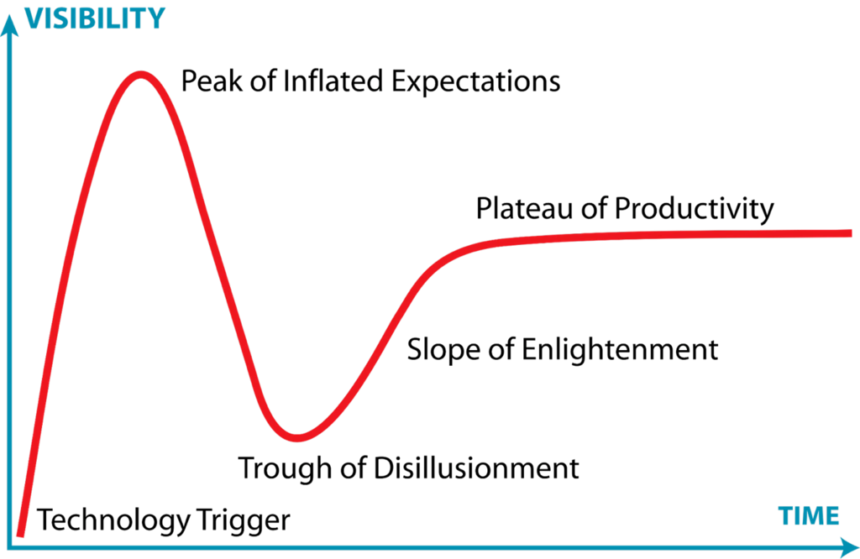
In the 1990s, Gartner analyst Jackie Fenn noticed a pattern: New technologies would emerge, get hyped up beyond any realistic expectation, go through a period of disillusionment and disappointment, and only later gain traction and become productive. Gartner dubbed this phenomenon the “Hype Cycle.”

With respect to artificial intelligence, the technology trigger was probably ChatGPT’s enterprise launch in March 2023, but some might argue that the development of transformer algorithms was technically the trigger. Either way, all of a sudden, people got really excited by AI, and investment and adoption soared.
Today, we are either at or near the peak of inflated expectations. Roughly $350 billion was invested in AI last year, and that’s set to double this year. At the same time, the evidence that these investments are resulting in significant productivity gains is mixed at best. A recent Duke University survey of CFOs found no impact on productivity at all.
Clearly, it is possible that there are actual productivity gains that aren’t yet captured by the data (Stanford’s Erik Brynjolfsson seems to think so). Also, it is not unusual for a technology to initially have a negative effect on productivity as users move up the learning curve. So what we’re observing might just be the typical growing pains of a new technology.
Still, we’re talking about nearly a trillion dollars of investment in just two years. And because the AI chips make up roughly 60% of that investment and are amortized over three years, to be financially viable, AI firms need to start producing hundreds of billions of dollars in profits fairly quickly. That seems unlikely, and we’re almost surely headed for a trough of disillusionment.
The Compulsion Of Reflexivity
George Soros made a fortune betting against conventional wisdom. When the British government committed to keeping the pound pegged to the German mark, he bet against it and earned a billion dollars in the process. He later pulled off similar trades against the Thai baht and the Japanese yen. Where others saw a boom, Soros saw a bust right around the corner.
His secret weapon was a theory he calls reflexivity. The basic idea is that expectations don’t form in a vacuum. They are shaped, in part, by our perceptions of what other people believe. The more widely an idea is accepted, the more likely we are to accept it ourselves and that, in turn, reinforces the collective zeitgeist.
If many believe that AI will create an economic boom, similar to that of electricity or the internal combustion engine, we’re more likely to believe it, too. That belief drives behavior: Investors buy stocks, companies pour money into AI, and the prediction becomes self-referential and self-reinforcing. All of this adds fuel to the fire. Nobody wants to get left out of a good thing.
What’s interesting about Soros’s theory is that it doesn’t depend on the merits or demerits of the asset or idea in question. You can believe in the transformative power of AI and still recognize that many of the decisions being made are driven by reflexivity. And when reflexive bubbles unwind, it’s not just asset prices that fall. So do reputations built on temporary expertise.
Chasing The Wave
It’s hard not to be amazed by AI. Today, anyone on earth who owns a cheap smartphone can access technology that seemed like science fiction just a short time ago. Advocates can point to real data showing that it has had significant real-world impacts. So why not jump on the wave and enjoy the ride?
Research from the St. Louis Federal Reserve Bank illustrates a key part of the problem.
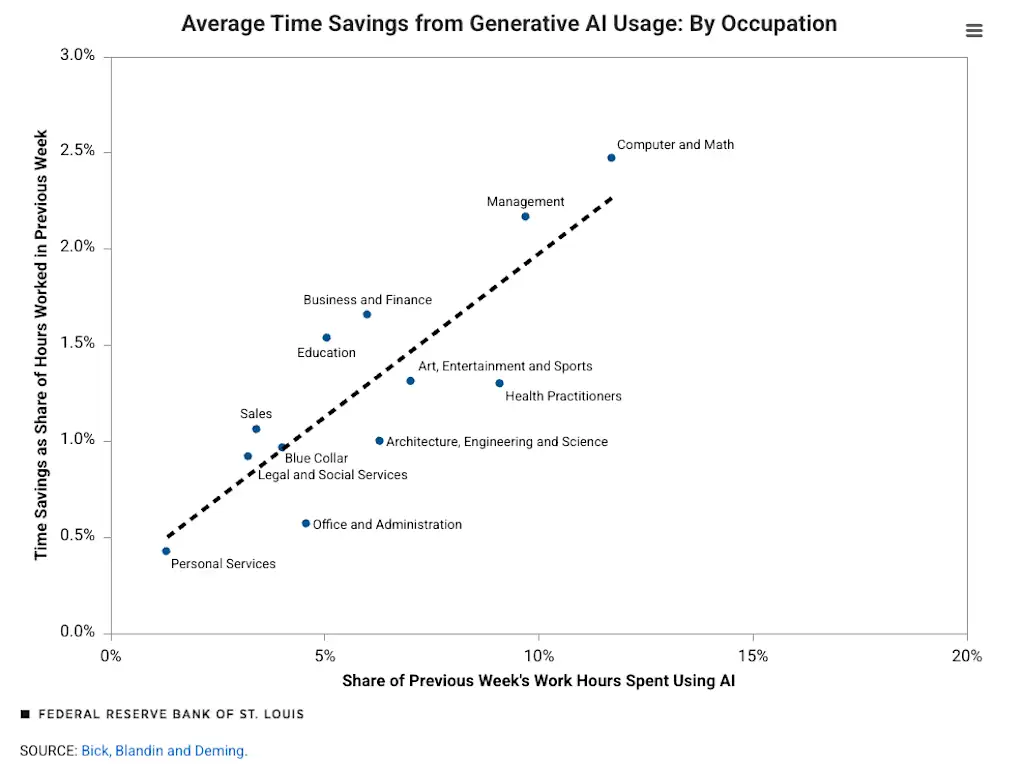
There is a wide disparity in the impact of AI. Some occupations, like software development, are being completely transformed by AI. Others, such as personal services, are hardly being affected at all. So perhaps it’s not surprising that people ensconced in the tech world predict that other industries will see similar productivity gains.
Consider OthersideAI CEO Matt Shumer’s viral tweet about how AI has completely transformed his ability to produce code and create products. You can’t blame him for being excited—the gains are truly impressive.
In a similar vein, OpenAI CEO Sam Altman claimed that similar impacts will soon be seen in other industries, such as marketing and communications:
“It will mean that 95% of what marketers use agencies, strategists, and creative professionals for today will easily, nearly instantly, and at almost no cost be handled by the AI—and the AI will likely be able to test the creative against real or synthetic customer focus groups for predicting results and optimizing. Again, all free, instant, and nearly perfect. Images, videos, campaign ideas? No problem.”
What sticks out to me about that quote is how little Sam Altman’s vision corresponds to the actual work that people in marketing agencies do—which is to work with clients to identify objectives and craft strategies to achieve. The production and placement of creative assets has been highly automated for quite some time.
The truth is that few people write code for a living, and extrapolating gains from software development to the economy at large takes quite a leap of faith. Humanity’s superpower—the thing that has allowed us to create our own destiny—is collective action. To do that, you need humans to interact with other humans.
Doubling Down On The Expertise You Already Have
There’s no doubt that artificial intelligence is a transformative technology—but so were smartphones, broadband mobile internet, cloud computing, and many other things over the last 20 years. It is truly amazing to think that just 20 years ago, none of it existed and life was significantly different. Yet still, none of those things had much of an impact on productivity.
The most likely scenario is that the future will look a lot like the past. Many things will be improved. Some will be transformed. But adoption will be uneven, with some organizations and industries moving quickly to put new applications into practice, while most will lag. As progress fails to meet expectations, disappointment and disillusionment will set in, and focus and budgets will shift elsewhere.
If you are truly an AI expert, with the knowledge and skill to shape the technology, you can still expect to do well. There will never be a shortage of organizations that need people to help leverage technology to do important work for them. But if you are just chasing the wave, you will be tying yourself to the ebbs and flows of market sentiment.
The truth is that you can’t separate a technology from the environment in which it operates. As the German philosopher Martin Heidegger argued: To build for the world, you need to understand what it means to live in it. Technology becomes powerful when people who understand solutions learn to collaborate effectively with people who understand important problems that need to be solved.
So while there is clearly a need for genuine AI experts, we still need experts in every other human domain. You’re much better off betting on yourself than betting on a technology you have little or no agency over.

