




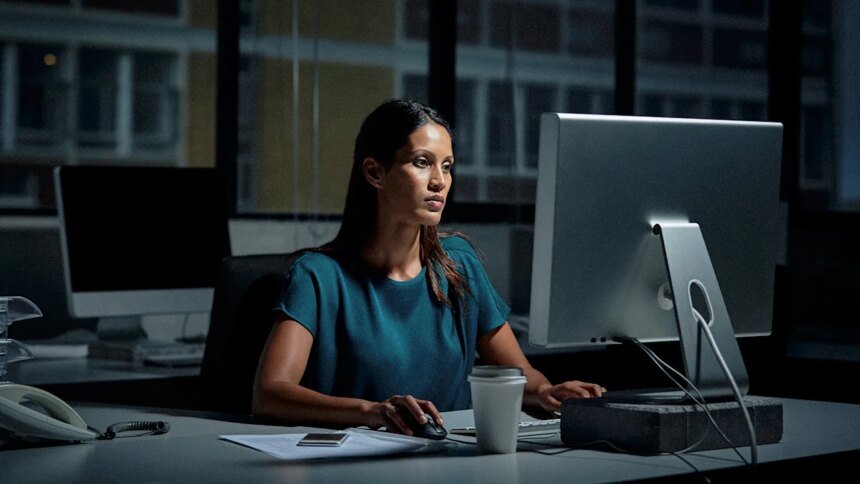

For the past few years, leaders have been trying to decode what’s happening to attention at work. We’ve debated burnout, quiet quitting, and whether younger employees simply approach productivity differently than previous generations. But new workplace data suggests something far more basic may be happening: many employees aren’t disengaged—they’re visually exhausted.
New research from VSP Vision Care and Workplace Intelligence found that desk workers now spend nearly 100 hours each week looking at screens, with most reporting that digital eye strain is directly affecting their productivity. Workers experiencing visual discomfort say it reduces their output by nearly a full workday each week—a number that should give leaders pause.
It would be easy to frame this as a wellness story or a benefits conversation. But that misses the bigger picture. The data isn’t just about eye health—it’s about how modern work has been designed, and what leaders choose to normalize.
We may be measuring engagement while ignoring endurance
When performance dips, organizations often look first at motivation or culture. Are employees committed? Are they resilient enough? Do they care about the work?
Those questions matter, but they can distract from a quieter reality: the modern workplace now demands an unprecedented level of visual intensity. According to the research, desk workers spend roughly 93% of their waking weekday hours focused on screens.
Think about what that means in practice. Back-to-back video calls. Endless message notifications. Constant toggling between documents, dashboards, and email threads. Even roles that once involved physical movement or conversation have shifted toward screen-based workflows.
Over time, that level of visual demand changes how people sustain focus. Fatigue builds slowly, and when it finally shows up as distraction or irritability, leaders often interpret it as disengagement rather than overload.
But human attention isn’t limitless. And when work requires uninterrupted visual concentration for hours on end, the issue isn’t necessarily a lack of commitment but rather a lack of thoughtful design.
Digital fatigue is a culture issue hiding behind a health statistic
One of the most revealing findings in the study isn’t just how much screen time employees report, but how little organizational support exists around it. Only about a third of workers say their company actively encourages eye breaks or provides education about managing digital strain, even though most HR leaders acknowledge more should be done.
That gap tells us something important about workplace culture. Many organizations have unintentionally equated productivity with constant digital presence. Being visible online becomes a proxy for being valuable. The result is an environment where stepping away from a screen—even briefly—feels risky.
Leaders rarely intend to create this pressure. But when expectations around responsiveness remain unclear, employees fill in the blanks themselves. They stay online longer, respond faster, and push through discomfort to signal commitment.
Eventually, that behavior becomes the norm. And when productivity starts to slip, we look for explanations everywhere except the most obvious one: we’ve built a system that asks people to maintain visual intensity longer than is sustainable.
Why Gen Z isn’t resisting work—they’re questioning the structure
Working closely with Gen Z students and early-career professionals has shown me something important: younger employees aren’t rejecting effort. They’re challenging assumptions about what effective work actually looks like.
They question camera-on expectations that prioritize appearances over outcomes. They ask why meetings need to run an hour when decisions could be made in twenty minutes. They push for clearer boundaries around communication instead of constant availability.
Some leaders interpret this as impatience or a lack of resilience. I see it differently. Gen Z entered the workforce during a period of rapid digital acceleration, and they’re often the first to notice when systems create friction.
Their questions can feel uncomfortable, but they also offer valuable feedback. If an entire generation is pushing back on nonstop screen time, it may be less about generational differences and more about a workplace model that hasn’t caught up with human limits.
Leaders don’t need more wellness programs. They need better structure.
Addressing digital eye strain doesn’t require a complicated initiative. It requires leaders to rethink how work is organized day to day.
That might include:
- Designing meetings with built-in visual breaks or audio-only segments
- Leaving intentional gaps between calls so employees can reset their attention
- Setting clear expectations around response times to reduce the pressure of constant monitoring
- Modeling healthy digital boundaries rather than praising nonstop availability
These shifts may seem small, but they change the message employees receive. Productivity stops being about how long someone stays glued to a screen and starts being about the quality of their contribution.
In my own leadership work, I often talk about balancing kindness, fairness, and structure. Visual fatigue sits at the intersection of all three. Acknowledging human limits reflects kindness. Creating clear expectations around availability reflects fairness. And designing workflows that support sustainable focus reflects strong structure.
When one of those elements is missing, employees feel it, even if they can’t articulate why.
The real risk isn’t eye strain. It’s misreading the signal.
When attention dips, leaders often assume disengagement. When someone turns their camera off, we question their commitment. But what if those behaviors aren’t signs of withdrawal at all? What if they’re adaptive responses to an environment that demands more visual endurance than most people can sustain?
When leaders misread these signals, they create unnecessary tension. Employees feel misunderstood. Managers feel frustrated. And the real issue—an unsustainable rhythm of work—goes unaddressed.
The modern workplace has quietly redefined focus as nonstop visual attention. But people don’t perform at their best by staring at screens longer. They perform better when leaders design work with intention. Digital eye strain isn’t just a health warning. It’s a leadership signal. And the future of work won’t belong to organizations that demand constant presence, but to those that know when it’s time to look up, step back, and lead differently.

