





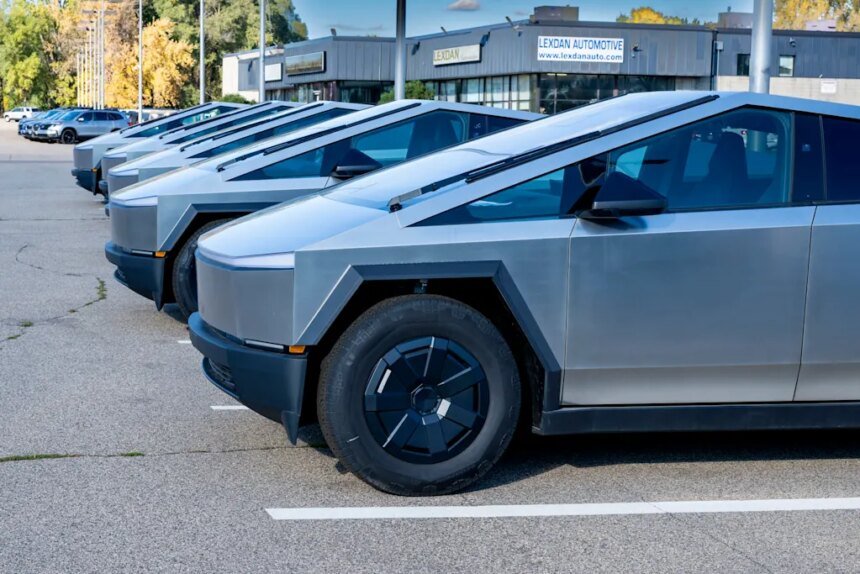

The Tesla Cybertruck is the new Ford Edsel, taking the crown from one of the biggest flops in American car history.
Last year, the Cybertruck spiraled into market irrelevance while the rest of the EV market found its footing, as the pickup experienced the single biggest sales collapse of any electric vehicle in the United States.
Elon Musk’s flailing company managed to move only an estimated 20,237 Cybertrucks in 2025. And that’s counting the units that Musk reportedly bought for himself through SpaceX and xAI to avoid further ridicule.
“He had his private companies buy hundreds if not thousands of Cybertrucks,” wrote Fred Lambert at EV blog Electrek. That’s an eye-popping 48.1% crash from the 39,000 units sold in 2024. Elon, seriously, stop this embarrassment and kill this polygonal joke already. I laughed at first but now it’s painful to watch.
To understand the magnitude of this failure, the all-electric Ford F-150 Lightning—an EV pickup so unsuccessful that Ford officially ended its production in December 2025 to pivot to a new hybrid model—still managed to humiliate Tesla from the grave. Ford sold 27,307 Lightnings in 2025, making it the best-selling EV pickup truck in America.
Both companies tried to buy their way out of trouble with heavy discounts and 0% financing offers. But while aggressive incentives helped Ford clear inventory and post growth, the same tactics failed to save the “apocalypse-proof” pickup from becoming a sales armageddon. Think about that for a minute: A discontinued EV truck outsold the Tesla truck by nearly 7,000 units and got canceled. Come the truck on.
I already called the Cybertruck a flop, but the final sales tally is even worse than I imagined. It’s officially the “biggest flop in decades,” according to Forbes. This is especially humiliating when Musk overpromised sales of 250,000 Cybertrucks annually by 2025. Tesla reached barely 8% of that target.
Plenty of reasons for failure
The reason for the Cybertruck’s collapse isn’t a mystery. It’s not the EV slump. It’s the inevitable result of shipping a beta product to customers as a finished vehicle, a design failure since its inception. The truck isn’t just ugly, it’s fundamentally broken. In 2025 alone, Tesla issued recalls covering a combined 115,912 Cybertrucks—more than double the number of recalls in 2024. That averages out to 318 recalls per day.
We are not talking about inconsequential software updates. These were dangerous, amateur-hour defects. The largest recall campaign involved 46,096 trucks that risked shedding their stainless-steel exterior trim while driving, turning the vehicle into a shrapnel grenade on the highway. Another 6,000 trucks were recalled because their optional light bars were attached with the wrong primer and could simply fall off. This follows a chronicle of disasters documented since Musk shattered the unshatterable pickup’s glass.
We’ve seen the “stuck pedal” trap that locked accelerators at full throttle, critical system failures where owners drove a mere mile off the lot before the truck died with a “red screen of death,” losing steering and braking redundancy, and misaligned doors and uneven surfaces that Musk himself admitted in leaked emails stuck out “like a sore thumb.” That’s just a selection of this disaster on wheels.
As Adrian Clarke—a professional car designer who now writes design critiques for the automobile publication The Autopian—told me when it was about to come out the factory line: “The Cybertruck is a low-polygon joke that only exists in the fever dreams of Tesla fans that stands high on the smell of Elon Musk’s flatulences.” Back then, Clarke also called out the terrible design choices that were going to lead to the bevy of manufacturing and quality problems, all part of the design and brand crisis that Tesla has been experiencing since 2023.
But there’s a third component that completes the Cybertruck’s failure trifecta: Musk’s former bromance with Donald Trump and his DOGE antics. Turns out not all press is good press, as these moves killed the Tesla brand perhaps more than the model stagnation, deadly car accidents, and mechanical failures. Musk’s political radicalization led many of Tesla’s existing customers to regret their purchases and potential clients to avoid them, both in the U.S. and abroad. As dealerships got torched and cars vandalized, the Cybertruck arguably became “America’s most hated car.”
The 2025 sales figures just confirm what we have known for more than two years now. The Cybertruck is not the disruptor Musk sold to the world and Tesla shareholders. It is a finger-chopping brick that depreciates faster than used bridal dresses. An ugly failure that is doing nothing but draining resources and further damaging the brand’s reputation (if it still has one).
It’s time to bury what’s already dead, Elon. The experiment is over. Sink this polygonal mess deep underground, along with all your failed promises, and call it a day.

