




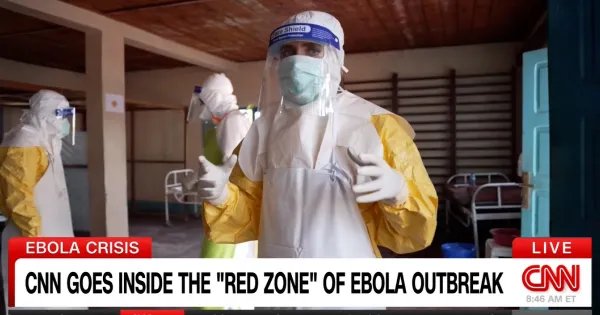

For the past few days, CNN’s chief international correspondent, Clarissa Ward, has been reporting from Bunia, the capital of the Ituri Province in the Democratic Republic of Congo, the epicenter of the latest Ebola outbreak.
Ward and her CNN crew, who have been the only TV news organization in the region, visited an Ebola “red zone” inside Bunia General Hospital where all suspected Ebola patients are placed.
Wearing layers of protective gear, Ward reported on doctors desperately working around the clock trying to contain this deadly virus in an atmosphere of grief, fear, and fragile hope. So far, according to the CDC, there have been 62 deaths and 363 confirmed cases caused by this latest Ebola outbreak in the DRC.
In her latest piece, Ward traveled to the remote gold-mining town of Mongbwalu in eastern Congo, where it is believed the latest Ebola outbreak originated. She spoke to a local journalist who told her that residents are skeptical of the aid workers and the mayor of Mongbwalu, who revealed when he first heard of the initial case from this outbreak.
Ward spoke to TVNewser as she wraps up her tour of the region.
ADWEEK: What preparations did you undertake before you got to the Red Zone in Bunia?
CLARISSA WARD: From the moment you land here, you are asked to wash and sanitize your hands at every place you visit. Your temperature is taken before you enter any location. And of course, before you go into the actual red zone, you are given multiple layers of protective gear. Also, when you leave the red zone, there is a whole process to remove the gear in order not to bring any contamination out.
How long did it take you to get to the epicenter of the Ebola crisis?
It took us over a week to get the necessary accreditation and documents to enter the Democratic Republic of Congo and get access to Ituri province. You need permissions from the Ministry of Communication and the Ministry of Health, which may explain why there are so few international journalists on the ground. We flew to Kinshasa from London, changing in Paris. The next day we took a UN flight from Kinshasa to Bunia, the capital of Ituri.
Are people’s customs getting in the way of observing the globally recognized precautions to contain the spread of Ebola?
One of the biggest challenges for authorities here is the tradition around funerals. In this region, [there’s] touching and washing the body before laying a loved one to rest. Hundreds of people normally attend funerals. Authorities have struggled to explain to people that they cannot touch the body and have to mourn at a safe distance.

