






Mastercard processes around 150 billion transactions a year, which puts the brand in a rare position: It can see where consumer spending is actually going, in an aggregated and anonymized manner—not where people say it is going.
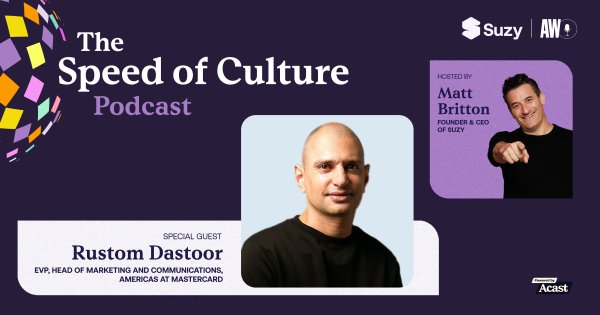
In this episode of The Speed of Culture podcast, Matt Britton sits down with Rustom Dastoor, EVP and head of marketing and communications for the Americas at Mastercard, live at CES 2026 in Las Vegas.
Rustom talks about why most brands are using AI to reinforce what already works rather than unlock what was never possible before. He introduces the concept of technical branding and explains why marketers will soon need to build their brands for AI agents rather than human consumers.
The conversation also covers how Mastercard reads 150 billion annual transactions to spot real consumer behavior, why sports has become the most valuable media environment for marketers, and what resilience, and hustle still mean in a technology-saturated world.
With 12 years at Mastercard and a career spanning roles across India, the United Kingdom, Singapore, and the United States, Rustom brings a global perspective to the craft of marketing. He has been at the center of Mastercard’s cultural marketing work, including its award-winning Priceless experiential platform and its partnership with Lady Gaga.
Before Mastercard, he held senior roles at major agencies and built his foundation in brand strategy, analytics, and consumer insight. He now oversees Latin America as well, adding further international breadth to one of the most data-informed marketing operations in the world.
Key Takeaways:
[02:09] Survivorship Bias and the Opportunity in AI — Rustom opens with a World War Two analogy. Rustom draws a direct parallel to how most brands are currently approaching AI: automating what already works, which has value, but misses the far larger opportunity. What he is urging marketers to ask is what they could not do before AI arrived, and to treat that question as the actual frontier worth exploring.
[05:26] Hyper Relevance Over Personalization — Rustom draws a line between personalization and what he calls hyper relevance. Personalization, in his framing, can still miss the mark. Relevance accounts for location, mood, time, financial context, and need, all at once. For Mastercard, with its enormous aggregated data footprint, this is where the next generation of marketing impact lives.
[13:24] Why Sports Has Become the Most Valuable Environment for Marketers — While the broader media landscape has fragmented beyond the point of easy navigation, Rustom explains that sports has moved in exactly the opposite direction. Leagues and properties have consolidated distribution rights, broadcast rights, licensing, and fan experience into tightly integrated ecosystems with consistent data streams. For a marketer, that creates rare conditions: scale, vertical integration, and the ability to follow a consumer accurately from one channel to the next. He also touches on the evolving role of athletes themselves as storytellers and brand builders in their own right, pointing to Mastercard’s partnership with Formula One racing team Mastercard and their driver Lando Norris as an example.

