







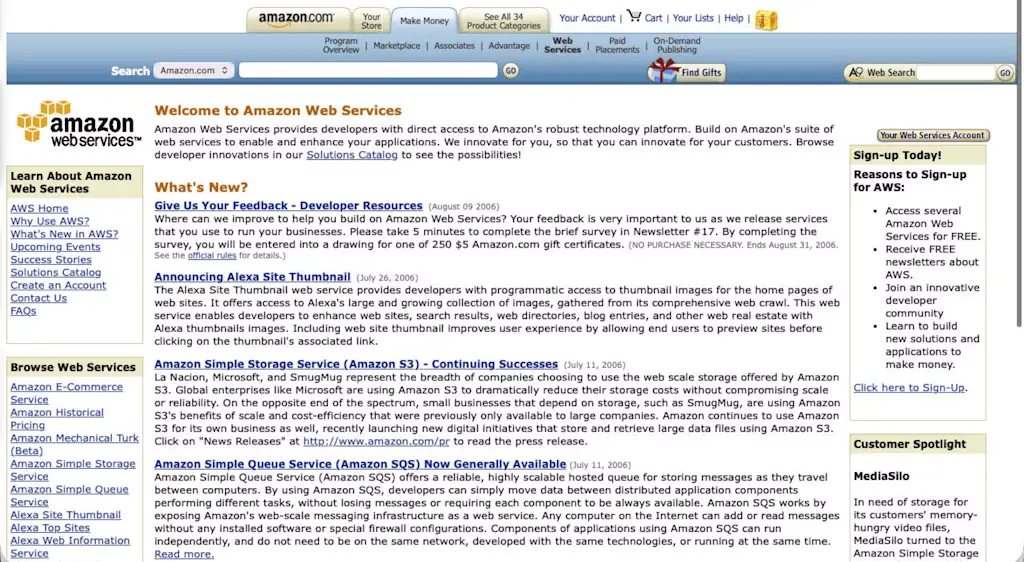
In 2006, Amazon Web Services was a fledgling—and a bit of an oddity. Amazon had taken the cloud-computing technologies it had created for its own operations and turned them into a business. Any organization could use them to build out an online presence without managing any infrastructure. Amazon watchers struggled to suss out what the e-tailer was up to: “I have yet to see how these investments are producing any profit,” carped one Wall Street analyst.
At the very start—when it was still a big deal if AWS collected $100 in revenue in a single day—an AWS product manager named Matt Garman had lunch with a friend who worked in another part of the company. “[The coworker] asked, ‘How is that AWS thing going? I heard about it, and it sounds pretty interesting,’” Garman recalls. “And I was, like, ‘I think this could be a billion-dollar business for Amazon.’” His lunch mate cautioned him about the daunting ambition of that goal.
As it turned out, AWS smashed through Garman’s $1 billion goal and then just kept going, reaching $128.7 billion in revenue in 2025. Along the way, it came to deliver the majority of Amazon’s profit, to the tune of $45.6 billion last year. As for Garman, his early faith in the company’s potential led to the ultimate payoff in June 2024, when he became its CEO, succeeding Adam Selipsky.
Along the way, nothing was guaranteed. “When we started to get a little traction, there was this kind of meme about how AWS would quickly become a commodity and everything would kind of normalize out,” he says. “And our team has shown incredible invention to prove that that’s not true.”
But AWS’s impact on Amazon, as spectacular as it’s been, fails to convey its influence on business and the world in general. Offloading management of the myriad technologies that power a website to someone who knows what they’re doing just makes sense. Over time, organizations of all kinds bought into that strategy, including enormous companies that were initially wary of ceding control over such a critical element of their operations. Eyeing the opportunity, two other tech giants spun up their own AWS-like units, Microsoft Azure and Google Cloud. Cloud computing became one of the tech industry’s fiercest competitive battlegrounds.

On March 13, AWS officially marked its 20th anniversary, which dates to the introduction of its Simple Storage Service, better known as S3 and still one of its flagships. (You have to be a tech history obsessive to remember that an earlier version of the concept, initially called Amazon.com Web Services, launched in 2002.) The company is still the dominant force in the category it created, but after years of pursuit, Microsoft and Google have narrowed its lead. Back in the first quarter of 2020, AWS held 32% of the market compared with Azure’s 18% and Google Cloud’s 8%, according to Synergy Research Group. In the first quarter of 2026, AWS’s share was 28%, Azure’s was 21%, and Google Cloud popped to 14%.
Thanks to artificial intelligence, the three cloud providers are hardly squabbling over their respective slices of a pie of fixed size. It’s a testament to the revolution AWS spawned that there’s been no debate about whether most companies will get their AI as a cloud service. Of course they will. Given the overwhelming computational resources necessary to make large language models (LLMs) operate at scale, it’s the only practical way to make the technology pervasive.
AI, says Garman, “is a massive technology leap that changes everything about how technology is consumed. It changes everything about how all of our customers are going to operate their businesses, how industries are going to work.” As a provider of AI on demand, AWS is charged with driving that change. But it’s also the biggest change the company and its category have seen in their first 20 years—and a chance for its rivals to make further inroads.
Garman calls AI “an enormous tailwind to our business already” but acknowledges that the challenge of getting it right is just beginning. “All technology disruptions should be viewed as both a threat and opportunity,” he cautions. On multiple fronts, AWS is evolving to meet this moment.
An ever-expanding toolkit
Like all the tech giants currently jockeying to lead the present AI revolution, Amazon Web Services was quietly, persistently serious about the technology well before it became the industry’s number-one obsession. “We obviously didn’t project a lot of the generative AI explosion that’s happened in the world today,” Garman says. “But we’ve long known that [AI] was going to be critically important.”
In 2017, Swami Sivasubramanian, who’d joined Amazon as a research intern a dozen years earlier, became AWS’s VP of AI. Later that year, at its mammoth annual re:Invent conference in Las Vegas, the company introduced SageMaker, a platform for creating, training, and otherwise wrangling machine-learning models. Upgraded and expanded many times since, it remains one of AWS’s core AI offerings.

At the time AWS was formulating its plans for SageMaker, Google’s TensorFlow software library dominated AI development. But AWS believed that customers would come to prize choice. “Even internally, when we built applications, we noticed you need multiple models even for a single application to make it happen,” Sivasubramanian explains. That realization informed 2023’s Bedrock, which lets customers use AWS to run dozens of AI models from major companies, including Amazon itself, Anthropic, Nvidia, DeepSeek, Qwen, Mistral, TwelveLabs, and—via a new partnership—OpenAI.
Along with building out AI’s software layer, AWS has spent years developing its own custom AI processors, affording it more control over its infrastructure than if it were entirely dependent on Nvidia for computing muscle. Amazon’s 2015 acquisition of Israeli startup Annapurna Labs has led to multiple generations of chips for inference and training, most recently the Trainium3, announced last December at re:Invent.

Recently, agentic AI—forms of the technology that can perform complex, sometimes time-consuming tasks with some measure of autonomy—has come to dominate the conversation about where AI is going. Reflecting on this development led Sivasubramanian to “a realization that AI agents will fundamentally change how we all work and live.”
Wanting to help AWS seize this opportunity, he explains, “I spun myself out.” In March 2025, he gave up his old job as VP of AI to become VP of AWS Agentic AI, overseeing a group focused on creating products that are, in one way or another, agent-centric.
By July, this investment began to pay off in new AWS services. Kiro is a coding environment that lets software engineers turn over some of their heavy lifting to an LLM-powered agent. Bedrock AgentCore helps them build agents of their own. DevOps Agent, announced at December’s re:Invent 2025, monitors other AWS services to detect and resolve problems before they require human intervention.
At AWS, like elsewhere, many of agentic AI’s earliest big wins are coming from its ability to speed software development by writing code. Sivasubramanian points to customers such as Thomson Reuters, which used a AWS agentic AI service called Transform to help modernize applications built long ago using creaky technologies such as Microsoft’s .NET. Work that would once have consumed three to four years now takes six to 12 months, Sivasubramanian marvels.
The benefits are hardly limited to big companies slogging through mundane but important technical projects. “Even my 10-year-old daughter, who doesn’t fully know yet how to build in Python, was able to spin up and build a website to manage calendars for the entire household,” he says. “And she built it on AWS.”
Beyond infrastructure
When Colleen Aubrey joined AWS as a senior VP in 2024, she was a new recruit—but also an old hand at Amazon, where she’d worked for nearly two decades. Until then, most of her experience was in its advertising arm. Her long immersion in the company’s unique culture smoothed the transition from ads to infrastructure, though the shift in jargon was a bit of a shock: “The acronyms were totally different,” she says.
Aubrey wasn’t at AWS to do infrastructure in its classic form. Instead, she was charged with spearheading its expansion into an area where it had far less experience: full-blown business productivity applications.

“At Amazon, we’ve built many of our own applications, and we learned a lot from that,” she says. “And my hypothesis was that we could bring to life some of that learning for AWS customers in the form of business applications. And that the time was a good time, because we could simultaneously think about what we’d build today given the capabilities of AI and where we might see that going.”
In April, at an event in San Francisco, the company introduced a line of cloud-based, AI-powered products for automating common business processes. Amazon Connect Decisions focuses on supply-chain management. Amazon Connect Talent conducts job interviews. Amazon Connect Health helps doctors’ offices with tasks such as scheduling and medical history review. And Amazon Connect Customer is the latest version of a customer service contact center platform that AWS originally launched in 2017.
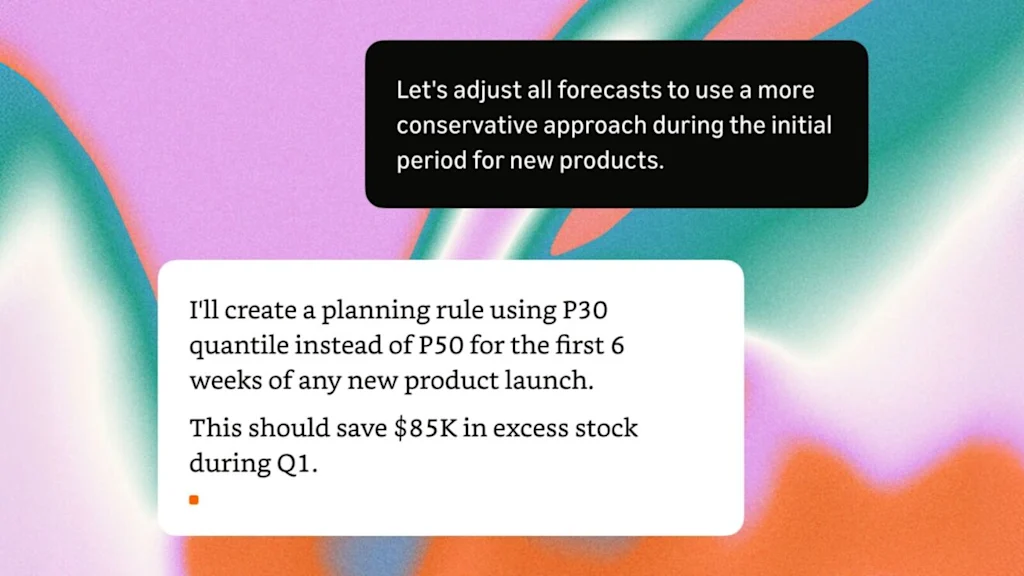
Generative AI allows the Connect products to offer chat-like interfaces and voice input. According to Aubrey, the goal is to offer software “that works in a way where, as a person, a human in the business, I don’t have to learn how to use a new tool. I interact with it in ways that are familiar.”
AWS’s first two decades didn’t necessarily set it up to create such experiences. The company has plenty of expertise at creating administrative dashboards that let technologists configure, manage, and monitor its services. But anyone who’s used them—or their counterparts at Azure and Google Cloud—knows they’re not exactly master classes in polished, consumer-grade usability. To up its game, the company hired Hector Ouilhet as AWS Solutions VP of Design in January 2025.
Ouilhet spent more than 14 years at Google, where he was one of the people responsible for Material Design, the design language that gave the company its first cohesive set of tools for creating interfaces that were both intuitive and recognizably Google-y. He compares the challenge at AWS to that one, with the added twist of AI both enabling and demanding new approaches to how people interact with computers.
“We build the whole thing ourselves in terms of the experience,” he says. “Not only how it looks, but how it feels, how it sounds, how it behaves, how it interrupts, how it listens. So now, the practice of design is way broader.” Ouilhet calls AWS’s approach to AI agent interfaces “humorphism.” Its principles—such as “Route work to whoever can do it best” and “Synthesize and tailor information for the moment”—are detailed at a website he created; he says he’d be delighted if other companies followed the lead.
Approachability also drove the latest updates to Amazon Quick, an AI assistant, introduced last year, that taps into business tools such as Google Workspace, Microsoft’s Teams and Outlook, and Slack for purposes such as research and task automation. At the April event, AWS announced new Quick apps for MacOS and Windows that make it more directly competitive with the likes of Anthropic’s Claude Cowork. It also started letting users sign up for the freemium service with a standard-issue Amazon account, allowing them to get up and running in minutes without confronting the potentially intimidating full-on AWS experience.
“The limit at the moment is about 300 employees,” says Jigar Thakkar, AWS’s VP of agentic AI for business, a Microsoft veteran (and Teams co-creator) who joined AWS in January. “If you’re much larger than that, you want to get the enterprise account, where we do a lot more governance and security.”
Secret ingredients
New business apps aside, AWS’s core business remains providing reliable ingredients for other technologists’ innovations. Its role is that of a silent partner, and only the occasional outage reveals its involvement by making clear how many sites depend on it.
When the company was young, its customers tended to be smaller outfits that were open to fresh ideas and knew they needed help scaling. Both Garman and Sivasubramanian mention SmugMug, the photo-sharing service whose early embrace remains a totemic success story. SmugMug’s CEO, Don MacAskill, negotiated AWS’s initial asking price of 40¢ a gigabyte for cloud storage down to 15¢, then took the plunge. He couldn’t be sure that Amazon would stay committed to its new business: “A lot of people told me I was crazy at the time, just tons and tons and tons,” he told me in 2017.
Today, AWS has the confidence of some of the world’s best-known companies, who call on it for ingredients that go far beyond online storage. AI is only accelerating their consumption of its services.
At United Airlines, AWS is “part of everything we do,” says its CIO Jason Birnbaum. The airline began working with the company in 2018, the same year it launched a customer-service program called “Every Flight Has a Story.” Rather than leaving travelers wondering about the issue that had caused a takeoff delay, the initiative provided them with an explanation of what had gone amiss—one handcrafted, at first, by a human “storyteller.”
That gesture, Birnbaum says, “was amazingly well-received—it just was tough to scale. We use AI now to write more than half of those messages, which has enabled us to cover way more scenarios and be way more transparent with our customers.” Passengers on more than half a million flights have received messages generated by AWS AI. “It’s been a home run for us, and it’s been a home run for our customers,” he adds.
When Mondelēz International CTO Chris Hesse joined the snack-food behemoth in 2021, it wasn’t an AWS shop. Now the majority of its cloud runs on AWS services. The maker of Oreos, Clif bars, and Cadbury eggs recently rolled out the Quick assistant to 50,000 office workers, a mass deployment that Hesse admits was on the early side, given Quick’s state when he decided to move forward. “I saw things that were maybe not as polished, and I was afraid people would talk about that,” he says. “But instead, everyone went, ‘Look at this thing that I built, look at this thing that it does. This helps me so much.’ That kind of thing.”
Capital One—whose senior VP of infrastructure, Will Meyer, says likes to think of itself as “a tech company that has this amazing risk management capability of a really savvy bank”—has been building on AWS for over a decade. Recently, much of that building has had an AI angle. Its projects have included an agentic car-buying experience for its auto loan business, AI assistance for 20,000 (human) customer service agents, and AI-enhanced fraud case resolution.
Even a bank that tries to think like a tech company wouldn’t have been able to ramp up all these AI-infused products in parallel without help. “There’s this whole category of stuff that AWS calls ‘undifferentiated heavy lifting’ that we wanted to get our teams out of,” Meyer says. “But for us, it’s also always been about tapping into the innovation that the cloud can deliver. It’s not just renting hard disks and CPUs from someone.”
AWS, he adds, has “been really good at just helping real customers solve real problems. And that’s a strategy I think is aging pretty well.”
These kinds of major customers’ value to AWS go beyond the checks they write. “Some of the very best information that we get on what to build next comes from really leaning into folks like Capital One and saying, ‘What are the [blockers] that would prevent you from putting everything on top of AWS?’” Garman says. “‘How do we help you have better security? How do we help your development teams innovate faster?’”
That listening is essential: By definition, AWS’s customers’ technological priorities become its own. Sivasubramanian notes, however, that it’s not just about giving people what they ask for. “Nine out of 10 times, we do exactly what customers want,” he says. “And one out of 10 times, we read between the lines and [conclude] they’re asking for a faster horse instead of a car. Then we build a car.”
In both forms, keeping up with customers’ ever-expanding needs seems to be paying off for AWS, even as Microsoft and Google provide more robust competition. In the first quarter of 2026, AWS’s $37.6 billion revenue represented growth of 28%. Its operating income, $14.2 billion, was up 23%. Stats show AI making an outsized contribution: The Bedrock model platform, for instance, now has 125,000 customers, including 80% of the Fortune 500. During the quarter, Bedrock processed more tokens than in its entire prior history, resulting in 170% quarter-over-quarter revenue growth.
“You don’t often find a business opportunity that’s grown as fast as AWS where there’s much more opportunity in front of it than behind it,” Garman says. “A lot of the time, by the time you get to something this big, you’re eking out single-digit percent growth as you try to optimize around the edges.”
Unpredictable though AI’s future is, it’s tough to envision it losing momentum anytime soon—or failing to define the next two decades for AWS.

