





Last week, I whooshed into a Luckin coffee shop in Lower Manhattan, snatched my mobile order off the counter, and was back on the street within eight seconds—as if I’d run upstairs to grab my keys.
The fact that this required zero human interaction barely registered, especially because I was too giddy about the deal I’d scored on the app. My iced coconut latte cost a mere $1.99—a full 69% off the regular price, after I used one of the six active coupons that appeared on the screen.
I had officially gotten myself swept up in America’s latest fast-food trend: cheap, flavorful drinks ready in an instant, sold by Chinese chains on apps where the coupons give hourly countdowns. I took a sip and enjoyed the coconut latte Luckin is pushing for all of May, a drink it claims has been sold more than 2 billion times worldwide since April 2021.
Chinese chains—Luckin Coffee, Mixue Ice Cream & Tea, Cotti Coffee, and Chagee among them—feel built for this moment, when Americans are pinched for cash and spending is tilting hard toward bargains and little treats. Their success here may determine whether habits forged in China’s brutal consumer economy will reshape how the rest of the world buys and sells fast food.
Chinese fast food colonizes the U.S.
China has a head start on dealing with the “down economy.” The country has been hit hard. Spending is projected to drop 18 points in 2026, trapping its food-and-beverage sector in what analysts call an acute oversupply problem.
China now has roughly three times more outlets than the U.S. per capita, a saturation level that has triggered a profit-killing race to the bottom. The country is in its third year of the so-called coffee wars, where chains like Luckin (the biggest, with 33,000 stores) and Cotti (a distant second, at 16,000) drove prices as low as 40 cents a cup last summer. There are too many stores chasing too few customers.
So now the biggest players are migrating here. In the past year, U.S. consumers have gotten their first Luckin outposts and their first taste of Mixue, the world’s largest food-and-beverage chain, which sells cheese-foam tea and $1 soft serve. They have witnessed the openings of Cotti coffee shops and Chagee teahouses, and a twentyfold jump in Heytea cafés. They have also seen the arrival of food chains like Wallace, China’s 20,000-unit KFC rival, which offers Californians a three-for-$10 chicken sandwich deal. Mainly, though, the influx is being driven by a flood of beverage joints hawking cheap coffee, tea, ice cream, and sweets.
The influx marks a striking reversal from the ’90s, when American fast-food companies began pouring into China, lured by the irresistible pull of a billion new customers—and the turnabout has happened with remarkable speed. Just a few years ago, U.S.-based coffee chains still eyed China as their great untapped frontier.
In this subscriber-exclusive story, you’ll learn:
- What Starbucks taught Chinese entrepreneurs about fast food—and how it’s now being sold back to Americans
- Why beverages are key to winning over customers in the U.S.
- Which marketing agency is influencing Chinese brands’ strategy
- The one big thing that could trip up Chinese chains
How Starbucks taught China
Three and a half years ago, I reported on Starbucks’s aggressive growth strategy in China. Starbucks was opening a new café every nine hours in the country, a pace so aggressive, it left some analysts puzzled.
Experts I interviewed saw a company working hard to appease the Communist Party. Founder Howard Schultz thought China represented the future: a vast middle class hungry for the “affordable luxury” of Starbucks coffee and his version of modern community, even though coffee was still a largely unfamiliar drink there. By the 2010s, China had become Starbucks’s second-biggest market, and Schultz declared it would overtake the U.S. for the top spot by 2025.
Instead, the opposite happened.
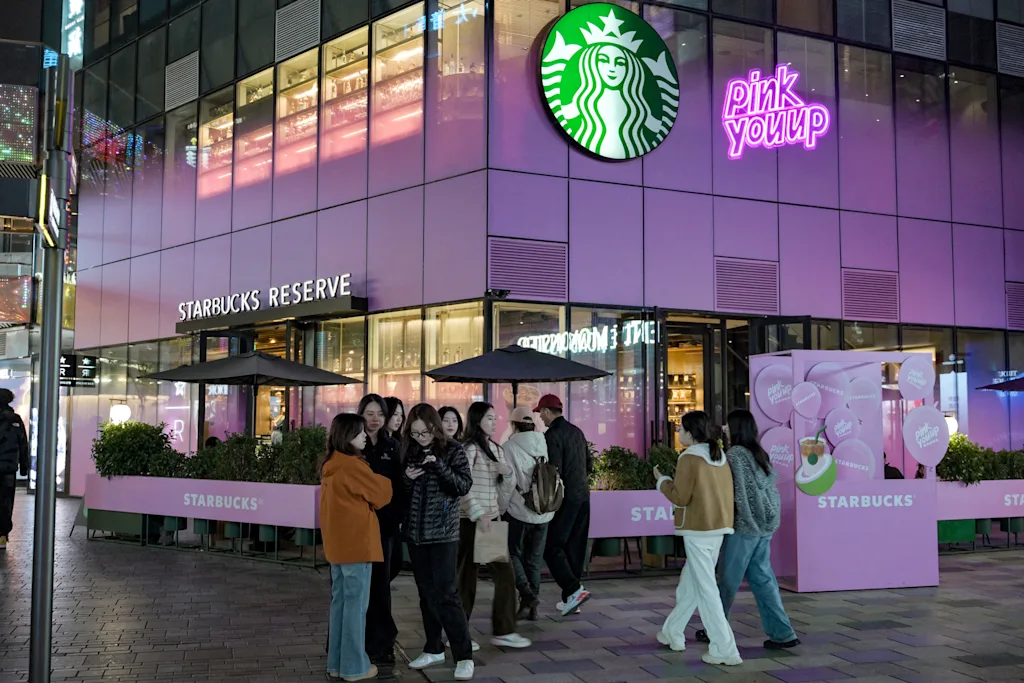
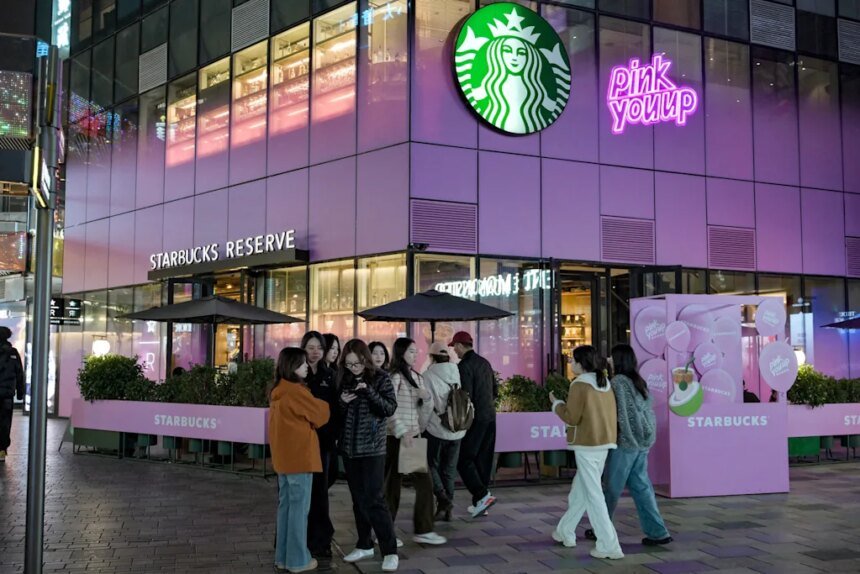
Consumers proved reluctant to pay Starbucks prices when the homegrown rivals that popped up offered cheap drinks, hassle-free mobile orders, quick delivery, and endless viral menu stunts. Starbucks pursued a pickup-only format in the U.S. after the pandemic (an ill-fated move that the company is just now rectifying), but was committed to maintaining the brand’s high-end coffeehouse image in China.
The company’s share of China’s coffee market fell from a high of 42% in 2017 to 14% by 2024, even as its store count doubled. A latte that cost $4.25 at Starbucks went for $2.25 at Luckin and $1.75 at Cotti.
In April of this year, under new CEO Brian Niccol’s leadership, Starbucks finally cut its losses and sold the China operation to Boyu Capital, a private-equity firm cofounded by the grandson of former Chinese president Jiang Zemin. Boyu got a favorable deal: It paid $4 billion to operate roughly 20% of Starbucks’s 40,000 global stores.
And it wasn’t just Starbucks: Tim Hortons, the only other Western coffee chain in China with more than 1,000 stores, saw sales fall 5.4% last year and posted $62 million in losses.
Meanwhile, the American coffee menu was evolving. A decade ago, iced was enough. “Millennials love cold brew,” Dunkin’ CEO Nigel Travis said after a menu revamp. Around the same time, Schultz insisted the market for cold coffee drinks was “limitless.”
Today, everywhere from Starbucks and Dunkin’ to Panera and Dutch Bros., you find dragonfruit refreshers with boba pearls, fruit-flavored cold foam, teas stuffed with fruit slices, ube macchiatos, and yuzu-filled croissants. America’s fast-food chains spent years trying to teach China to drink coffee. Now, back home, it’s starting to feel like it’s Shanghai’s turn to teach Seattle.
Luckin and Starbucks square off in the U.S.
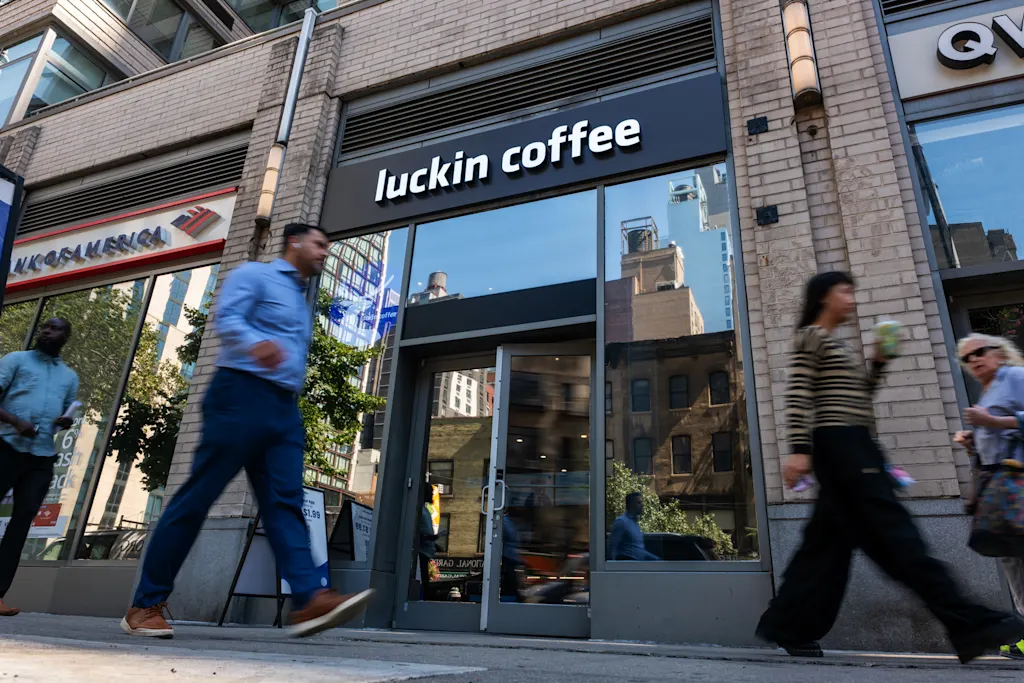
For its first U.S. location, Luckin chose Lower Manhattan, setting up in a shuttered Body Shop on Broadway near Astor Place. The heavy foot traffic and proximity to NYU’s campus made it appealing. But really, this seemed like a way to mock Starbucks.
Once a hangout for East Village characters near The Village Voice offices, Astor Place had for three decades been the site of a Starbucks that was briefly the largest in the U.S.—a popular study spot, date meetup, and de facto public restroom overlooking the square. The café closed unexpectedly in 2024. Store management blamed an “astronomically high” rent hike, though the landlord countered that rent stayed the “exact same.” Starbucks cited “the needs of our customers.”
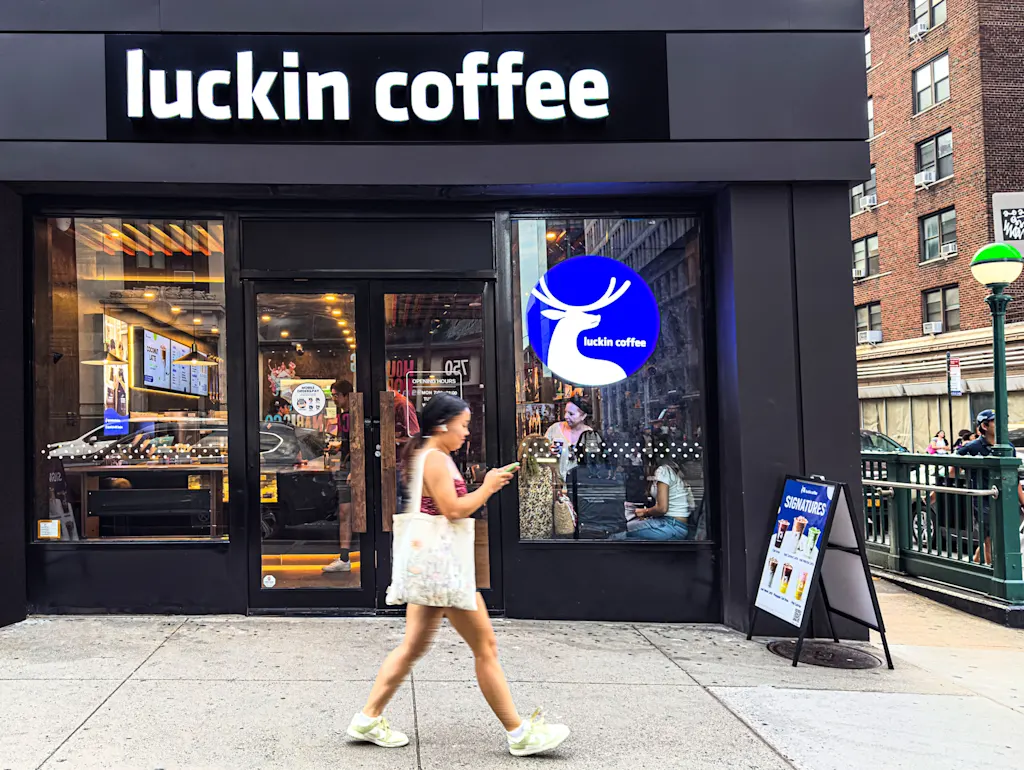
Months later, in June 2025, Luckin opened what it labeled store No. U.S. 00001 a block away. (Yes, Luckin’s numbering system for U.S. locations goes up to 99,999.) It’s more of a beverage dispensary, accepting no orders in person and featuring just three small tables—and it would probably have popped a vessel in a younger Howard Schultz’s forehead.
(A side note: While it marked Luckin’s physical arrival to the U.S., the company wasn’t a stranger to American markets. From mid-2019 to mid-2020, it traded on the Nasdaq, reaching a valuation of $12 billion before regulators accused it of inflating revenue by 45%. Luckin paid the Securities and Exchange Commission $180 million to settle fraud charges, and it was delisted.)
On the corner across from the new Luckin sat a vacant storefront. Following the grand opening, Starbucks rented the window space on both exposures and hung ads. It also bought a video ad at the intersection’s subway entrance. When I swung by, I could see Luckin customers being greeted in two directions by a model smiling with her Starbucks iced coffee.
The ads seemed to telegraph some anxiety. Luckin couldn’t seriously eat into Starbucks’s market share on its home turf, right? Well, maybe it could. Last year, Starbucks closed 42 New York cafés as part of a U.S. restructuring plan focused on reviving its “third place” model. It shuttered 400 underperforming stores nationwide, about 1% of its global footprint. Around 100 were mobile-order-only locations. Asked whether Luckin’s arrival had factored into this, Starbucks told the Financial Times that it was simply “doubling down on what customers have always loved about Starbucks—a warm and welcoming coffeehouse with high-quality beverages crafted by a skilled barista.”
Meanwhile, since its first U.S. store opened, Luckin has added 15 more Manhattan locations, with at least three more on the way. Store No. 00002, in Chelsea, faces a Starbucks, as do three of its other sites. Eight more are located within a two-block walk.
But stalking Starbucks would only do so much. I wanted to understand the actual strategy for winning over American coffee drinkers. I tried to meet with corporate Luckin representatives, but a meeting scheduled at the Financial District’s Fulton Street store (around the corner from a Starbucks) fell through twice. I was also told to presubmit my questions, because they needed “approval from China” first.
The U.S. team later explained that the topics I had asked to discuss were “outside of their current communications parameters.” They did, however, offer me a 700-word pre-written Q&A where they answered questions they wrote themselves. One prompt read, “How the brand is approaching localization from a product/marketing perspective, without getting into business strategy or expansion planning.” They responded: “For Luckin, localization is about understanding how coffee and beverage culture fit into local customers’ daily lives, not simply translating a brand from one market to another.”
What Luckin has offered investors isn’t any more illuminating. CEO Jinyi Guo has called the U.S. “strategically important” to the growing brand (its global store count has increased 39% in the past year, to 33,596 units) and believes that “Luckin’s unique value propositions and customer experience” are ready to compete in even a “highly developed” coffee market like the United States.
The most direct comment was probably one in an Instagram post addressed to customers after the Astor Place grand opening: “This is just the beginning. NYC, we’re here.”
Mixue sings an American tune
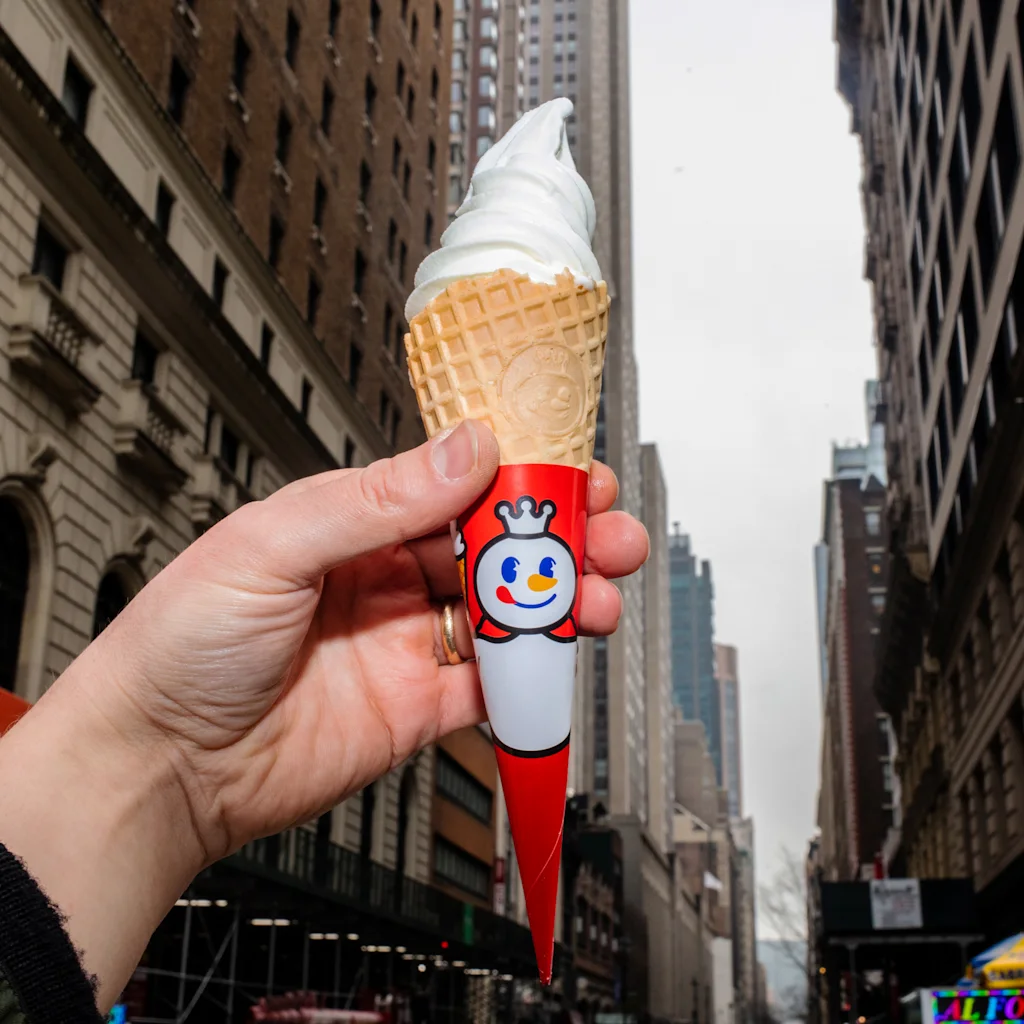
Mixue—a Chinese ice cream and tea chain founded in 1997 that has dethroned McDonald’s as the world’s largest food and beverage chain—arrived in the U.S. six months ago in a bicoastal strike, opening locations in Los Angeles and New York at the same time.
On a recent afternoon at the New York City flagship by Herald Square, people were queued on a red carpet (as happens often) for their turn to get boba and ube soft serve in a conspicuously Barney shade of purple. The storefront, two stories of all red, features the friendly, cape-wearing mascot, a snowman named Snow King, perched over the phrase “I LOVE YOU 🖤 YOU LOVE ME”—the lyrics to its world-famous jingle, which plays from loudspeakers effectively nonstop. One pedestrian sang along as he passed by.
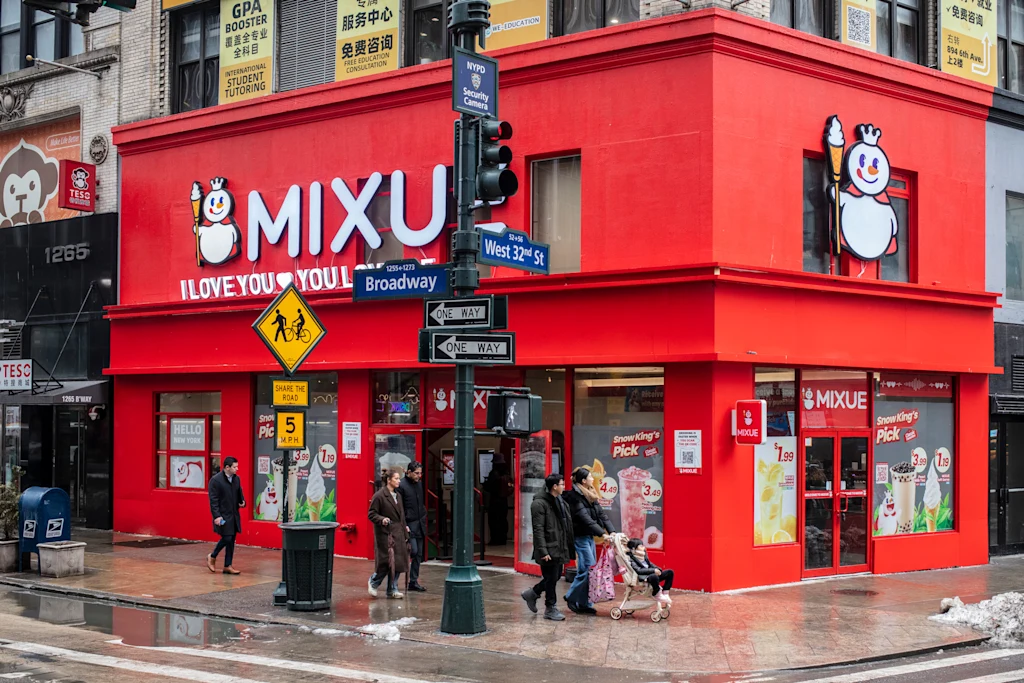
The Mixue motto, as founder Zhang Hongchao relayed it to Chinese state media, is: “Let people around the world eat well and drink well for just two American dollars.” Since December, New Yorkers have indeed been paying $1.99 for fresh lemonade and $1.19 for soft serve—half the price of a McDonald’s cone, and likely the cheapest in Manhattan. (Prices are slightly higher at L.A.’s Hollywood location.) Fruit teas and sundaes round out the menu, but one thing every customer takes home is the Mixue theme song, lodged in their head.
That is because the brand took “Oh! Susanna”—the 180-year-old American folk song about coming from Alabama with a banjo on the knee—and replaced every line of its melody with the same 11-word phrase: “I love you, you love me, Mixue ice cream and tea.”
The marketing agency behind this relentlessly cheerful earworm, Hua & Hua, works with several top Chinese food and beverage chains. In China, it’s known for creating the Super Sign, a method arguing that the most brilliant marketing is often the least creative. Instead of inventing something new, a brand should look for a universal symbol already hardwired into culture—a folk tune, a clown, a mermaid—and claim it as its own. Brother duo Sam and Nan Hua termed this “cultural copyright” in a 2013 book.
Decades ago, American brands pulled similar moves in China, where Ronald McDonald mugged for photos with party officials, and KFC swapped a chicken mascot, Chicky, for the all-American Colonel. Hua & Hua had this to pull from, and considers Mixue its magnum opus. Its AABA melody (found in “Twinkle, Twinkle, Little Star,” “Over the Rainbow,” “Every Breath You Take,” and many Beatles songs) is one of the catchiest types of music. And because “Oh! Susanna” entered the public domain long ago, Mixue paid nothing for it.
At December’s Herald Square grand opening, customers who sang the jingle got a free ice cream. TikTok and Instagram are full of American influencers singing it into their camera, often mangling the name as “Micks-yoo” or “Micks-oo–eey” instead of the correct “Mee-shweh.”
Earlier this year, Mixue opened its 60,000th global location. The majority of stores—more than 55,000—are still in mainland China. But lines are now forming in Bangkok, Jakarta, and Los Angeles to experience buying tea in Mixue’s carnival atmosphere of animated menu screens, workers dancing in Snow King costumes, machines whirring, and the never-ending jingle.
The future of Chinese chains in America
Not long ago, the consensus among Westerners about Chinese retail brands was they were “good, but not great, and definitely not cool,” argues Chris Pereira, CEO of iMpact, a firm that helps Chinese companies expand into Western markets. He says that American consumers’ openness, at least to unusual beverages, is something Chinese brands themselves “are still trying to figure out what to do about.”
It took American chains decades to acculturate themselves to Chinese customs and palates when they entered the country in the ’80s and ’90s. At first, KFC and McDonald’s charged too much: a little over $1 for a burger, 50 cents for a Coke in a society where monthly wages were $17 to $35. This was purposeful, to market Western fast food as a “treat.” Often, these were family outings that everybody dressed up for; it’s why McWeddings remain a thing. But as incomes rose and local rivals flooded the market with cheaper burgers and pizza, the luxury aspect waned. By the late ’90s, both chains were starting to become dependable family restaurants.
Starbucks arrived in 1999, securing coveted space in Beijing’s China World Trade Center. Its aim to give Chinese consumers a modern, upscale spin on their traditional teahouse turned its “third places” into a status symbol for a certain type of social striver and a punch line for others. A source I interviewed in 2022 recalled satirical advice being passed around the internet in the 2010s about how to “act cool at Starbucks”: Order an espresso, carry The Economist, and leave coins on the table so you could wave at staff and say, “I’m used to tipping in America. Keep it.”
Yet Starbucks seemed to relish the image. “We don’t run a discount company,” Schultz said in 2024 as rivals were practically giving coffee away. “We’ve already established a premium brand image in the market.”
The tension between what a brand is at home and what it becomes abroad is the trap laid by expansion, Pereira argues. It plays out in menu design, cultural signaling, workforce practices, even naming conventions. “Get the balance wrong in any of these directions and you lose,” he says.
When I think of Chinese chains selling their translation of American culture back to Americans, nothing comes to mind faster than the insidious Mixue jingle.
“Oh! Susanna” has a complicated history in the United States. Its national popularity turned Stephen Foster into America’s first professional songwriter. But the song is rooted in blackface minstrel traditions, and was only later rewritten to strip out explicit racism. What remains is a vaguely Southern-sounding ditty that many people can sing just a few words of.
Whether Mixue knew about this tangled history, I couldn’t tell you. Company representatives didn’t respond in time to my inquiries.
But one thing is certain. Since hearing it, I can’t get the blasted song out of my head. “I love you, you love me, Mixue ice cream and tea.” Does it even matter that it makes no sense? It taps into something basic and global—our appetite for things that are simple, sweet, and easy to consume without thinking.

