





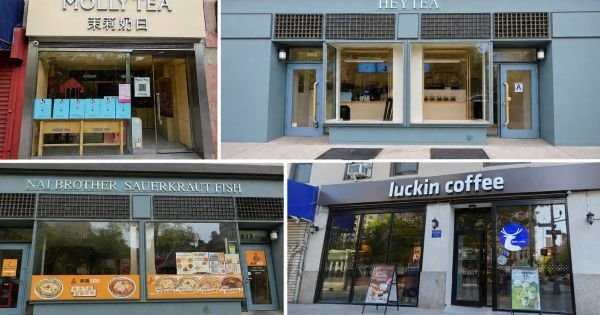

Local slowdowns fuel global competition
Even though Chinese brands are coming west because growth has slowed in their home market, this movement is still more about strategic expansion than survival migration.
The brands arriving here have already been sharpened in the world’s most competitive consumer market, on price, speed, and innovation. And they’ve proven they can excel at rapid global expansion.
Temu’s monthly active users in Latin America soared 143% in the first half of 2025 alone. Latin America now accounts for a third of Shein’s worldwide app downloads.
As these brands start to expand into the United States by way of New York City, they’re bringing a different way of doing retail, introducing ideas like blind box psychology, app-first ordering, and social-first product drops.
Luckin drove hour-long lines at its New York pop-up before a single store opened, through campaigns on RedNote, TikTok, and Instagram. American brands rarely launch this way.
Why brand marketers should care
Gen Z and millennials follow experiences, not legacy brands. Most Americans have never seen Luckin’s tropical cold brew flavors in a shop before, and are already being called more interesting than conventional American coffee by consumers.
A perception gap is opening that most American brands haven’t noticed yet. Chinese entrants are proving that affordable can mean desirable, well-designed, and culturally fluent. That is a direct challenge to the premium positioning American brands have leaned on for a decade.
Now is the perfect time for the value equation to be rewritten.
Wake up and smell the pineapple cold brew
Every wave of foreign retail looked like a curiosity before it became the competition, and eventually the new normal.
Korean beauty rewired skincare. Fast fashion rewired retail. All these trends originated with consumers willing to try something new.
Chinese retail moves so much faster than most American brands are used to.
Having led international expansion for a public tech company, I can attest that it’s a well-known practice for serious brand strategists at major retailers to go to Shanghai and Shenzhen to study consumer behavior. That’s because China’s retail innovation runs three to five years ahead of the West.
But as China’s retailers increasingly come directly to the streets of America, the gap is closing fast. If you’re in New York, take the 7 train to Flushing and experience the retail innovations that will be coming to your own block—and soon, across America—before you know it.

