





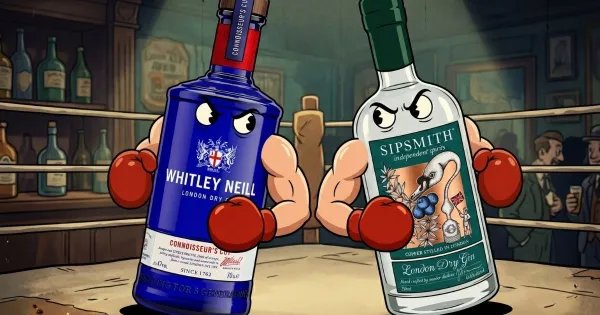

Every brand needs an enemy. A competitor you choose to benchmark against and beat.
Not every rival in the market. Not the whole category. Just one brand, one that overlaps most directly with your business, performs well enough to be worth studying, and is close enough to be attacked credibly.
The concept forces prioritization.
Once you make that choice, competing becomes more disciplined. Instead of asking what’s happening in the market, you start asking harder and more useful questions: Which rival matters most to us? Why this one? Where can we beat them? What would winning actually look like? And which actions deserve disproportionate focus?
The very real problem
Some companies study competitors to death, tracking share, benchmarking prices, dissecting launches, and filling decks with competitive analysis. Others claim, with great confidence, not to have competitors.
Both miss the same thing: a clear rival, a clear focus, and a clear plan for what to do next.
In many organizations, competitive analysis stops just before the only part that matters: “So what?” Teams struggle to convert all that intelligence into a small number of operational choices. What should sales do differently? What should marketing change? Where should revenue management push? Where should it stop admiring the spreadsheets and actually do something?
Too often, the output is a haze of noble intentions: improve visibility, strengthen premium credentials, sharpen innovation, support conversion.
None of this is specific enough to win.
Choose the right enemy
A good enemy, in general, should be larger than you, but not so much larger that the comparison flatters ambition more than it guides action.
Declaring war on the category giant may sound bold at the annual conference. It often means very little in practice. That was certainly true for Schweppes in soft drinks, where Coca-Cola was an obvious giant, but a poor enemy brand.
It was simply too large in awareness, budgets, distribution power, and market gravity to be a useful operational benchmark.
The best enemy is the brand from which you can realistically steal listings, shelf space, displays, customers, and share.
Turn observations into projects
At Suntory, Sipsmith’s decision to beat Whitley Neill in the premium gin category, instead of vaguely positioning Sipsmith against a broad and noisy set of competitors, immediately made our discussions more useful.
How did Whitley Neill structure pricing? Where was its range stronger on shelf? Which equivalent SKUs rotated faster, and why? Where were the distribution gaps? Which occasions did it serve better? And where was it stronger in visibility, execution, or retailer argument?

