






You’ve probably noticed it yourself: buyers aren’t just Googling anymore. They’re asking ChatGPT, Gemini, and Perplexity questions and trusting whatever answers they get. If your brand isn’t named in those answers, well, you may not even be a consideration.
That’s why understanding Answer Engine Optimization (AEO) and rank tracking solutions like HubSpot AEO vs SE Ranking are worth your time. HubSpot AEO and SE Ranking are both high-quality tools, but they solve different problems for different teams.
This comparison guide will help you figure out which one — or both — actually fits your team. No jargon overload. Just a clear, side-by-side look at features, pricing, and who each tool is truly built for.
Table of Contents
What is AEO and why does it matter now?
Think of AEO (or GEO) as the AI-era companion to SEO. You’re not just chasing a ranking on a results page; you’re shaping what the AI says about your brand when a buyer asks a direct question.
Looking at HubSpot’s own data, 42% of CRM buyers are using AI search as part of their evaluation process. Furthermore, organic traffic for customers is down 27% year-over-year, while AI referral traffic has tripled. And here’s the kicker: AI-referred leads convert at 3x the rate of traditional search visitors.
So, the urgency is warranted.
AEO and SEO aren’t competing priorities. They work together. SEO drives qualified traffic through traditional search. AEO earns visibility in AI-generated answers. The best teams are investing in both.
AEO vs SEO and How They Work Together
AEO and SEO work together rather than replacing one another. They solve entirely different problems:
- SEO improves discoverability in traditional search results, measuring success through rankings, click-through rates, and organic website visits.
- AEO improves brand visibility in AI-generated answers, measuring success by brand mentions, citations, share of voice, and sentiment.
A buyer asking “what’s the best CRM?” on ChatGPT may never click to your site, but if ChatGPT names your brand positively, they are primed to convert. In fact, Ahrefs data shows that AI search visitors have generated a 23x better conversion rate than traditional organic search.
Now here’s the question marketing teams are wrestling with: do you need a purpose-built AI visibility tool like HubSpot AEO to optimize for AI-generated answers, or does a full-suite SEO platform like SE Ranking (which has added AI tracking features) cover enough ground?
HubSpot AEO vs SE Ranking Overview
Before diving into specific features and pricing, here’s our thought process in a nutshell:
HubSpot AEO is the specialist. It is built specifically for AI visibility and tracks how your brand appears in answers from ChatGPT, Gemini, and Perplexity.
SE Ranking is the generalist. It is a comprehensive SEO suite covering rank tracking, site audits, and backlink analysis, and it recently added a growing AI search toolkit to its platform. On its own, frankly, it leaves a lot to be desired for AEO. However, the team recently released a standalone AI visibility tool called SE Visible that is more directly comparable to HubSpot AEO.
SE Visible is a completely separate product from SE Ranking with its own login, pricing, and feature set, purpose-built to monitor how brands are represented, cited, and perceived across AI search platforms.
HubSpot AEO and SE Visible are the most apples-to-apples comparison for dedicated AI visibility tracking. At the same time, SE Ranking is best evaluated on its own merits as a traditional SEO suite with added AI monitoring capabilities.
At-a-Glance Comparison
|
Feature Area |
HubSpot AEO |
SE Visible (by SE Ranking) |
SE Ranking |
|
Primary focus |
AI visibility + actionability |
AI visibility monitoring |
SEO research + rank tracking |
|
AI visibility tracking |
Yes — ChatGPT, Gemini, Perplexity |
Yes — ChatGPT, Gemini, Perplexity, Google AI Overviews, Google AI Mode |
Yes — via AI Search Toolkit (ChatGPT, Gemini, Perplexity, Google AI Overviews, AI Mode) |
|
Prompt tracking |
Yes — daily tracking, custom prompts (25 on base plan) |
Yes — 200–1,000 prompts depending on plan |
Yes — 100 prompts/day on Core plan |
|
Competitor Benchmarking |
Yes — shows which sources AI cites |
Yes — source category breakdowns (media, blogs, forums), top cited URLs |
Limited — mentions tracked, not deep citation intel |
|
Multi-country/language |
Yes — competitor citation comparison |
Yes — visibility, sentiment, and source gap analysis vs. competitors |
Limited within AI toolkit |
|
Citation analysis |
Not specified |
Yes — 7 countries, 5 languages |
Limited |
|
SEO rank tracking |
Not included |
Not included |
Core feature — 2,000 keywords/day on Core plan |
|
Site audits |
Not included |
Not included |
Yes — 120+ technical SEO metrics |
|
Keyword research |
Not included |
Not included |
Yes — gap analysis, competitor keywords |
|
CRM integration |
Native — recommendations tied to your CRM data |
None |
Zapier, Make, n8n, Looker Studio, GSC |
|
Content workflow |
Built-in — content recommendations in Marketing Hub |
Not included |
Content marketing tool available on some plans |
|
Pricing entry point |
$50/month standalone (28-day free trial) |
$79/month billed annually; $99/month billed monthly (10-day free trial) |
$103.20/month Core plan (14-day free trial) |
|
Standalone option |
Yes — no other HubSpot product required |
Yes — fully standalone product |
Yes — full SEO suite |
|
Best for |
Growth teams, in-house marketers, and HubSpot users |
Brands, agencies, and PR teams focused on AI visibility across markets |
SEO agencies,
freelancers, multi-project teams |
HubSpot AEO vs SE Visible (by SE Ranking): Features
Let’s break down the features that actually matter for your buying decision based on value.
Performance Monitoring & Analysis
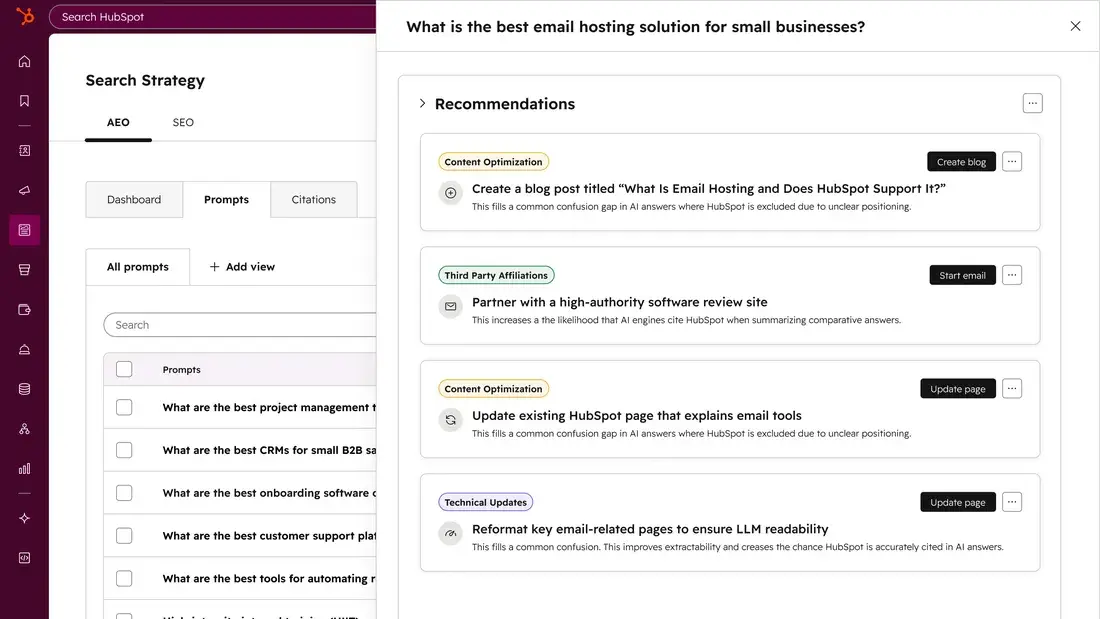
HubSpot AEO was purpose-built to focus on AI answers. That said, it excels at tracking brand visibility in AI-generated answers across all major answer engines, including ChatGPT, Gemini, and Perplexity.
It does this using four core features:
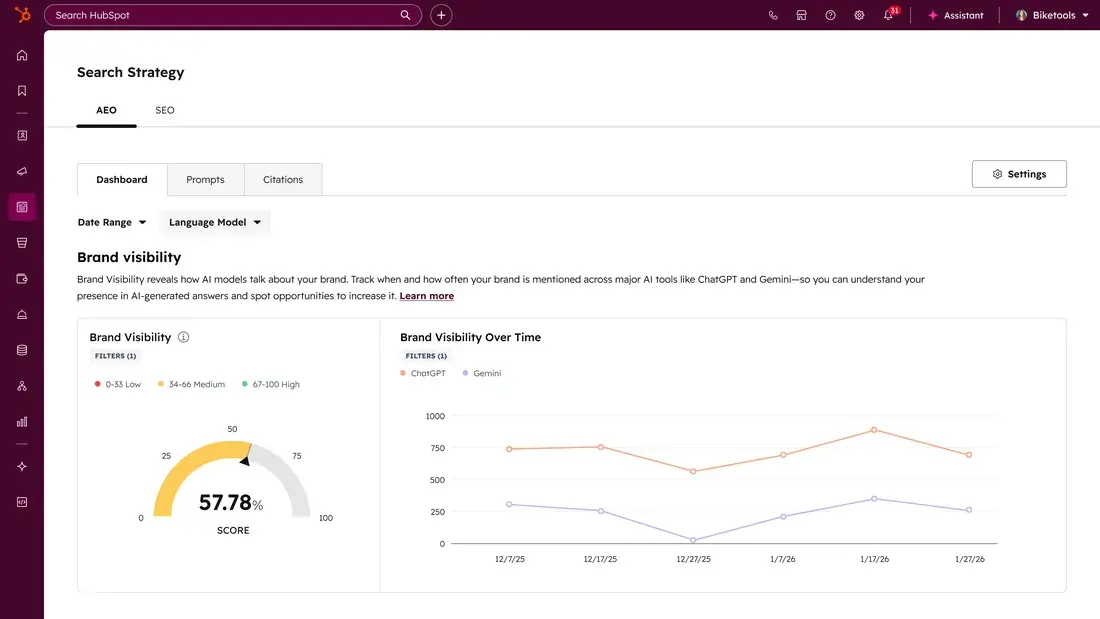
- Brand Visibility Score, which tracks how often your brand appears in AI-generated answers and updates weekly to show trends.
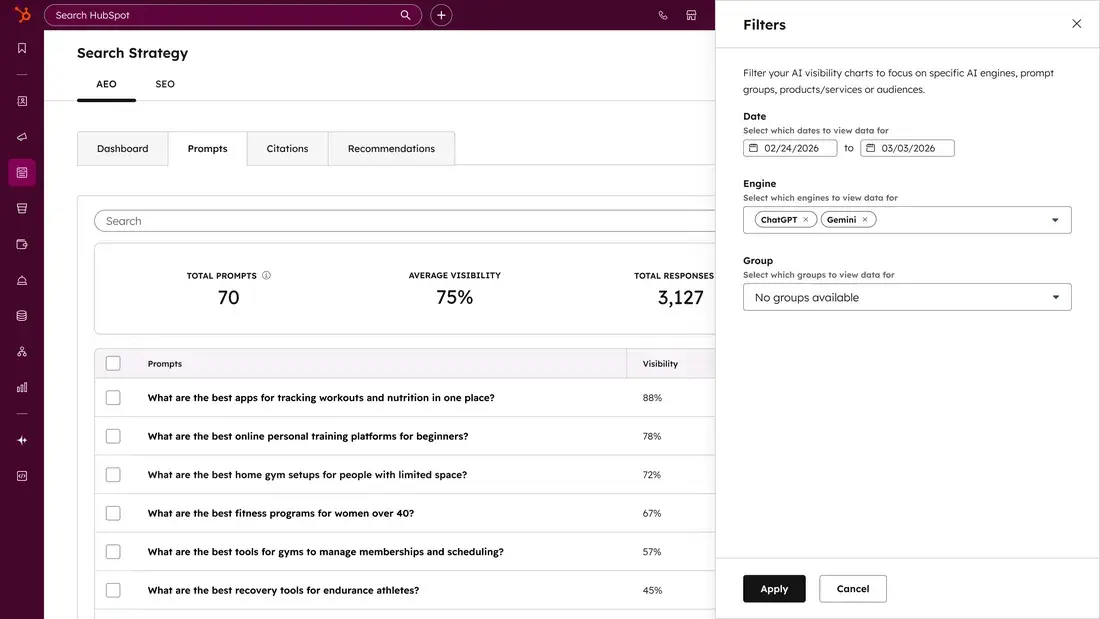
- Prompt Tracking,, which allows you to set prompts that match real buyer questions. If using Marketing Hub, it pulls prompt suggestions directly from your CRM data.
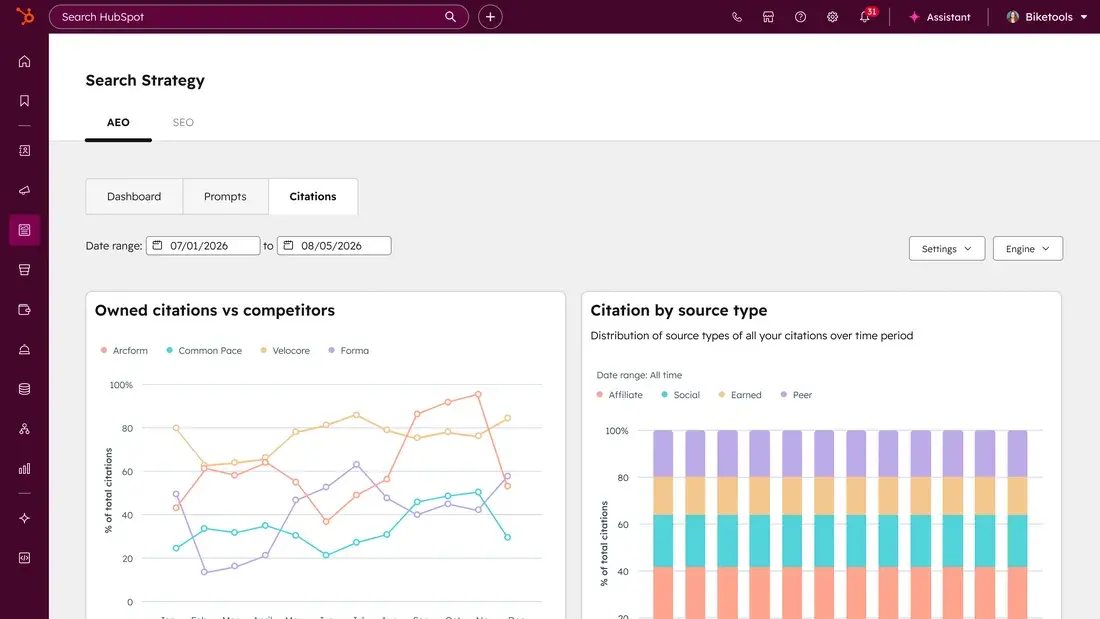
- Citation Analysis to show which pages influence AI answers. This tells you exactly where your content is working and gaining citations and where competitors may be doing better, acting as strong competitive intelligence.
- Prioritized Recommendations generate a specific action list of what content to create or update to close visibility gaps.
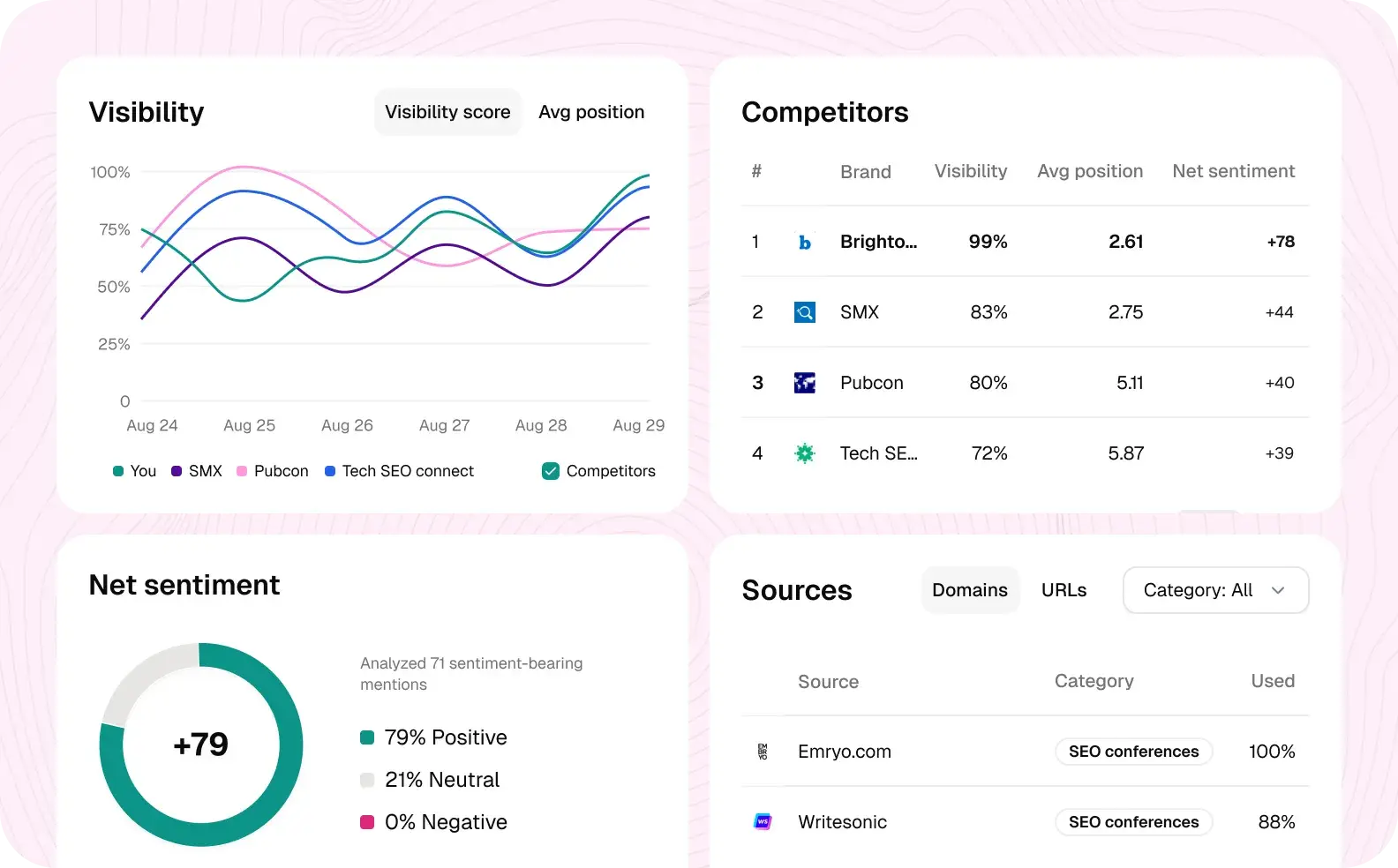
SE Visible focuses on AI visibility monitoring, with a distinct set of features:
- AI Brand Visibility Tracking monitors brand mentions and visibility trends across ChatGPT, Gemini, Google AI Overviews, Google AI Mode, and Perplexity, with weekly data updates and sentiment scoring (positive, neutral, negative).
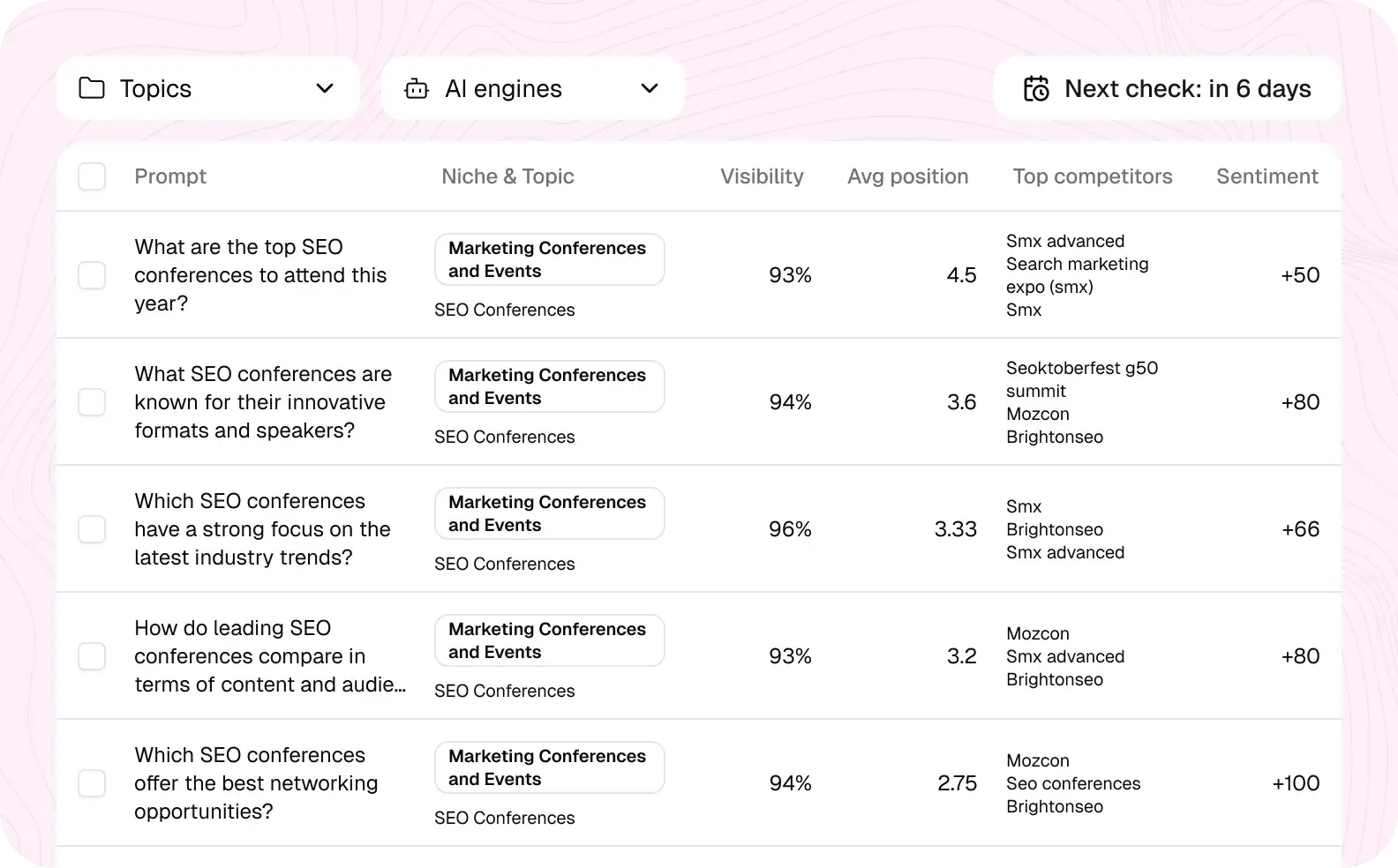
- Prompt & Answer Monitoring surfaces the prompts 7 topics where your brand appears in AI answers, with filtering by date,5engine, and topic.
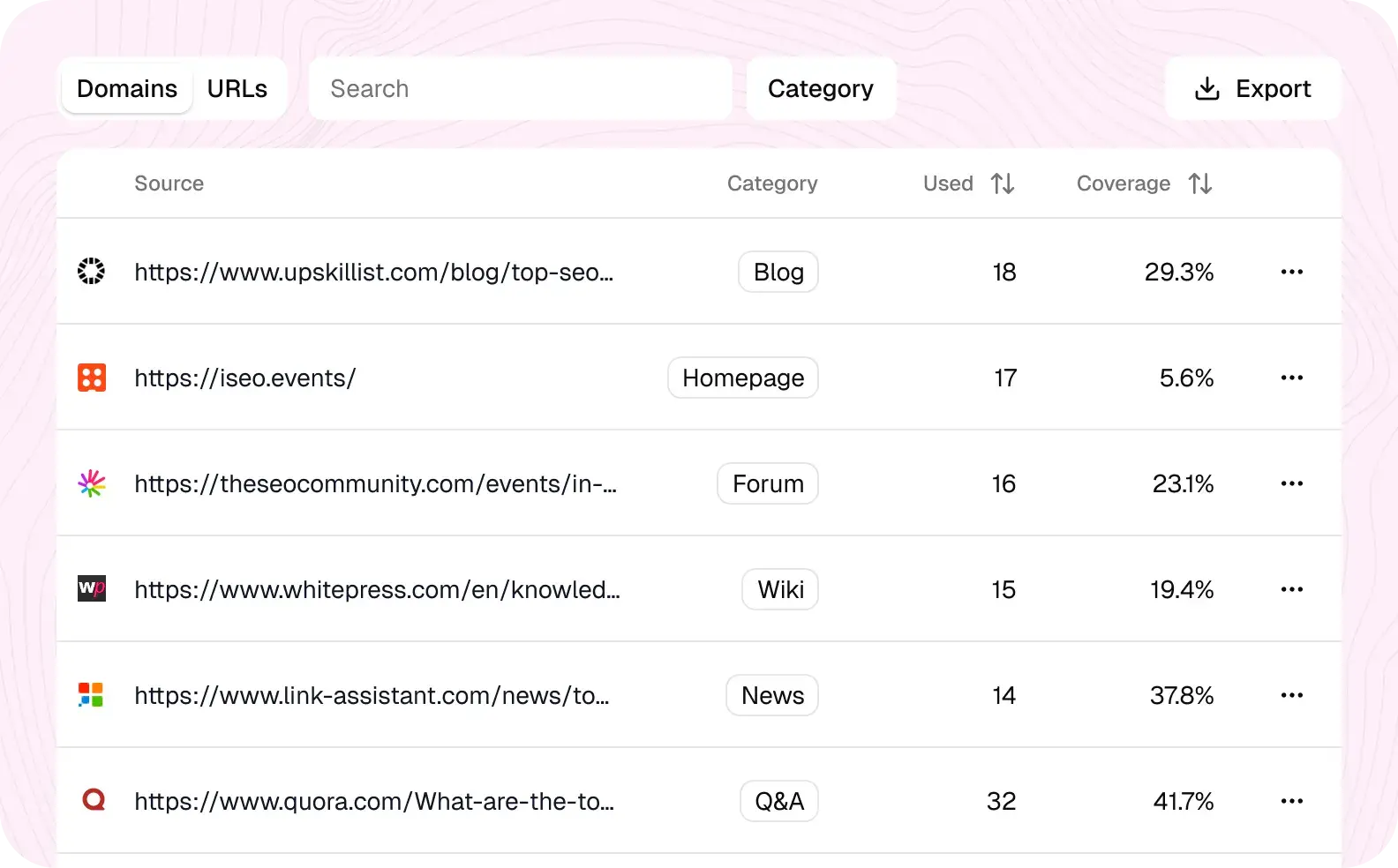
- Source Analysis reveals which domains and URLs appear most frequently in AI answers, broken down by category — media, blogs, forums — so you can build smarter PR and outreach strategies around the sources AI engines actually trust.
- Competitor Benchmarking lets you benchmark your brand’s visibility and sentiment against key competitors, including identifying which sources and prompts favor competitors over your brand.
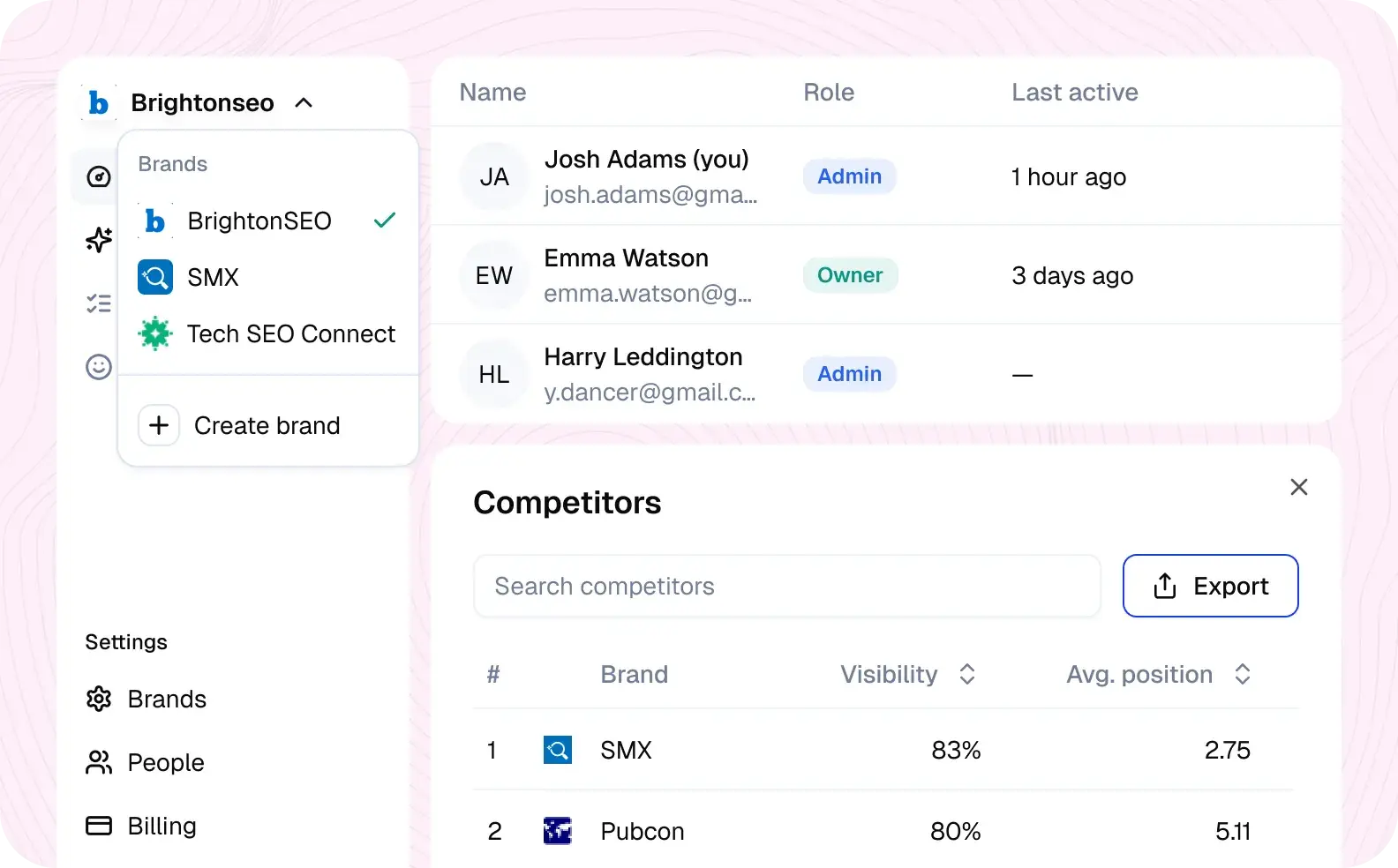
One standout feature for SE Visible is its multi-country and multi-language support, covering seven countries (US, UK, Canada, France, Germany, Netherlands, Spain) and five languages. For teams running regional campaigns or managing international brands, this adds real strategic value that HubSpot AEO currently does not.
SE Ranking focuses on traditional SEO, but recently introduced an AI Search Toolkit to aid in AI performance, with monitoring across Google AI Overviews, Google AI Mode, ChatGPT, Gemini, and Perplexity — as well as its core rank tracking and site audit capabilities.
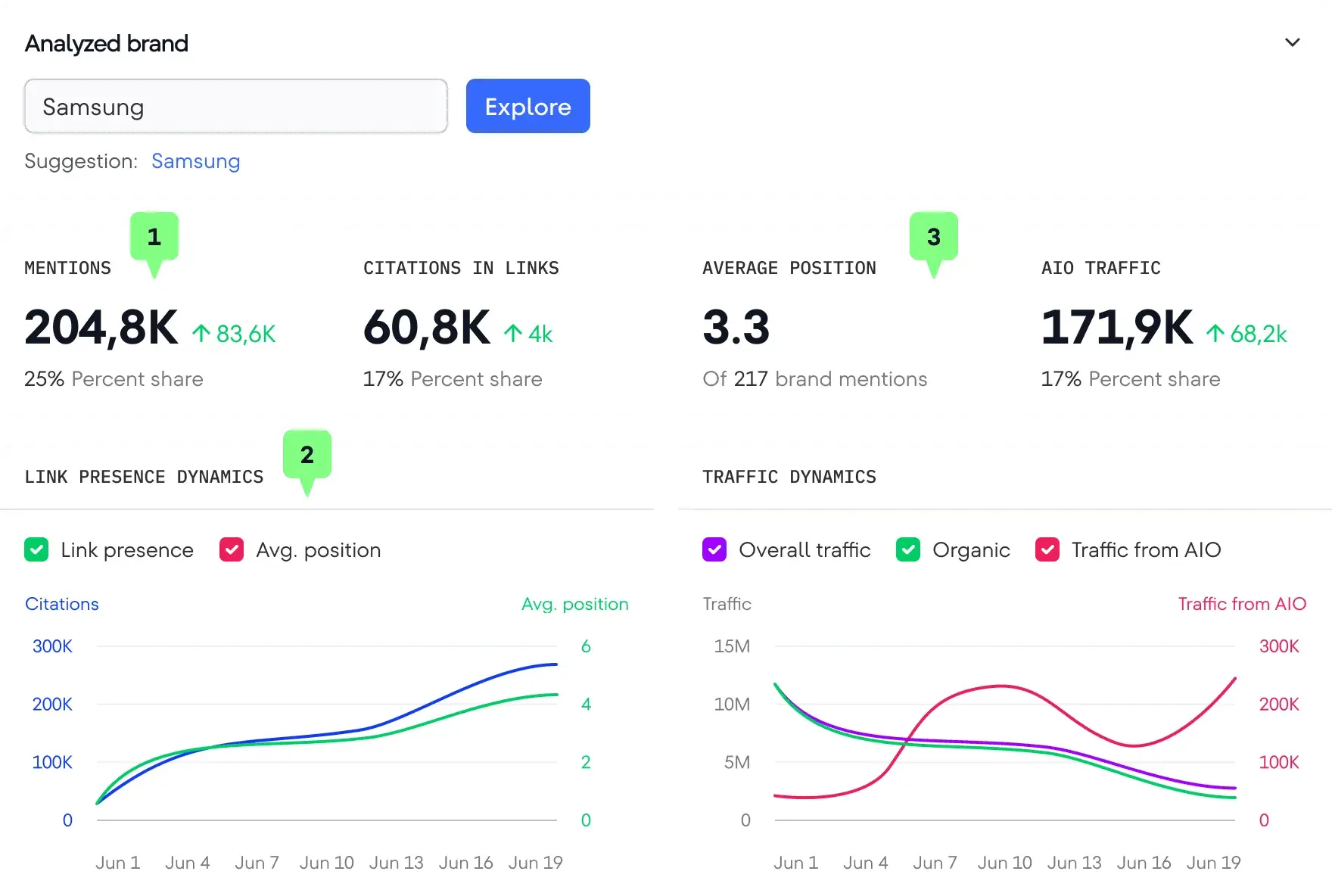
When it comes to navigating AI answer performance, two features stand out:
- AI Results Tracker & GEO Research: Monitors brand mentions across Google AI Overviews, ChatGPT, Gemini, and Perplexity, tracking visibility in AI-generated search results.
- Traditional Rank Tracking & Audits: SE Ranking supports traditional SEO research, auditing, and rank tracking across search engines. The Core plan tracks 2,000 keywords daily across Google, Bing, Yahoo, and YouTube. It also crawls pages for over 120 technical SEO metrics.
Task Automation
- HubSpot AEO runs prompts daily against major answer engines, automatically updating your prioritized recommendations without manual audits.
- SE Visible provides weekly automated data refreshes, continuously monitors brand mentions and sentiment across all five AI platforms in the background. It does not currently offer daily prompt runs or built-in content workflow automation, but it surfaces trends and source changes without manual intervention.
- SE Ranking handles automated daily keyword checks, scheduled site audits, and automated client reports, while the AI Results Tracker monitors search surfaces in the background.
As AI models constantly evolve, continuous monitoring is critical to adjust and adapt the strategy as needed. On top of that, answer engine optimization is an ongoing practice, not a one-and-done project. As you adopt the strategy, it will likely add new redundant tasks to your to-do list.
When evaluating HubSpot AEO vs. SE Ranking, it is important to look at how each platform handles repetitive, discrete tasks to keep your team focused on execution rather than manual data collection.
HubSpot AEO automates the end-to-end AEO workflow. Once configured, HubSpot AEO automatically runs your prompts daily against major answer engines. As your brand’s visibility shifts in the AI ecosystem, the tool also automatically refreshes its prioritized recommendations, ensuring your marketing team always has a current action list of content to update. It manages this entire process seamlessly inside a connected marketing platform.
SE Visible automates AI visibility monitoring at the brand level. Weekly data updates track shifts in mention frequency, sentiment, and source behavior across all five platforms, without requiring manual pulls. It does not yet offer the same daily cadence or built-in content action layer as HubSpot AEO, but it is purpose-built for visibility measurement rather than workflow orchestration.
By contrast, SE Ranking automates the traditional SEO workflow. It handles high-volume daily keyword rank checks, scheduled technical site audits on a weekly or monthly basis, and generates automated client reports. While its AI Results Tracker does monitor search surfaces in the background without manual prompting, SE Ranking relies heavily on integrations with Zapier, Make, and n8n for custom automated reporting pipelines (i.e.,, pushing rank-tracking data directly into a Looker Studio dashboard).
HubSpot AEO vs SE Visible (by SE Ranking): Pricing
It doesn’t matter how great a tool is if it doesn’t fit into your budget. Pricing models for HubSpot AEO vs SE Ranking are straightforward, but their entry points and scaling logic reflect their fundamentally different focuses.
HubSpot AEO Pricing
HubSpot AEO provides a low-barrier entry point for AI visibility. It begins with a completely free AEO Grader to assess baseline brand visibility. This tool scores your brand out of 100 based on sentiment, share of voice, presence quality, brand recognition, and market position. From there, the standalone product is a highly accessible $50 per month (or $45 per month if billed annually) and includes a 28-day free trial.
This tier includes tracking for 25 prompts across ChatGPT, Gemini, and Perplexity, deep citation analysis, and prioritized recommendations without requiring any other HubSpot subscription. Furthermore, if your team already utilizes Marketing Hub Pro or Enterprise, the CRM-connected AEO tools are natively included at no extra cost.
SE Visible Pricing
SE Visible offers three pricing tiers, all available with a 10-day free trial. The Basic plan starts at $99/month, billed monthly, and includes 200 prompts, approximately 12,000 AI answers analyzed per month, and 3 projects. The Plus plan scales to $355/month, billed monthly, and includes 1,000 prompts, approximately 60,000 AI answers analyzed per month, and 10 projects. Annual billing saves 20% across all plans, and scaling is based on prompt volume and number of projects, not by platform access or seat count.
SE Visible includes access to all five AI engine integrations (ChatGPT, Gemini, Google AI Mode, Google AI Overviews, and Perplexity), unlimited users, and CSV export.
Compared to HubSpot AEO, SE Visible carries a higher entry price ($79/month vs. $50/month) but also offers higher prompt volume at the base tier (200 vs. 25). For teams primarily focused on AI visibility monitoring at scale — particularly across multiple brands or markets — SE Visible’s volume limits offer strong value relative to its price. Custom plans are also available via the sales team.
SE Ranking Pricing
SE Ranking has a higher entry cost, but it’s also an entire SEO suite, not just an AEO add-on. Following a 14-day free trial, the Core plan of SE Ranking begins at $103.20 per month (when billed annually) or $129 billed monthly. This plan manages up to 10 projects and includes 2,000 daily keyword checks, 120+ point site audits, backlink analysis, and tracking for 100 GEO prompts per day across engines like ChatGPT, Perplexity, and Google AI Overviews.
The Growth plan scales to $223.20 per month (annually) to cover 30 projects and 5,000 daily keyword checks, adding API access and historical data.
Another important cost note: SE Ranking calculates its tracking limits by multiplying your keywords by the number of search engines tracked, which can inadvertently inflate effective costs.
Ultimately, HubSpot AEO is significantly cheaper and user-friendly for dedicated AI tracking and CRM integration. SE Ranking is more expensive, but highly economical if you are actively looking to replace separate, individual rank tracking and auditing tools with a single platform.
HubSpot AEO vs SE Ranking: Execution & Integrations
Insight without action is just a dashboard. Teams need an AI tool that helps turn the information and recommendations it surfaces into strategic moves. Here’s how each platform does that.
HubSpot AEO connects its AI visibility insights to CRM-informed recommendations and content workflows. For example, when the tool identifies a prompt where a competitor outperforms you, it generates a prioritized recommendation.
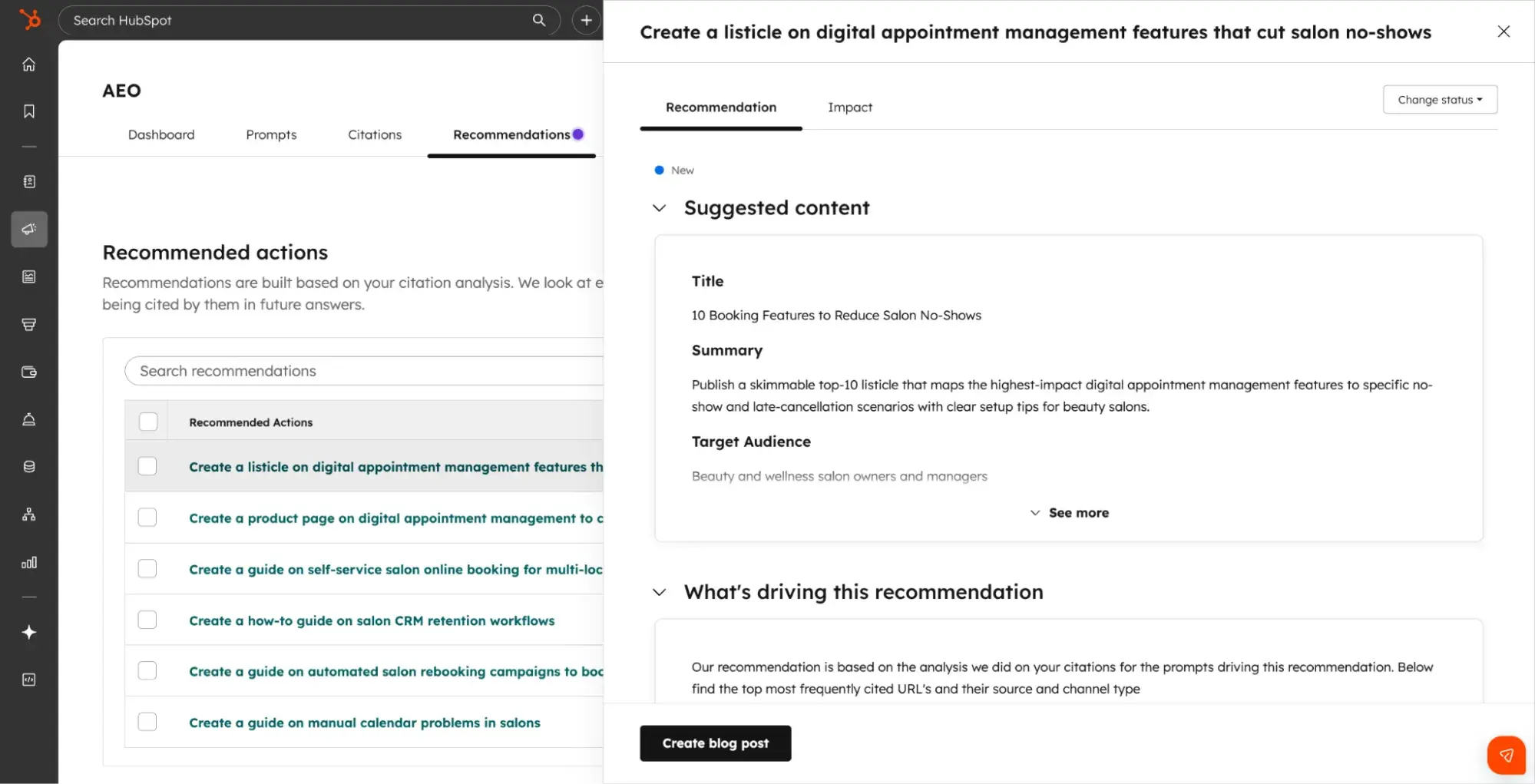
If you are on Marketing Hub Pro or Enterprise, these recommendations connect directly to your content creation tools and CRM data, allowing you to draft content without leaving the platform. This is particularly powerful when running content audits to refresh your content library.
SE Visible is a monitoring and analysis platform. It surfaces how your brand is being represented in AI answers and surfaces source and competitor data you can act on — but it does not include a built-in content workflow or CRM connection. Teams will use their CSV exports and dashboards to inform their content and PR strategies externally. For brand and PR teams, this is often exactly the right fit: clean data you can plug into your existing workflows.
SE Ranking is an insights platform, not a management platform. However, it does connect to Google Search Console, Google Analytics, Looker Studio, Zapier, Make, and n8n to help put its findings to work. While SE Ranking does not connect to a CRM, it can handle crucial automated audits, scheduled reporting, and automatic rank monitoring.
HubSpot AEO vs SE Visible (by SE Ranking): Who are they best for?
The right software is not necessarily the one with the longest feature list; it is the one that perfectly aligns with your organizational structure and daily workflow. HubSpot AEO and SE Ranking vary greatly in how well they integrate with different team structures and workflows.
Choose HubSpot AEO if …
It is exceptionally powerful for existing HubSpot Marketing Hub users, as having AEO recommendations connected directly to CRM data and content creation tools saves substantial time and ensures competitive intelligence is highly customized to your actual customer segments.
Choose SE Visible if …
- You need dedicated AI visibility tracking with high prompt volume, and don’t need SEO rank tracking or site audits bundled in.
SE Visible is purpose-built for monitoring how your brand is represented in AI answers, with no SEO overhead.
- You are managing multiple brands or clients and need multi-project tracking with unlimited users.
SE Visible’s project-based structure and collaboration features make it well-suited for agencies and brand teams managing several properties simultaneously.
- International or regional AI visibility matters to your strategy.
With support for seven countries and five languages, SE Visible is the strongest option among the three for brands running localized campaigns or monitoring AI sentiment across multiple markets.
- You work in brand, PR, or product marketing and need to monitor how AI engines portray your brand, spot misinformation early, and understand which media outlets or blogs AI is citing — without being embedded in a broader CRM or SEO platform.
Choose SE Ranking if …
- You are an SEO agency or freelance consultant who needs rank tracking, audits, competitor analysis, and client reports in one platform.
It is built for professionals managing multiple distinct properties (typically 5 to 30 client sites) that require deep traditional SEO execution within a single, unified platform. It also offers white-label reporting via an Agency Pack add-on specifically for client deliverables.
- Traditional SEO is your core workflow, and you want to layer AI visibility tracking on top.
- You need deep keyword tracking and international SEO. SE Ranking offers (2,000+ keywords/day and SEO coverage across 188+ countries. This is a lot of value at a lower price point than premium competitors like Semrush or Ahrefs.
How to Improve Brand Rank AI in Two Weeks
Getting started with Answer Engine Optimization does not have to be a complicated, months-long implementation project. Because AI models are constantly processing and re-indexing information, you can begin capturing meaningful data and making strategic adjustments almost immediately.
A 14-day sprint is the perfect timeline to establish a firm baseline and launch your initial content optimizations. Let’s break down what this looks like using HubSpot AEO vs SE Ranking and SE Visible.
How to Get Started with HubSpot AEO
When utilizing HubSpot AEO, your first two weeks should be laser-focused on gathering immediate visibility data and rapidly transitioning those insights into CRM-connected content updates.
Here is the specific playbook to follow:
1. Start with HubSpot’s free AEO Grader.
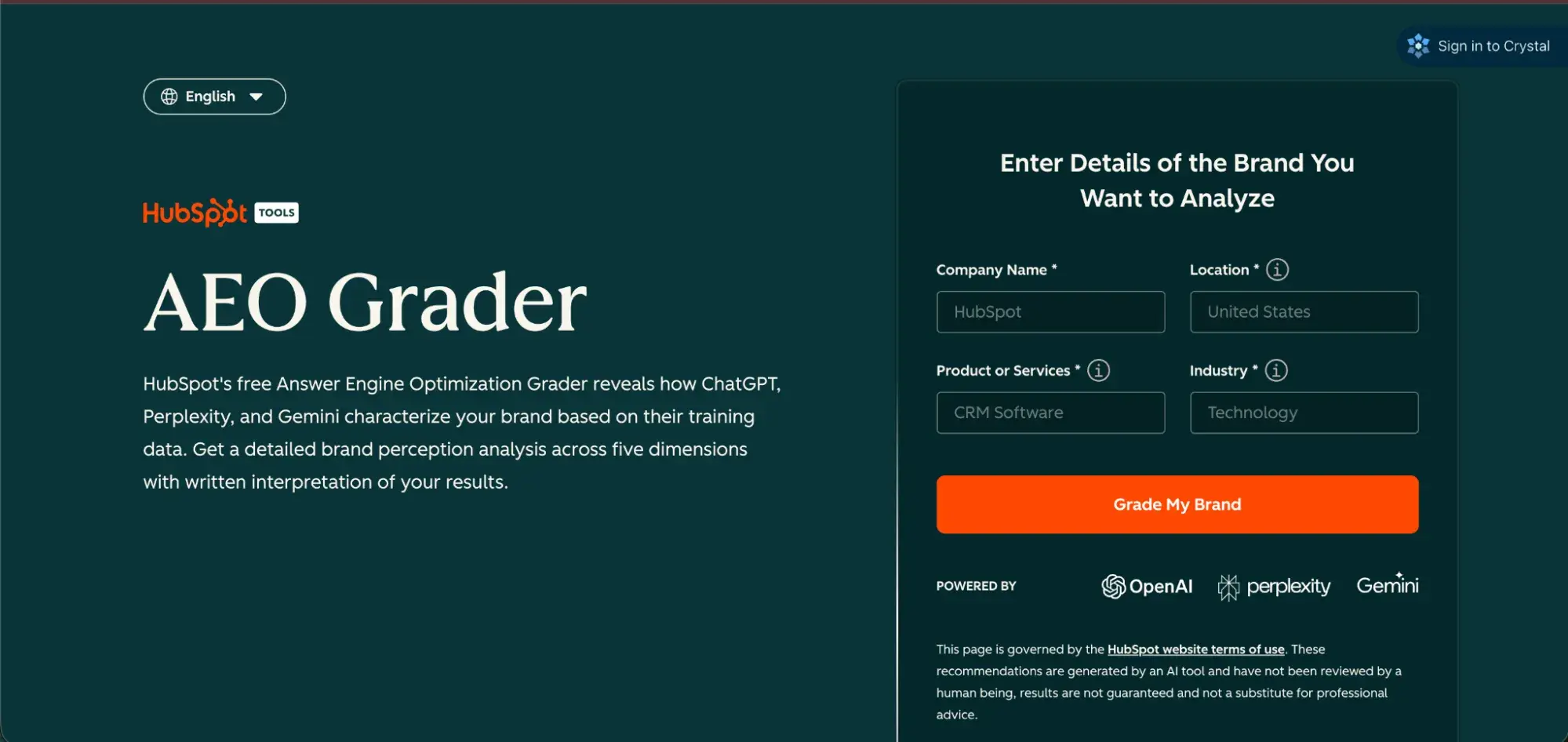
Before you change a single word of content, you must know where your brand currently stands. HubSpot’s free AEO Grader provides an immediate baseline score across five crucial dimensions:
- Sentiment
- Presence quality
- Share of voice
- Brand recognition
- Overall market position.
You can generate this score in minutes without even creating an account.
2. Launch a free 28-day trial of HubSpot AEO.
Once you have your baseline grade, activate the free trial to set up your ongoing tracking. Use it to set up 25 prompts (the trial limit). Make sure these prompts reflect real, direct questions your buyers are asking during their evaluation process to get the most value from the trial. This can also help you gauge how you will use and should budget your AI credits.
3. Review your brand visibility score and citation analysis.
Allow HubSpot AEO a few days to gather comprehensive data across the engines, then analyze the results. Usually, working on this on days 3-5 is a good timeline.
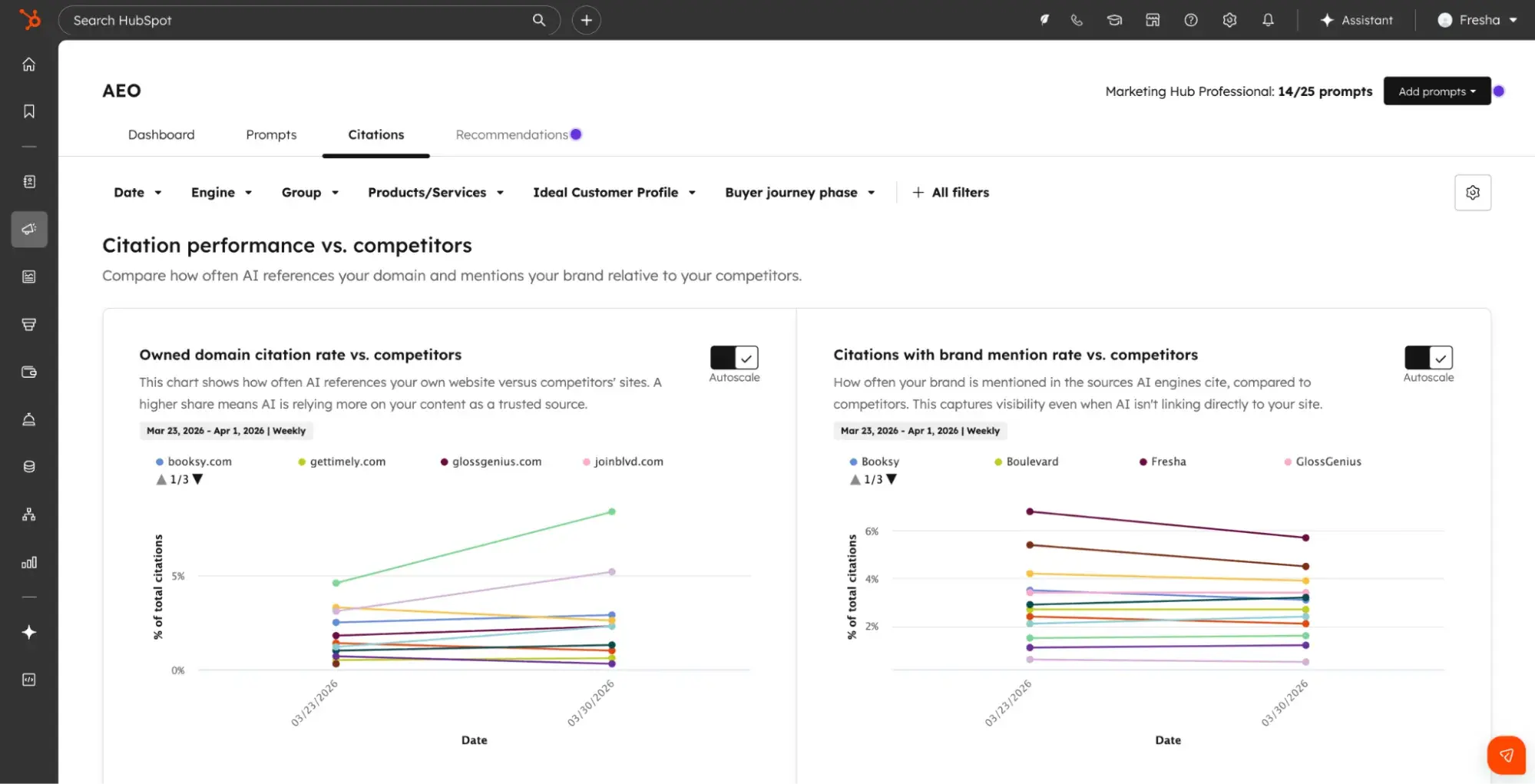
The citation analysis is particularly vital here, as it will reveal exactly which domains and content types the AI models are currently pulling from to build their answers.
4. Execute your prioritized recommendations.
Identify the top two to three highest-impact content actions from your prioritized recommendations list and assign them to your content team.
5. Compare your visibility score to the baseline after two weeks.
While large-scale changes to your brand’s AI presence typically reflect content improvements made over 4-8 weeks, comparing your score at the two-week mark will help you catch meaningful early signals regarding how AI is describing your brand.
After comparing your two-week visibility score to the baseline, you can get more granular about what content should be created, updated, and prioritized to improve your AEO.
How to Get Started with SE Visible
If your team’s primary goal is AI brand monitoring, particularly across multiple markets or brands, SE Visible’s 10-day free trial gives you a fast ramp:
1. Start the 10-day free trial and set up your first project.
Create your brand profile and connect the domains you want to monitor. If you are an agency, use this time to configure separate projects for each client.
2. Configure your prompts and topics.
Load in the buyer questions and product topics most relevant to your brand. SE Visible provides localized topic suggestions by language, which is especially useful if you are running multi-country monitoring.
3. Review your brand visibility and source analysis.
After a few days of data collection, examine which domains AI engines are citing when your brand appears in answers. The source breakdown by category (media, blogs, forums) will tell you where to focus your PR and content outreach to earn more citations.
4. Run a competitor benchmarking report.
Compare your brand’s AI visibility and sentiment against your top competitors. Identify which prompts and sources favor competitors, and use those gaps to prioritize your next content or PR sprint.
How to Get Started with SE Ranking
If your team chooses SE Ranking to manage AI tracking alongside a comprehensive SEO strategy, your first two weeks will naturally blend traditional technical SEO maintenance with AI Search Toolkit monitoring.
1. Start the 14-day free trial and connect your domain.
Connect your domain and set up a rank tracking project immediately. This gives the tool access to your traditional SEO baseline and current priorities when it comes to AEO.
2. Run a full site audit.
Before trying to optimize for advanced AI answers, you must ensure your technical foundation is sound. Running a full site audit will identify critical technical SEO gaps (such as crawlability or indexability issues) that could hurt your AI visibility.
3. Set up the AI Search Toolkit.
With your technical foundation assessed, configure the toolkit to actively monitor your brand’s mentions across ChatGPT, Perplexity, and Google AI Overviews.
4. Execute a keyword gap analysis.
Use SE Ranking’s deep keyword research tools to run a gap analysis. This will reveal the specific topics and search queries where your direct competitors are currently ranking, but your brand is entirely absent. Use these insights to plan and prioritize your next content sprints.
Frequently Asked Questions about HubSpot AEO vs SE Ranking
Does SE Ranking support answer engine optimization?
Yes, SE Ranking monitors brand mentions across Google AI Overviews, Google AI Mode, ChatGPT, Gemini, and Perplexity. However, SE Ranking lacks the CRM-connected recommendations and purpose-built AEO workflow that HubSpot AEO provides. For teams that want a standalone AI visibility tool from the SE Ranking ecosystem, SE Visible is the purpose-built alternative.
What is SE Visible, and how is it different from SE Ranking?
SE Visible is a standalone AI visibility monitoring platform built by the SE Ranking team. It lives at visible.seranking.com with its own pricing, login, and feature set — separate from SE Ranking’s core SEO platform.
SE Ranking is a comprehensive SEO suite that added AI tracking features to its core platform, whereas SE Visible (a separate product built by the SE Ranking team) is purpose-built from the ground up specifically for monitoring how brands are represented in AI-generated answers across ChatGPT, Gemini, Google AI Mode, Google AI Overviews, and Perplexity.
Do I need a CRM to benefit from AEO?
No. HubSpot AEO is available as a standalone product for $50/month without requiring a CRM. However, HubSpot AEO becomes meaningfully more powerful when connected to Marketing Hub Pro or Enterprise, as prompt suggestions are generated from your actual customer segments rather than generic industry lists.
When should I choose AEO over SEO?
You should not choose AEO over SEO, or vice versa—they serve different purposes. If your SEO foundation (technical health, rank tracking) is strong but AI visibility is an unmeasured gap, AEO is the right addition. Once your SEO is solid, AEO extends your visibility into the AI answer layer.
How quickly can I see meaningful changes from AEO updates?
Most teams see their first baseline visibility data from AEO within the first two weeks. Actual changes in brand visibility scores typically reflect content improvements made over 4–8 weeks, as AI models re-index and update their citation patterns.
Can I use HubSpot AEO without other HubSpot Hubs?
Yes, HubSpot AEO is a fully standalone product at $50/month. You get full access to brand visibility tracking, prompt tracking, citation analysis, and prioritized recommendations without needing a CRM or Marketing Hub.
Ready to see where your brand stands?
The fastest way to understand your AI visibility is to measure it. If you’re not yet sure where to start:
- Run the free AEO Grader. Get a scored baseline across five brand visibility dimensions in minutes.
- Start a free 28-day trial of HubSpot AEO to set up ongoing prompt tracking, citation analysis, and recommendations, or the 10-day trial of SE Visible if multi-brand or international monitoring is your priority.
- Start the 14-day trial of SE Ranking to try its full SEO suite alongside its AI search toolkit.
- Book a demo of HubSpot AEO if you want to see the CRM-connected workflow in action before committing.

