






In the 2,000-plus episodes of Stuff They Don’t Want You To Know, hosts Ben Bowlin, Noel Brown, and Matt Frederick have lured perennially suspicious Americans with topics like the Illuminati, AI psychosis, the Ticketmaster conspiracy, and a segment called “Could fermented cabbage save humans from microplastics?”
Say what you will, the three hosts have landed their show in the country’s top 100 podcasts—no mean feat, considering that the world offers a choice of over 4.7 million of them.
The show’s roots date to the 1998 debut of website How Stuff Works, which branched into podcasting and eventually led to the creation of Stuff Media LLC. iHeartMedia snapped it up in 2018 for a reported $55 million.
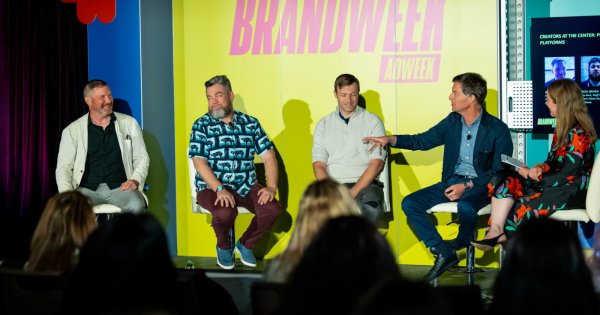
Today, having steered their program across multiple formats and platforms, Bowlin, Brown, and Frederick have plenty to say about the evolution of content. Joining iHeart CEO Conal Byrne on stage at Brandweek, they shared some of the most important lessons they’ve learned. We’ve selected five of them here.
All ideas deserve consideration
Bowlin credited much of the show’s popularity to his colleagues’ willingness to consider almost any topic, a practice that dates back to the early days of podcasting, when there was no real formula for anyone.
“When we first started off in this new frontier, there were no bad ideas,” Bowlin said. “Luckily, we were able to have the agency, and a team behind us, that said: ‘We should try everything.’”
Your audience is also your content
While “listener mail” has been a regular feature of the program, the hosts rely on their adherents to bolster the episodes with their own experiences and expertise. Bowlin referred to it as an “interactive and reciprocal” relationship.
On a recent episode about nuclear weapons, Brown said, they heard “from a guy who is literally the guy that launches nuclear weapons, and he told us what that world is like,” he said. “And it’s not a big red button, it turns out.”
Metrics can include your gut feeling
Byrne keeps his eye on every measurement of how the show is performing—”from cost to sales to downloads, the gross margin, the bottom line margin, all that stuff,” he said. But even in the era of data analytics, it’s still okay to use “squishy” metrics.
When he listens to episodes, Frederick asks himself: “Did I feel good listening? Did the conversation move, and did it go in interesting directions?” For Bowlin, the big measurement is the question: “Are we excited to do this again tomorrow?”

