




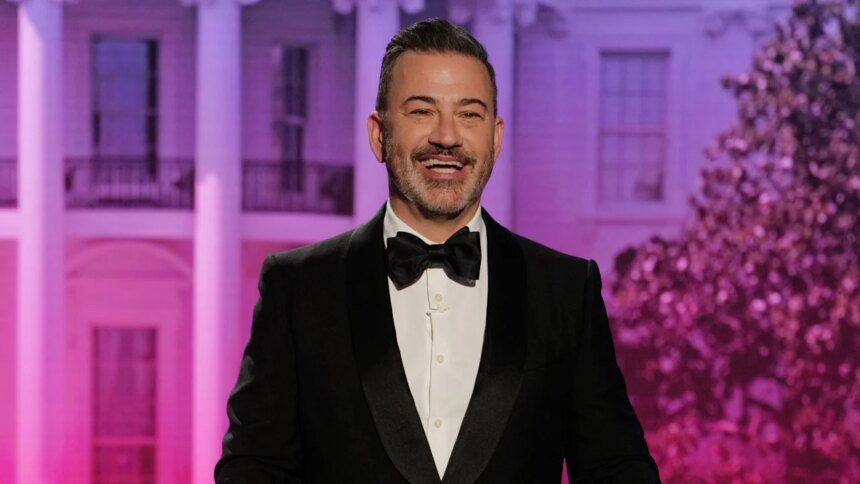

It looks as if Donald Trump will have to keep waiting for his least-favorite talk show host to hang up his jersey in the studio rafters.
The president emerged from the chaos of last week’s attempted shooting at the White House Correspondents’ Dinner with two major demands—that his big, beautiful militarized ballroom resume construction and that ABC fire Jimmy Kimmel over a morbid joke. (Days before the WHCD, Kimmel had described Melania Trump as having “the glow of an expectant widow.”)
While the first request may or may not find support, subject as it is to the whims of the courts, the second one seems even less likely.
In a stark contrast to last September—when ABC and parent company Disney quickly yanked Kimmel off the air after Federal Communications Commission Chair Brendan Carr objected to a monologue about Charlie Kirk’s assassination—Disney has so far only indicated that the incident is being discussed. It seems the conditions for Kimmel getting pulled off the air are simply no longer there. Like many other organizations, Disney and ABC may have internalized a key lesson from this past year: Trump’s grievances are so fickle that it’s often easier to mostly ignore them.
A wave of capitulation
When Trump returned to the White House in 2025—having won an electoral victory that, just a few years before, had seemed impossible—many executives behaved as if the election proved Trump’s infinite powers had bent the culture of the United States in his direction.
Some companies like Amazon and Meta quickly sprang into proactive appeasement mode—making aggressive DEI cuts, donating to Trump’s inauguration fund, and in Amazon’s case, splashing out $40 million on a documentary about the first lady—while others seemed to surrender.
In December 2024, for instance, ABC settled for $15 million in a lawsuit Trump filed after This Week host George Stephanopoulos inaccurately claimed in an interview that the president had been found liable for rape in a civil case. (Trump had actually been found liable for sexual abuse and defamation, not rape, in that civil case.) In another era, a lengthier legal battle would have likely ensued.
By the time CBS and parent company Paramount similarly settled for $16 million in a Trump lawsuit over an “unfair” edit of 60 Minutes, and also canceled Stephen Colbert’s hated-by-Trump talk show (both conveniently while Paramount awaited FCC approval for an $8 billion merger), the president had truly started throwing his weight around.
It wasn’t just entertainment. Trump used legal maneuvers, and even executive orders, to exert leverage over law firms and universities that had displeased him in some way. Legal elites like the Paul, Weiss firm—who had represented prominent Democrats, prosecuted Trump, or worked on litigation related to the January 6 insurrection—faced executive retaliation such as suspended security clearances and restricted access to federal buildings. Top universities with alleged antisemitic or anti-conservative biases saw their federal funds frozen or canceled and their tax-free status under threat, pending concessions.
The majority in both camps quickly complied.
Ultimately, nine of the country’s most powerful law firms capitulated, agreeing to massive pro bono commitments aligned with the administration’s causes, along with DEI concessions. Meanwhile, six universities agreed to at least partly accommodate Trump’s demands, with Columbia proving particularly compliant. (The university’s many compromises included tighter protest restrictions and stronger oversight of Middle East studies programs.)
What did these organizations get for their obedience? Further demands, as well as Trump boasting in interviews: “They’re all bending and saying ‘Sir, thank you very much.’ Nobody can believe it.”
The power of pushing back
Less visible in the early rush to appease Second-Term Trump were the organizations that stood up to him.
A cluster of four high-profile law firms, including Perkins Coie and WilmerHale, chose to take their cases to court—a likely place for law firms to be—and won federal district rulings last May, holding that the executive orders against them violated their First and Fifth Amendment rights. As for higher education, after Trump froze more than $2.2 billion in Harvard’s research funding, the university filed two lawsuits against the U.S. government.
Refusing to negotiate under threat paid off. A Boston judge ruled in Harvard’s favor last September, concluding the administration had conducted a “targeted, ideologically motivated assault on this country’s premier universities.” Meanwhile, the other outlier in academia, UCLA, similarly resisted Trump and found backing from a judge last November, who ruled that the government could not, in fact, withhold funding to force universities to “change their ideological tune.” (The Trump administration appealed the decision but recently dropped the appeal.)
In the intervening months, these organizations and the Trump administration have been locked in a holding pattern. Team Trump quietly abandoned its executive orders on those law firms in March, only to renew the push against them once word got out. The president also reportedly dropped his demand for $200 million from Harvard, only to upgrade the demand to $1 billion the day after The New York Times reported that story.
Although this back-and-forth seems destined to continue indefinitely, the organizations that pushed back have already won something: their dignity, the backing of their cohorts, and a flattering reputational contrast to peers that capitulated.
These legal and symbolic victories were not yet visible for ABC, however, when Kimmel made an apparent mischaracterization of Charlie Kirk’s murder last September and the FCC demanded retribution. The network booted Kimmel’s show from the air, before realizing the public was not on its side and quickly reversing course.
If the FCC couldn’t successfully agitate to get a comedian fired at the time, their chances look even bleaker now.
The newer new normal
Although ABC was among the first entities to appease Trump after the election, with a $15 million settlement in December 2024, the network still found themselves subject to a pressure campaign from the FCC amid the Charlie Kirk brouhaha. By then, it should have been clear that caving in to Trump’s demands only begets further demands, and the expectation of caving in to them as well.
If compliance doesn’t mean safety, why not at least go down swinging?
ABC’s eventual decision to stand its ground on Kimmel seems to have worked out in the network’s favor. As of last month, Jimmy Kimmel Live! has posted double-digit viewership gains, year over year, rising 22% in total viewers and 45% in the coveted adults 18-49 demo. Perhaps more importantly, with the benefit of hindsight, the fiery reverence around Kirk looks like a feverish blip today. ABC executives must understand by now that it would’ve been preposterous for such ephemeral outrage to take out a 23-year late-night institution without a strong reason.
This time, the reasons for Kimmel to go are pathetically weaker.
Had the host joked about the nearly 80-year old president’s imminent death after the WHCD, perhaps an apology might be in order, and a firing campaign at least understandable. In reality, not even the callers on MAGA backer Megyn Kelly’s show agreed with her that Kimmel should be fired. Not exactly helping matters for the FCC, Trump himself joked about mortality getting in the way of his marriage earlier this week, which Kimmel, of course, later mocked on his show.
Trump’s superpower has long been projecting the image of someone with superpowers. The reason he’s been so successful at it is because he’s enjoyed fealty from GOP politicians happy to ride his coattails and supporters glad to have someone sticking it to the opposition. This steady backing has emboldened him in his second term to indulge seemingly every whim imaginable, from silencing critics to mass deportation. But his Icarian sun-flights of late have revealed him to be eminently scorchable.
The wind is decidedly no longer at Trump’s back. After a flurry of other defeats, the combination of tariffs and his flailing, unprovoked war on Iran has driven up the cost of living in the U.S. to the point where Trump’s approval rating is rapidly dropping even among his own supporters.
While companies like Amazon, reportedly in talks to revive The Apprentice with the president’s son, continue bowing down, others have absorbed the message of the “No Kings” protests. Trump is not a monarch; he’s a lame duck with waning support and the glow of an expectant retiree.
There has never been a better time to not comply.

