


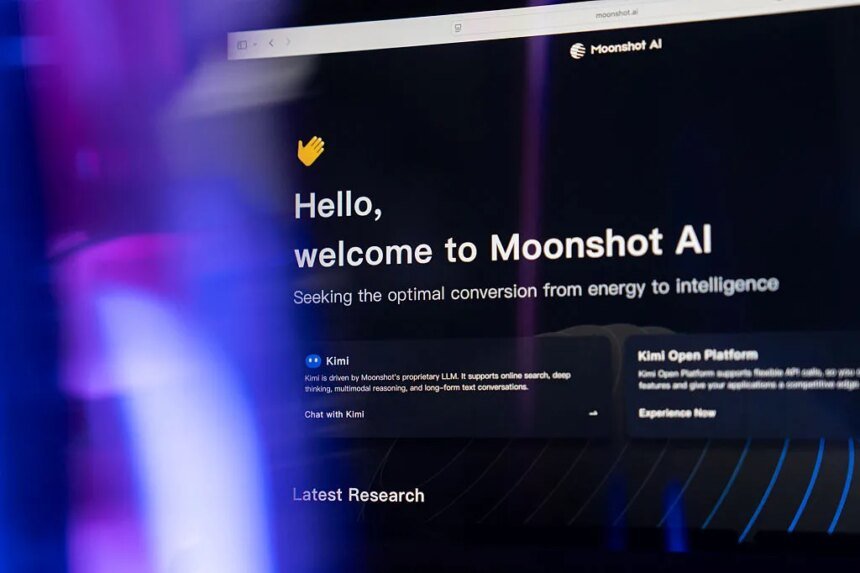

Chinese company Moonshot AI released a new version of its Kimi model this week, generating another wave of discourse about China and open source AI.
Moonshot said that although Kimi K3 “still trails the most powerful proprietary models, Claude Fable 5 and GPT 5.6 Sol,” the new open source model “demonstrated frontier-level performance across our evaluation suite, consistently outperforming other tested models.” Independent analyses from Arena.ai and Vals AI also suggested that Kimi is competitive with flagship frontier models.
The announcement, which coincided with a speech from Chinese president Xi Jinping at the World AI Conference in Shanghai, seems to have spooked Wall Street, with the Nasdaq dropping about 1% on Friday as investors sold off stocks in chip companies like Nvidia.
Many of the resulting posts from tech industry figures will sound familiar to those who remember the debate after another Chinese company, DeepSeek, released its open source R1 model in January 2025. Except now, everything seems heightened after the Trump administration’s tariff war with China, repeated fights over the national security threat supposedly posed by Anthropic, and as major AI companies prepare to finally go public.
For example, David Sacks — the Trump administration’s former AI czar and now co-chair of the President’s Council of Advisors on Science and Technology — contrasted Kimi’s progress with a United States that is “tying itself in knots: politicians and bureaucrats are banning new data centers, piling on state regulations, and pushing for new federal agencies to pre-approve frontier models. This is how you lose the AI race.” (The news also gave him an excuse to take a dig at Anthropic, calling Claude an example of “woke lobotomized models.”)
And former Uber CEO Travis Kalanick echoed complaints that Chinese are “distilling off” (i.e., being trained on the outputs of) American AI models.
“If distillation isn’t enforced against, then everyone should be able to distill from everyone else.. otherwise one arm [would be] tied behind American models’ backs,” Kalanick wrote. (Of course, American models have also been built on top of Chinese ones, specifically Kimi.)
Meanwhile, OpenAI’s head of strategic futures Dean Ball said that Kimi is “a very good model” whose performance probably can’t be “explained away by distillation or anything like that,” adding that he’s “personally surprised the Chinese state continues to allow the open sourcing of models this good, given potential risks.”
In fact, Ball suggested that “probable outcome of an open-weight-model-dominant world is full AI communism,” where AI is treated as “a ‘public good’ which will ultimately be provided by the state as a kind of ‘digital public infrastructure.’”
“This future strikes me as a dystopian hellscape, but I’ve never met an open-weight models advocate who doesn’t ultimately concede this is where things end,” said Ball. He even suggested that the Trump administration (which he used to work for) will eventually realize it needs to “create large amounts of regulatory risk around the use of open-weight Chinese models.”
“You don’t need to ‘ban open source’ (one of the dumber motifs of AI policy discussion),” Ball said. “You just need to direct every agency to issue soft law that creates FUD [fear, uncertainty, and doubt]. ‘A Federal Reserve Advisory Bulletin found that there may be backdoors in Chinese AI models.’ It needn’t be that well justified. You just create enough regulatory risk that every regulated enterprise backs off.”
However, Shakeel Hashim, editor of the AI-focused publication Transformer, argued that much of the worry is overblown, both because Kimi “likely does not have dangerous cyber capabilities,” and because the Chinese government will face “extremely similar incentives” to restrict open Chinese models once they develop those capabilities.
When you purchase through links in our articles, we may earn a small commission. This doesn’t affect our editorial independence.

