



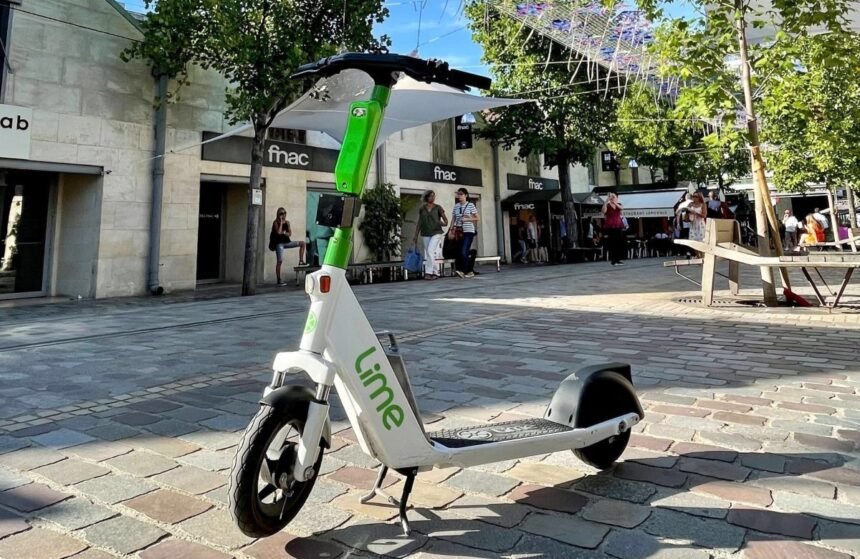

Micromobility company Lime has raised $167 million in its IPO, ending an almost decade-long run as a private company that saw wild valuation swings as it navigated multiple major hype cycles and a global pandemic.
The nine-year-old scooter and bike company, which is backed by Uber, sold 6.68 million shares at $25 each, at the mid-point of its $24 to $26 price range. Shares started trading on the Nasdaq stock exchange under the ticker “LIME” on Wednesday afternoon, jumping around 9% in the first hour.
The long-awaited IPO pegs Lime’s valuation at around $1.66 billion, just shy of the price fellow micromobility company Bird got when it merged with a special purpose acquisition company in 2021.
“Having that resilience and patience and belief and optimism that we will get through the toughest moments [has] really paid dividends over the long run, because there were many days, weeks, months, where I wasn’t sure if Lime was going to make it past the next three months, four months,” CEO Wayne Ting told TechCrunch in an interview Wednesday. “To be here today as a public company feels incredibly rewarding, and it took a lot of, a lot of heart, sweat, and tears to get to this point.”
Lime has been considering an IPO for years. In 2021, following a $523 million funding round, CEO Wayne Ting told TechCrunch the company was eyeing an IPO in 2022. He re-heated the idea in 2023, saying that Lime was still waiting for the right market conditions.
Ultimately, though, Ting said he only wanted to go public when he could prove to the market that Lime was a far more durable company that one like Bird.
“We felt like we needed to demonstrate we were going to be a self-sustaining, profitable, free cash flow positive business, and that only happened over the last three years, [where] we had three years of free cash flow positive results,” he said. “I think the timing is right, because the business is strong. We still have a lot of growth ahead of us.”
Lime needs the funds. In its IPO filing in May, the company expressed “substantial doubt” that it could continue as a going concern. Lime said it needs the IPO proceeds to help resolve around $1 billion in liabilities, more than half of which is due by the end of this year, though some of that debt is convertible. Without an IPO, Lime told prospective investors, it would need to find other sources of financing.
Lime is riding that financial edge because the micromobility industry has proven to be fairly brutal over the last few years, even in the good times. Bird had to file for bankruptcy protection and restructure after it went public, and other competitors have either merged (Tier and Dott), been delisted from major exchanges (Micromobility.com), or gone out of business entirely (Superpedestrian).
Amid the chaos, Lime has managed to improve its revenue over the last few years. It generated $521 million in 2023, $686.6 million in 2024, and $886.7 million last year. The company also trimmed its losses from $122.3 million in 2023, to just $33.9 million in 2024, though that figure edged back up in 2025 to $59.3 million. (The company reported adjusted gross profit in 2025 of more than $400 million, when discounting costs like depreciation.)
That growth has come largely from Lime’s ability to scale globally. It now operates in 230 cities across 29 countries. But the company is also somewhat dependent on Uber, which owns 24% of Lime, and accounted for more than 14% of its revenue last year. (Uber allows people to book Lime rides through its app in some cities.)
Ting said Lime’s focus on driving down unit costs, plus its ability to use software and machine learning to manage city-by-city operations are what helped lime create a more financially sustainable business. And he said he only expects those advantages to improve now that Lime has access to the public markets.
“It’s more capital for us to invest in growth and expanding Lime, in investing back into our technology. I feel like a lot of the advantages that we have being the only skilled operator, the only profitable operator, is only going to amplify now that we’re public,” he said. “It’s a real game of inches business, and we’re constantly looking for this 1%, 2% improvement.”
Ting also said he believes being a public company will encourage more cities to partner with Lime.
“I know a lot of cities don’t like the fact that they sometimes would bring an operator into the market and that operator will go out of business in six to 12 months. They want a long-term sustainable partnership, and now that we’re public, our financials are available to any city regulator looking to decide who’s going to be a good long-term partner,” he said.
This story has been updated with information about Lime’s stock starting to trade and from an interview with CEO Wayne Ting.
When you purchase through links in our articles, we may earn a small commission. This doesn’t affect our editorial independence.

