


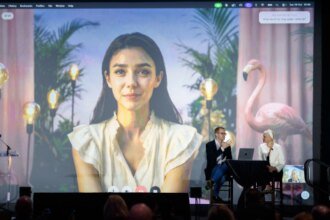




Five Grand Slam titles and more than a decade as the world’s highest-paid female athlete. But the fiercest competition Maria Sharapova describes may be the one she’s navigating now. In her second act as an investor, entrepreneur, and podcaster, she discusses what the court never prepared her for: the deals she walked away from, the candy brand she built and ultimately shuttered, and what it really takes to sit across the negotiating table from Nike.
This is an abridged transcript of an interview from Rapid Response, hosted by former Fast Company editor-in-chief Robert Safian. From the team behind the Masters of Scale podcast, Rapid Response features candid conversations with today’s top business leaders navigating real-time challenges. Subscribe to Rapid Response wherever you get your podcasts to ensure you never miss an episode.
You were so young when you first had success even. You won Wimbledon in 2004, the first of five Grand Slams. You were 17. At that point, do you remember how strategic you were about brand alignment? Were you even making the decisions?
I was from the first day. After that victory, I remember getting out of the car to the Wimbledon Ball and my manager, who’s still my manager to this day, he looks over and he’s, like, “There’s not a camera lens that you will not love this evening. You make the most out of this opportunity tonight.” A week later, I’m back in California, and I’m training for seven hours a day. But in that moment, [it was] maximize the potential.
Within that week, I took a few days off. I flew to Portland. I re-signed my Nike deal. My dad told me to get in the room, and there may be things you don’t know. There are certain elements of the deal that you’re not going to be familiar with, but you know what? This is your future. This is your money, and you need to be in that room. He gave me … I was a teenager. I’m 17 years old. What do I know about money? But for him to say, “Just be there, and someone in the room, the C-suite individuals that will be talking this big game, they’re going to see your face, and it’s going to be a little tougher to bring the deal lower to you.”
I remember being in that room, just being amazed by some of the zeros they were discussing. Right after that, I signed my first non-sport deal with Motorola. They were just coming out with the Razor phone. It wasn’t a big check, but the opportunity was big because I was going to be on billboards all over the world. My manager, he’s, like, “Just wait. You take this one, people will see your face, will know your name, and that will grow into bigger things.” That was a really great lesson.
It’s so interesting because you put so much time, and from an early age, into tennis, into what gets you this attention. Then, when the attention comes, it’s like you have to learn that business piece of it on the fly a little bit. It comes at you, but you don’t … The things that maybe from the outside look like it’s fun, like you get to be celebrating winning Wimbledon. It’s not fun. It’s just a different work.
No. The next day, you’re focused on winning the next one, which is the U.S. Open. There’s only a certain amount of time that you’re really allowed to think about your success, which in some ways is sad. But while you’re holding the trophy, all the other opponents are training. The world doesn’t end to watch this big moment in your life. Although you have to appreciate it and take it in, you can’t believe the hype. You have to get back on the horse and train and get better, because people will now know your game and your name, and they’ll want to beat you even more.
But back to business as a young 20-year-old. You realize as a female, you’re not playing until you’re 60, or retired. You’re there until, perhaps, 35 at your very best. In my early 20s, I recognized that there will be an end. And whether the end is because of an injury, whether it’s because I want to start a family, or whether it’s because I lose interest, that time will come. That business frame of mind, I loved every meeting that I got to participate in. I learned through people in boardrooms. I learned from not knowing. I learned from asking questions.
For a lot of athletes and celebrities, their business is endorsements. That’s as far as they go. You’ve pushed farther as an investor, as an entrepreneur, and as a strategic business leader. You’re on the board of a luxury fashion house, Moncler, a public company valued at more than $16 billion. Is being on a board a different pressure? How do you see your role on the board?
Well, it’s a different type of intensity. Every meeting is like a U.N. meeting. They’re done in Italian because it’s an Italian public trading company. Every time you speak, there’s a similar microphone like this. You press a button, and it’s your time to speak. There’s a little bit of a delay. The one thing that you really miss is the sense of a match point, like in sport, where there’s this tension. You’re constantly under a little tension. When you finish something that you’ve held this tension in, there’s nothing really like it.
There’s nothing that really gets your juices flowing, and being in that boardroom was one of the first times where I was like, “Wow. I’m in unfamiliar territory. I like this feeling of having to show up and having to prove something.” Not for everyone, but for myself, I took it as an opportunity to learn. Sitting in a room with Remo Ruffini, talking about a potential succession plan, talking about the evolution of business. Moncler is a seasonal business that’s mostly focused on the winter months. How do you become a company that’s not just relevant for 70% of the time, but for 95% of the time? I learn. I love it. And I get to be in a room with smart people.
You always had a reputation on the court as being a killer competitor. Are you as competitive about business in the same way?
I don’t think I’m as aggressive. I don’t pump my fist as often, but I have a competitive nature. I love teamwork. I love the idea of having a goal and everyone having different perspectives, and aligning on the same goal. Even though I played an individual sport, team was everything to me. Getting off the court, having a crap performance and acknowledging that we just lost as a team. There are those moments that they were tough parts of my career, but I really miss them.
You’ve got an investment portfolio: BetterUp, Therabody, Supergoop. You’ve also been an entrepreneur. I know you launched a premium candy brand, Sugarpova, which unfortunately didn’t work out well and shuttered in 2021. What lessons have you learned from leading a startup, from investing in startups?
I had Sugarpova for over 10 years while I was playing, and got it profitable after several years. It was an MBA on the job, ultimately. Going into it, I didn’t know what a P&L [profit and loss statement] was. I didn’t know what a strategic marketing plan was. Do you sell at a savings store, or do you sell premium? Are you scaling a product that costs $5? How are you doing it but maintaining its quality? That was incredibly valuable and something that I now get to think about as I invest in companies.
You were the highest paid female athlete in the world for a decade plus. In a lot of ways, you set the blueprint for athletes that followed. Much is changing right now, so fast. Social media has such a role. Women’s sports outside of tennis is getting a lot more attention. Do you look at the blueprint for female athletes differently? Is that blueprint in flux in some ways?
Well, there’s never been a playbook. If there was, I think it’s certainly being rewritten right now for female athletes. I think there are positives to it. There are also negatives. I think it’s easy to get distracted in the world, where there are more opportunities to make money, and there are more opportunities to take advantage of a successful career—whether you are a Grand Slam champion or whether you are a college player. I remember great financial deals that I had to say no to, because I knew that they would take up too much of my time saying yes to incredible events that, at the time, as a young girl, might seem really fun and interesting. But you also know that you’ve got to be on the other side of the world competing in Asia or Europe. There are a lot of sharks out there, and you have to find the right people.

