







MGM Resorts International CEO Bill Hornbuckle is leaving open the possibility that the casino operator could acquire Barry Diller’s People Inc., a striking reversal after the media company abandoned its own effort to take over MGM.
Asked at the Global Gaming Expo this week whether MGM was considering buying People Inc., Hornbuckle said MGM would continue pursuing what is in the best interest of shareholders and “trying to unlock the value of a company that we think is grossly undervalued.”
Hornbuckle pointed to MGM’s collection of assets, including BetMGM, its casino operations in Macao, its resort under construction in Japan and its properties in Las Vegas.
The Wall Street Journal reported last week that MGM was exploring an offer for People Inc. The publishing and holding company, formerly known as IAC, owns roughly 27% of MGM and is its largest shareholder.
People Inc. last week withdrew its $48.30-per-share proposal to buy the rest of MGM. Diller said the “mix” of factors required to complete the transaction had not come together as the company had hoped, but said People Inc. remained interested in a possible strategic transaction with MGM.
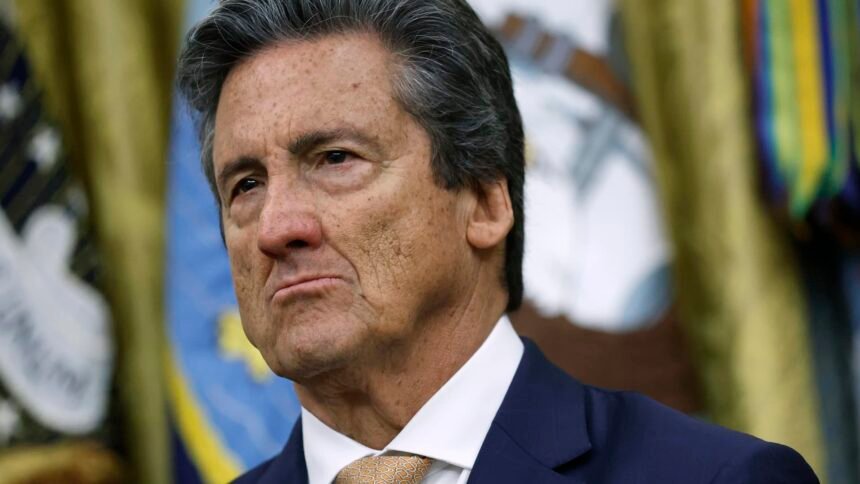
MGM Resorts International CEO William Hornbuckle listens as President Donald Trump delivers remarks during a meeting with U.S. travel executives in the Oval Office of the White House on Sept. 2, 2026 in Washington, DC.
Kevin Dietsch | Getty Images
Hornbuckle called Diller and People Inc. “an amazing shareholder” and said Diller remains bullish on Las Vegas.
“There’s nothing like it replicated anywhere in the world,” Hornbuckle said. “It is the one place, particularly in his world, where AI won’t disintermediate it.”
Unlike some of People Inc.’s publishing and digital businesses, Hornbuckle said, Las Vegas is built around physical experiences that artificial intelligence cannot replace.
“People are coming here to enjoy things physically, and that’s not going to change,” he said.
MGM shares were trading near $32 ahead of the G2E discussion, well below the $48.30 price People Inc. had offered in June.
Caesars prepares to go private
The talks between MGM and People Inc. come as one of MGM’s biggest Las Vegas rivals prepares for a take-private transaction.
Caesars Entertainment shareholders last week approved the company’s $17.6 billion sale, including assumed debt, to Fertitta Entertainment. The deal would combine Caesars’ casino and digital operations with Tilman Fertitta’s Golden Nugget casinos, Landry’s restaurant group and other hospitality assets.
Caesars CEO Tom Reeg said operating as a private company would allow management to take a longer view.
“We’re forced as public companies to think in 90-day increments far more than is healthy for any business,” Reeg said. “That’s not how you run a business.”
He said the combination with a hospitality company that has more than 400 outlets across the country creates an opportunity to connect the businesses into a broader customer ecosystem.
The transaction is undergoing an extended antitrust review by the Federal Trade Commission, which recently issued a second request for information.
Reeg called the request normal for a transaction of this size and said the markets under scrutiny are not particularly material to the combined company.
“You shouldn’t be surprised if there’s a property or two that ultimately gets divested,” Reeg said. “But I wouldn’t expect them to be needle movers from a news perspective.”
A Happy & Prosperous Dragon Link slot machine is viewed at Caesars Palace Hotel & Casino on May 29, 2025 in Las Vegas, Nevada.
George Rose | Getty Images
Reeg said the recent interest in the casino space from Diller, Fertitta and activist investor Carl Icahn indicates that sophisticated investors see long-term value in Las Vegas despite weaker visitation and concerns about prices.
“You have some of the smartest people in the world saying, ‘How do I get in?'” Reeg said.
Asked whether those investors were buying because Las Vegas is a bargain, he said, “I think it’s both.”
Wynn’s UAE bet
Beyond Las Vegas, Wynn Resorts CEO Craig Billings said construction of Wynn Al Marjan Island in the United Arab Emirates remains on track despite regional conflict that has contributed to a roughly $600 million increase in the project’s budget.
Billings said approximately half of that increase is related to the conflict, but the resort has missed only one day of construction.
Most of the disruption came during a two- to three-month period when supply chains were being rerouted through different ports, he said. Shipping costs also surged because insurers were unwilling to cover some routes.
“From our perspective, it’s super straightforward: Get open, start earning EBITDA,” Billings said. “You’re going to pay for that uptick in cost very, very quickly.”
Billings said Wynn’s property and construction insurance costs at the site have not increased, citing the security provided by authorities in the UAE. The resort is scheduled to open in September 2027.
The property will be the first integrated resort with casino gaming in the UAE and represents Wynn’s biggest expansion beyond its existing markets in Las Vegas, Boston and Macao.
Macao’s premium customer
Billings also played down the importance of broad visitation figures in Macao, which saw record visitor traffic in August.
Wynn’s results depend less on how many people enter Macao than on which customers arrive, he said. The company targets the premium end of the market.
The Wynn Palace casino resort, operated by Wynn Resorts Ltd., in Macao, China, on Saturday, April 5, 2025.
Eduardo Leal | Bloomberg | Getty Images
Billings described Macao as the largest gaming market in the world, generating roughly five times the gaming revenue of the Las Vegas Strip with about 30% as many hotel rooms.
“Whether Macao’s up 2%, down 3%, you have to look through any given cycle,” he said. “We remain very, very focused on the mid- and long-term in Macao.”
Hornbuckle said MGM is the smallest of the major operators in the market and is similarly focused on higher-value customers. He said 94% of MGM’s occupied rooms in Macao are filled by known casino customers, and the company is converting more standard rooms into suites to meet demand.
And while luxury retail sales have been soft in China, Billings said that is not necessarily a warning sign for casino spending.
Chinese consumers are changing their brand preferences, he said, weakening the historical relationship between luxury retail sales and gaming revenue.
MGM’s Japan resort emerges from the ground
Hornbuckle said MGM’s integrated resort in Osaka, Japan, is on time and on budget after more than a year of site preparation on the man-made island of Yumeshima.
The development will cover roughly 97 acres and 18 million square feet. Hornbuckle said its casino floor will be four times the size of the casino at MGM’s Bellagio.
“We’re finally coming out of the dirt,” he said. “You can see the structures. Steel is being laid.”
Hornbuckle said that if Singapore’s integrated resorts provide a reasonable comparison, MGM Osaka could quickly become a $2 billion cash-flow business.
Japan has so far only approved the Osaka development, but Hornbuckle said the potential for competition in or around Tokyo wouldn’t pose a threat, given Japan’s population and the time it would take a rival to propose and build a new project.
“If we don’t have a five-year head start on this — and then some — I’d be absolutely shocked,” he said.

