





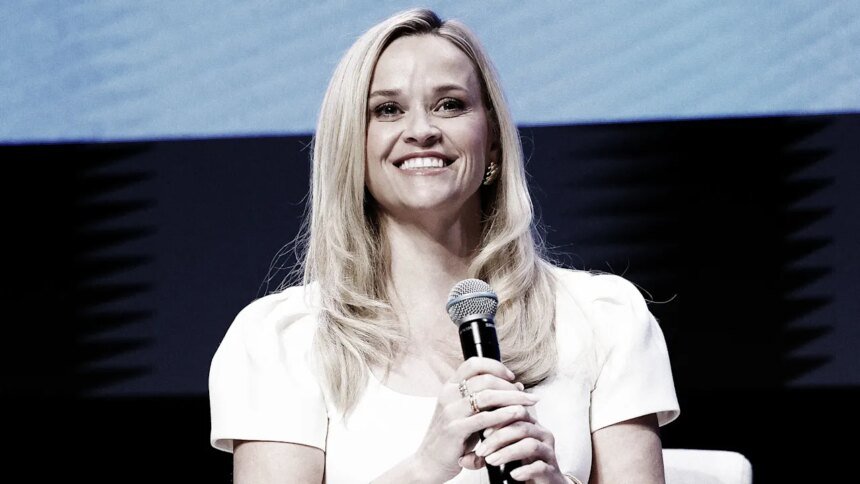

Celebrities are continuing to learn the hard way that publicly pontificating about their views on AI, like politics, might come with far more risk than reward. The latest incident involves beloved Academy Award winner and Walk the Line star Reese Witherspoon, who is facing ongoing backlash for an Instagram video she posted last week—and then again defended this week—encouraging women to learn more about AI.
In a recent video posted from what appears to be her kitchen, Witherspoon told her followers that she’s worried not enough women are using AI. Her evidence: An informal poll she took at a recent meeting of her book club, where most of the members told her they weren’t using the tech. In a caption—admittedly, without sharing a source—Witherspoon pointed to statistics suggesting that women are far more likely to have their jobs automated away by artificial intelligence. Witherspoon’s original post is benign enough, though, at times, her verbiage and tone veer into sounding like sponsored content for the AI industry.
“The thing I’ve learned about technology is if you don’t get a little bit of understanding from the very beginning, it just speeds past you,” Witherspoon explains in the video. “So you have to have little bits of learning just to keep up.” She concludes the video by asking if people want to learn more about AI with her. This is a big deal, given her audience. Witherspoon has 30 million followers on Instagram and manages one of the most popular and trend-setting book clubs in the country, Reese’s Book Club.
The backlash was swift. Her post attracted thousands of comments, with many laying into the actor for ignoring criticisms of the AI industry, including its impact on the environment, the large power consumption required by data centers, and concerns about bias that can be encoded into LLMs. Some people accused Witherspoon of hyping up the tech industry and even posting an undisclosed ad.
To defend herself, Witherspoon returned to the topic again on Monday. No, she wasn’t telling anyone to do what they didn’t want to, she conceded, but AI is already everywhere, including on Instagram. She acknowledged concerns about the tech, but stood her ground. “To be clear, no one is paying me to talk about this,” she said. “I’m planning on learning as much as possible so that I’m educated about this technological revolution.”
Witherspoon’s biggest error was likely underestimating just how toxic and polarizing the conversation around artificial intelligence can be. Yes, some celebrities have leaned into the LLM era, no doubt with eyes on capitalizing on the technology and growing their fortunes. Ben Affleck even founded his own AI firm, InterPositive, which was recently purchased by Netflix. Still, the rise of AI has mostly agitated Hollywood, where creatives are rightfully anxious that AI-powered animation, avatars, and video editing stand to put many people out of work (and corrupt the creative process). Some even contend that the top AI labs might be ushering in a new era of fascism. The playwright Jeremy O’Harris recently approached Sam Altman at the Vanity Fair Oscars Party and suggested the OpenAI executive was akin to the Nazi propagandist Joseph Goebbels.
It’s possible that Witherspoon, who is otherwise wealthy and extremely influential, was not the right messenger for this particular take. On the merits, though, she is absolutely correct. The gender gap in AI is absolutely real: The statistics bear out that men are using AI more than women, and women seem to be more skeptical of the technology. Researchers recently analyzed studies that spanned about 140,000 people and found that women are using AI tools at a noticeably lower rate. (This might be a double-edged sword, as women are more likely to be judged, a so-called “competence penalty”, for using generative AI, compared to their male counterparts).
Still, a major risk is that AI will create a massive productivity, and then, economic gap between workers, and exacerbate inequality along the lines of gender. As workplaces look to demand AI competency from prospective applicants, people who don’t use the technology are likely putting themselves at a disadvantage.
More broadly, even if you think AI is nefarious, as many of the critics opposed to Witherspoon seem to be, it is probably advantageous to understand how it works, rather than ignoring it entirely. Abstaining from the technology won’t be enough to confront the most urgent threats presented by AI, especially when it’s already being embedded into the platforms that shape our lives. After all, it’s best to know your enemy—right?

