





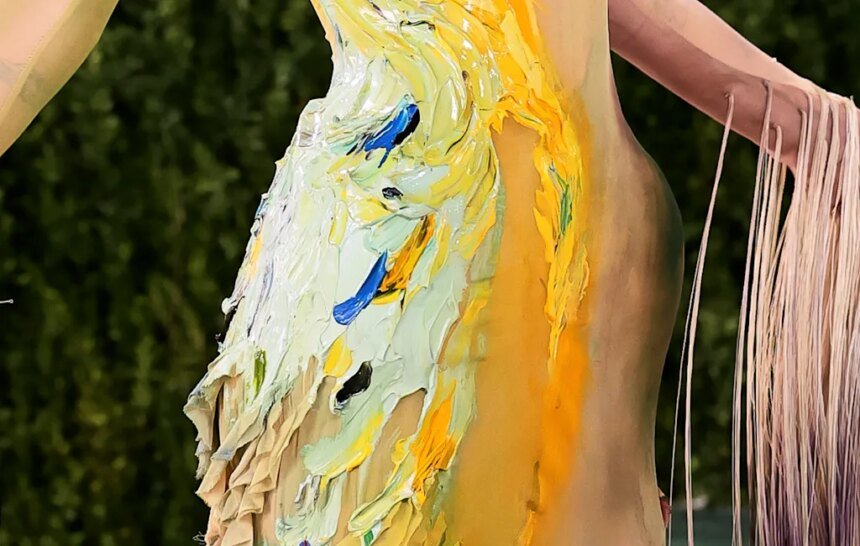

When influencer and entrepreneur Emma Chamberlain stepped out on the carpet at the 2026 Met Gala, it was in a swirl of acrylic ink and thick, glossy paint. She looked like a painting come to life—as if, with each next step, a prismatic smear of color might follow in her wake.
Chamberlain was wearing a custom-made Mugler gown by creative director Miguel Castro Freitas. But what laid on top of the dress’ expert construction is what turned it into a head-turning spectacle: The entire piece was painstakingly handpainted, from hem to neckline, by artist Anna Deller-Yee. She relied entirely on real fine art supplies to achieve the final look, a process that took 40 hours of painting, four days of drying time, and a six-foot-long shipping crate to transport the resulting gown from Paris to New York City.
The theme of this year’s Met Gala, which took place on May 4, was “Fashion is Art.” The concept was inspired by “Costume Art,” an exhibition at the Met celebrating the “centrality of the dressed body” through depictions and interpretations of the human form. Several celebrities took this theme to its most logical endpoint by directly recreating works of art, including Lauren Sánchez Bezos as John Singer Sargent’s Madame X, Gracie Abrams as Gustav Klimt’s Portrait of Adele Block-Bauer I, and Madonna as The Temptation Of St. Anthony. Fragment II.
Chamberlain took a different approach. Rather than reinterpreting a single piece of art, her garment pulls inspiration from a wide body of Impressionist and Expressionist works, aiming to capture their focus on visible brushstrokes and atmosphere. The final product turned Chamberlain into a kind of canvas, transforming each detail of Deller-Yee’s craft into a statement in its own right.
Building on a history of fine art and fashion
Deller-Yee first began her career as a print designer for the Italian apparel brand Marni in 2021. She specializes in hand-painted prints, alternating between creating works that can be digitally scanned and painting directly onto finished garments, depending on the project.
Deller Yee’s uniquely analog process has since catapulted her work into the global spotlight, including through partnerships with Nike; Nicki Minaj, whose 2024 Met Gala outfit she designed in collaboration with Marni; and Anna Wintour herself. She is now represented by creative agency Hugo & Marie as part of its in-house artist bureau.
For her second-ever Met Gala project, Deller-Yee says Castro Freitas, who she’s worked with as a Mugler collaborator since 2024, approached her directly.
“When Miguel arrived [at Mugler], we started to work together on prints, and the work became more and more elaborate, and also more and more intimate, in terms of really sitting down with him and understanding his vision for the brand,” Deller-Yee says. One day, she recalls, she received a message from the Mugler team about an upcoming opportunity to collaborate on a gown for the Met Gala.
“I was like, ‘Wow, that’s a huge amount of trust to place on somebody that you’ve only known for a few seasons,’ but I could already feel that we were getting along very well,” she says. “[Castro Fretias and I] are very close in a lot of ways that we think about creativity. This collaboration felt very natural—there was nothing in it that felt forced.”
Finding inspiration
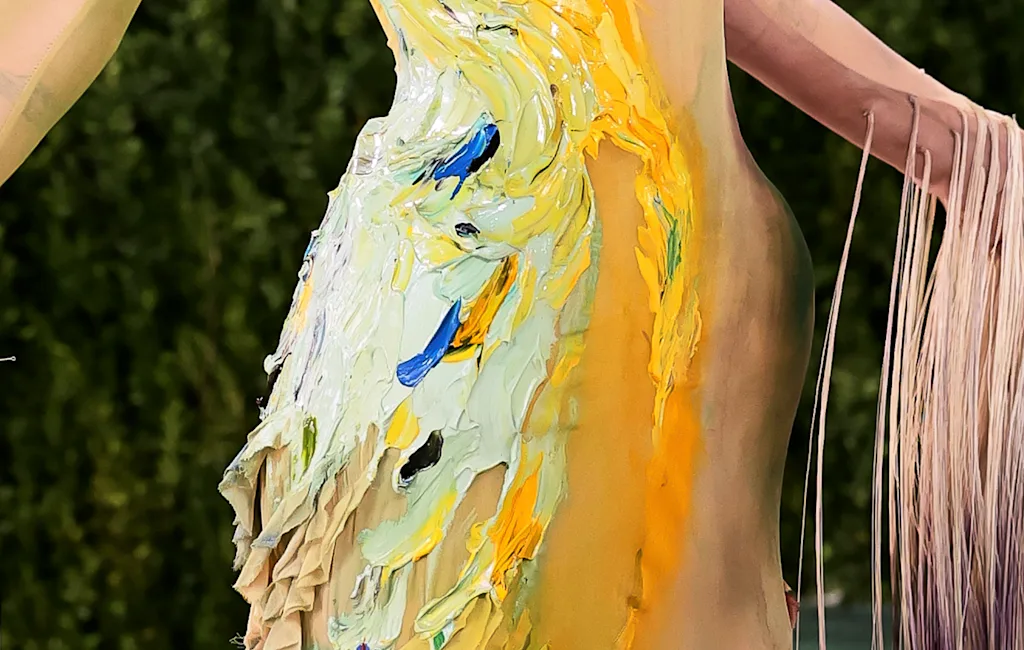
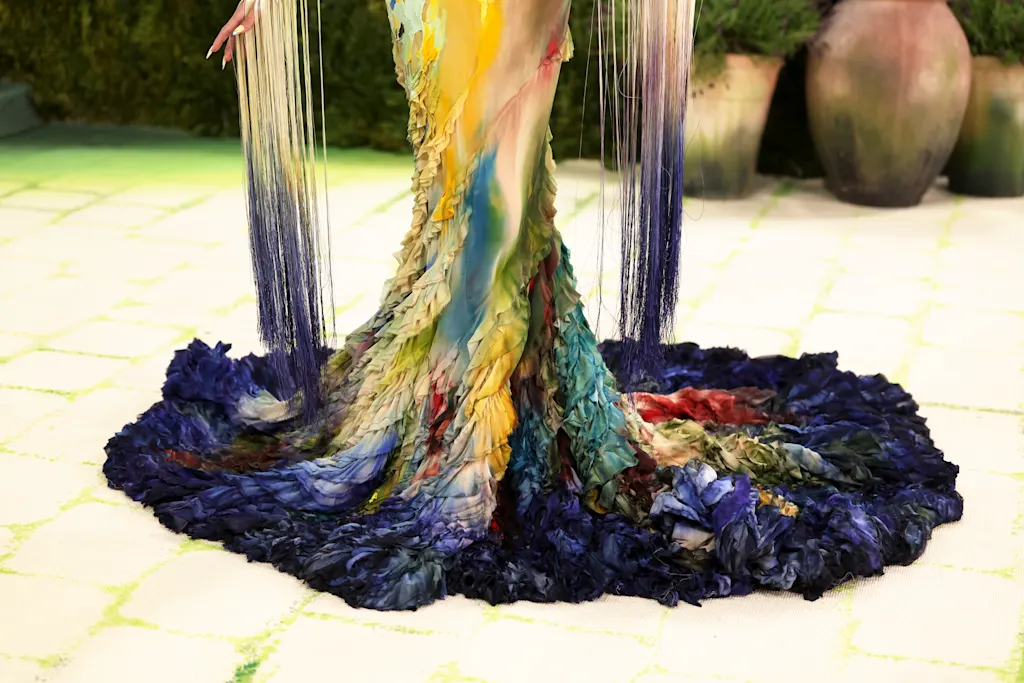
On the red carpet, Chamberlain’s dress looked like it had just been pulled from an artist’s grasp, with its glistening, three-dimensional swatches of paint, visible brushstrokes, and almost wet-looking hem. According to Deller-Yee, that was part of the original design remit.
“There was a lot of materiality in work, and that’s what Emma wanted: to literally feel like she’s a painting,” Deller-Yee says.
Castro Fretias’ vision for the dress was crafted in collaboration with Chamberlain and Jared Ellner, her stylist. They pulled artistic inspiration from Impressionist and Expressionist paintings; archival Thierry Mugler looks like his glittering La Chimère and Butterfly dresses from 1997; paintings made by Chamberlain’s father, who is an oil and watercolor artist; and Deller-Yee’s own portfolio. “They wanted to have this specific look that I have in my own work, which is this contrast and clash between very watery, runny paint, and extremely thick and almost sculptural-looking impasto brush strokes,” Deller-Yee says.
To achieve a truly painted look, Deller-Yee opted to use only traditional fine-art supplies on the dress. But the first—and most daunting—challenge, she says, was to actually spread the dress out in her Paris studio, given that it’s made of hundreds of meters of fabric.
“When it arrived, I was like, ‘Oh my God, that dress is so giant,’” Deller-Yee says. “Up until that point, I had only seen renderings of it, and it was just the front view—I didn’t realize that it had such a long train on it too. And I was like, ‘This is so much fabric—this is the largest thing I’ve ever painted before.’”
Giving Emma Chamberlain’s gown 3D texture
Her first step was to mount the dress on a large cardboard form that helped separate the skirt into workable planes. From there, she sprayed down the entire lower half of the gown with water and began applying highly pigmented acrylic ink with light brushstrokes, starting with lighter hues and building up to the darker shades. In between layers, she continuously sprayed the whole piece again, creating the illusion that each piece of the skirt was melting into the next.
Once the skirt was complete, Deller-Yee moved on to the upper half of the garment. For this piece, she switched to using acrylic paint mixed with a thickening gel, which she applied in a chunky, yellow-blue swirl up the flank of the gown and over the chest. The very last details were a series of small, almost imperceptible white flowers at the neckline of the gown, as well as delicate sleeves of fringe painted in a dark blue.
When Chamberlain finally arrived on the runway, the dress felt like a celebration of the uniquely human joy to be found in the evidence of an artist’s craft.
“One of the things that people have said to me is that the dress deeply touched them—they were really just in awe of it,” Deller-Yee says. “To me, in the specific times that we live in right now, which are extremely turbulent and bring so much ugliness with them, it’s beautiful to be able to make people dream and show them a sense of wonder.”

